How Trump's anti-DEI crusade could widen the pay gap

Add Axios as your preferred source to
see more of our stories on Google.
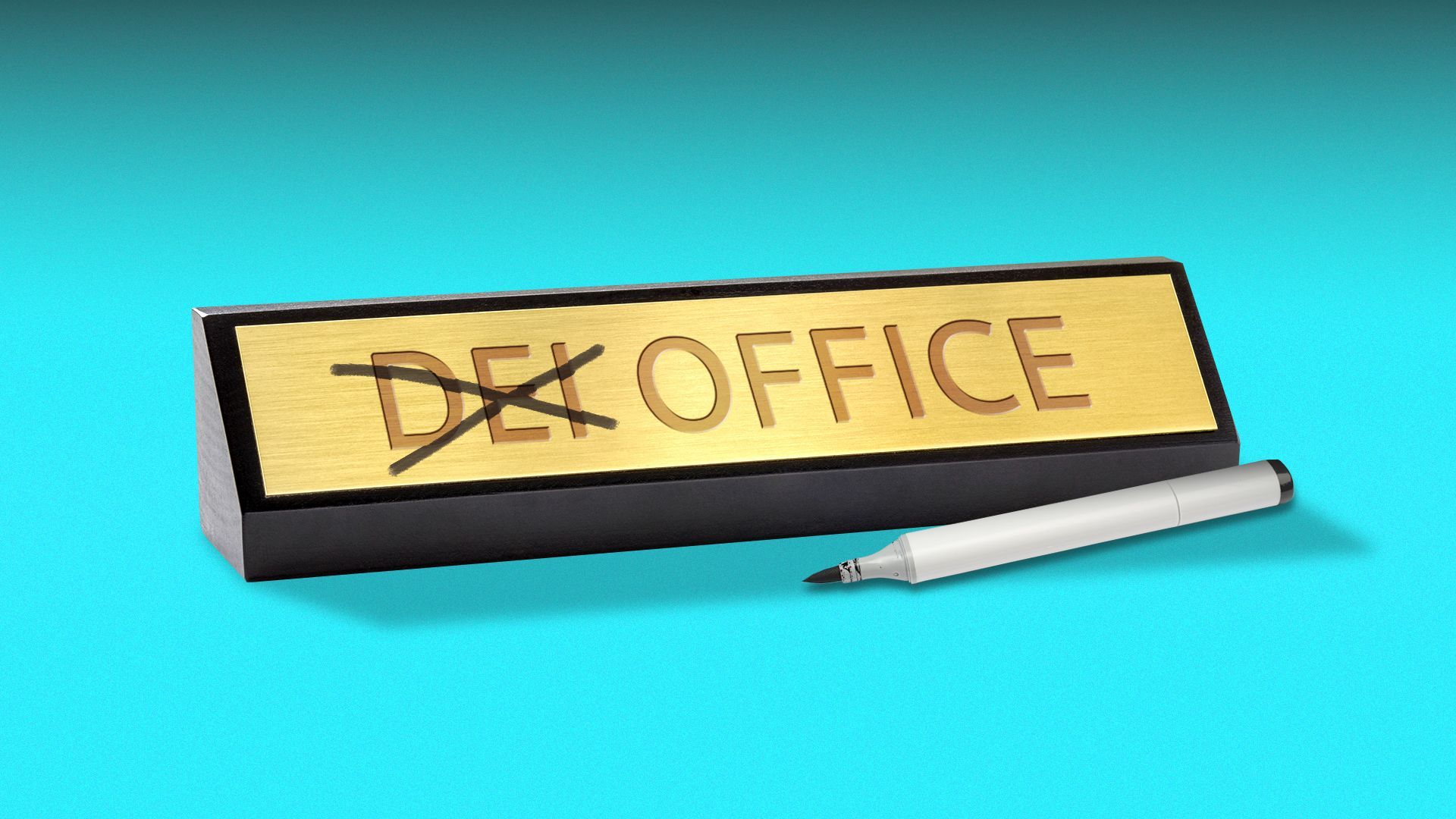
Illustration: Annelise Capossela/Axios
As the Trump administration escalates crackdowns on DEI, employment and economic experts are warning that the impact on pay disparities could lead to greater income inequality and higher poverty rates among historically disadvantaged groups.
Why it matters: Diversity, equity and inclusion initiatives are intended to level the playing field for marginalized groups, but President Trump has accelerated cuts by threatening lawsuits and withholding federal funds.
- Financial distress and the broader GOP-driven cultural shift have also led many companies to leave DEI on the cutting floor, especially programs that are seen as bolstering one group above others.
What they're saying: "What the Trump administration has done really adeptly is kind of manipulate cultural forces to communicate that these programs might end up being very costly for your company," Joan Williams, UCSF law professor and director of the Equality Action Center, told Axios.
- "They would like you to think that any program that addresses and tries to level the playing field for different demographic groups is an illegal DEI program, but the law just doesn't back that up," Williams said.
- "So they're kind of in 'move fast and break things' mode, where they're just trying to intimidate people without a lot of legal basis."
Between the lines: Trump's attacks come two years after the 2023 U.S. Supreme Court case that struck down affirmative action and led to a tide of companies dropping DEI programs.
- Cultural shifts have also changed the business world's definition of "social honor," which was previously associated with appearing to prioritize equity without needing to spend very much, according to Williams.
- "Now, there's been a recent flip ... where some companies are backing off that like crazy and talking about the need for more masculine energy on the job," she noted, referring to Meta CEO Mark Zuckerberg's recent comments in which he called the corporate world "pretty culturally neutered" and would benefit from having more "masculine energy."
- "It's all pulling in the same direction, which is against attention to pay equity," Williams added.
Reality check: Income inequality is already a huge problem in California, especially in the Bay Area.
By the numbers: The per capita median income for white Bay Area residents is nearly two times higher than it is for Hispanic, Indigenous and Black residents, per a 2024 analysis from the Bay Area Council Economic Institute.
- As you move up the earning spectrum, that gap widens further, resulting in much higher poverty rates for those groups, said research director Abby Raisz, who co-authored the study.
- The median pay for women who worked in San Francisco in 2023 was also about $21,300 less than for men — almost double the statewide gender wage gap, data from the U.S. Census Bureau shows.
- "It didn't just happen accidentally," Raisz told Axios, citing America's history. "But this is an inflection point where a lot of people are maybe just giving up" on pay parity and DEI despite continued "cycles of poverty and debt and community disinvestment."
The big picture: California passed legislation in 2020 requiring private employers with 100 or more employers to report annual pay data.
- The latest numbers, released by the state's civil rights department this week, found that white workers are almost twice as likely to be senior executives compared to workers of color.
- Less than 5% of Latinos, and 10% of Black and Native American workers are in top-earning positions, compared to nearly 25% white workers and 33% of Asian workers.
- Women make up a larger share of people in the lowest pay range and remain overrepresented in lower-paying jobs. Over 70% of nonbinary workers are also concentrated in the lowest pay range.
The intrigue: Corporate DEI initiatives have always varied in success, but some of the most effective ones that target structural issues — like standardized performance evaluations — often carry the lowest legal risks, according to Williams.
- That's one avenue companies can explore amid concern about blowback.