San Francisco ranks among healthiest counties in California and U.S.

Add Axios as your preferred source to
see more of our stories on Google.
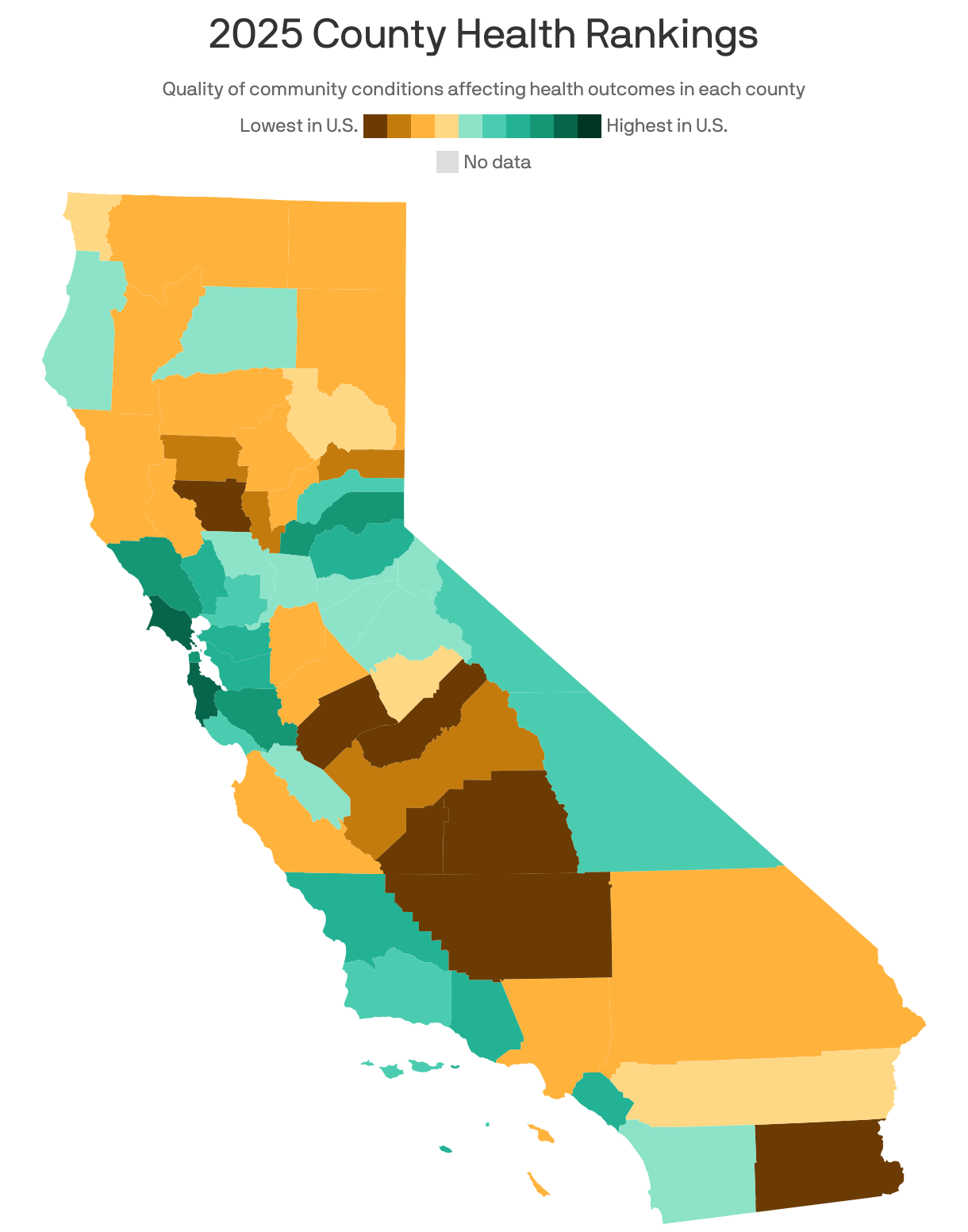
San Francisco is more likely to have community conditions that contribute to better health than other counties, the 2025 County Health Rankings show.
Why it matters: Community conditions — also called "social determinants" — range from affordable housing and well-funded schools to accessible broadband and air pollution levels. These factors can vary greatly across the U.S., creating wide disparities in health and life expectancy.
How it works: The report, published annually by the University of Wisconsin Population Health Institute, ranks counties by the quality of those factors, along with data on premature deaths, low birthweight, and self-reported mental and physical well-being.
- Some are directly connected to health, such as the number of doctors in a community or vaccination rates. Others are indirectly tied to physical health, such as social ties, educational opportunities, work commute times, economic well-being, and the environment.
What they're saying: "The conditions necessary for healthy, thriving communities don't happen by chance," said Dr. Sheri Johnson, a principal investigator for the project.
Zoom in: San Francisco is faring better than the average county in California and in the nation, the findings show.
- Most Bay Area counties also earned high scores, with Marin County ranking highest in the state.
- Imperial ranked lowest; many Central Valley counties also fared poorly.
The big picture: As a community with one of the healthiest scores, San Francisco has a lower rate of preventable hospital stays, less poverty, and more access to healthy foods than other counties.
- San Francisco also has a better provider-to-people ratio of primary care doctors, dentists and mental health professionals.
By the numbers: From 2019 to 2023, the county reported an 89% high school graduation rate. Some 88% of adults ages 25 to 44 had completed some type of post-secondary education within that same time frame (compared with just 68% of adults nationally).
- 100% of the population also has adequate exercise opportunities, with access to public parks, according to data from 2019 and 2022.
Yes, but: When it comes to housing, nearly a quarter of households (compared with 17% nationally) have experienced either overcrowding, high housing costs, or lack of kitchen or plumbing facilities.
- Child care costs also remain a huge burden for San Francisco families, with the average household spending 41% of its income on child care for two children in 2023 and 2024 (compared with 28% nationally).
Zoom out: Appalachia, the Deep South, Tribal regions and counties along the U.S.-Mexico border were more likely to have community conditions that contribute to poorer health due to a longstanding history of discrimination and disinvestment, the report shows.
The bottom line: People in power or policymakers often create and maintain the conditions that have the greatest effect on health outcomes through laws, culture and norms, Johnson said.