California adds more than 26,000 EV chargers in six months

Add Axios as your preferred source to
see more of our stories on Google.
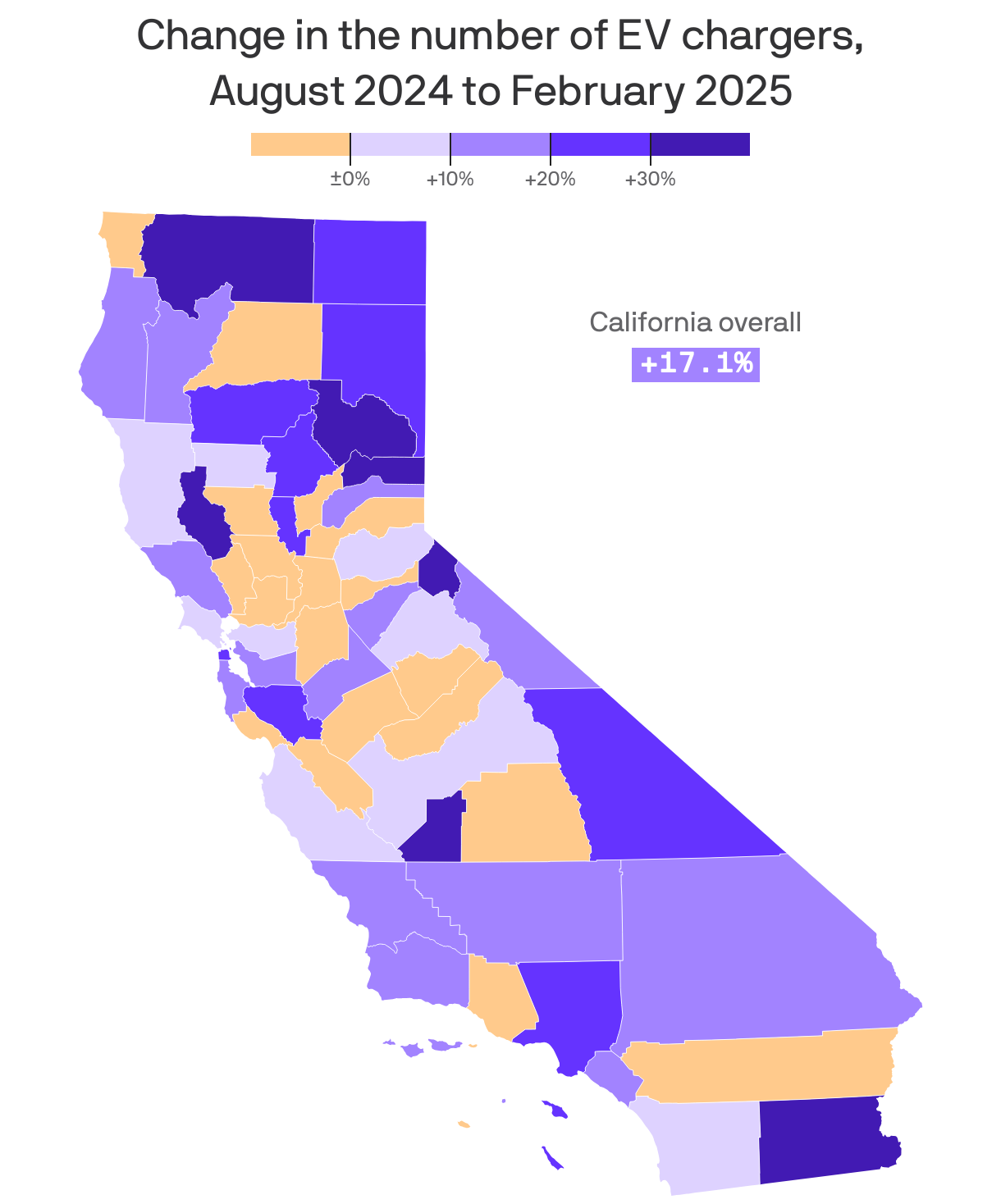
California continues to make progress on building out its charging infrastructure for electric vehicles with the addition of thousands of new chargers.
Why it matters: Beginning next year, 35% of all new car models sold in the state must be zero-emissions, ramping up to 100% by 2035. In order to accommodate the influx of more EVs, the state must build public charging stations at an unprecedented rate.
Driving the news: From August 2024 to February, California saw a 17.1% increase in the number of public and shared private chargers in the state.
- It now has a statewide network of more than 178,500 EV chargers, with 26,193 having been built since August.
What they're saying: "As the federal government works to make it harder for you to charge your electric car, California is doing the opposite. We're embracing our clean car future," Gov. Gavin Newsom said in a statement on Wednesday.
The big picture: The EV transition is a key tool for California's climate agenda as it looks to cut carbon emissions.
By the numbers: The state projects it will need 1 million public chargers by the end of 2030 — nearly 10 times more than what's available today — to support the expected 7 million EVs on the road.
- That means building at least 129,000 new stations every year for the next seven years.
Zoom in: San Francisco saw a 22% increase between August and February, with the addition of about 600 more chargers, bringing its total to more than 3,400.
- Lake County in Northern California had the largest percentage increase at 117%, going from 50 to 107 chargers.
Yes but: While most counties across the state saw increases, some, including parts of the Central Valley, saw decreases.
- Del Norte County in the northernmost part of the state had 61 chargers in February compared to 83 in August – a 26.5% decline.
- The drop off in certain areas could be due to some chargers being reclassified or decommissioned over time and reporting discrepancies, according to Harrison Reilly, a spokesperson at the California Energy Commission.
Between the lines: "It is noteworthy every time the state adds thousands of new chargers — that's a lot of people with access to a new resource and that's always valuable," said Ted Lamm, associate director at UC Berkeley's Center for Law, Energy and the Environment.
- Though public chargers are accessible by everyone, shared private chargers are usually located in limited shared spaces such as apartment buildings or workplaces. Of all the chargers in the state, 52% are shared private ones.
- This distinction is important because some communities are still struggling to access a much-needed resource, Lamm added.
- "Are these chargers located on highway corridors for road trippers and long distance commuters or are these chargers available in the community at curbside in public charging spaces for those who don't have the capacity — financially or infrastructurally? Those are huge areas of concern for the equity of this transition," he said.
The intrigue: The uptick in shared private chargers, however, still remains "critical to gaining EV adoption," especially among people who don't live in a single-family home, added Loren McDonald, a chief analyst on EVs at the data firm Paren.
Reality check: Installing more chargers is dependent on both private and public funding and can be expensive, especially for much-needed fast chargers which could cost up to up to $117,000.
- The lack of federal support could also contribute to delaying California's goals, though not to the extent to prevent the transition from happening, Lamm noted.
The bottom line: Expanding availability of public charging is not only critical to boosting consumer confidence in EV adoption, but essential for the state to meet its ambitious climate goals.