How the Lawrence Tract attempted racial integration in the 1950s

Add Axios as your preferred source to
see more of our stories on Google.
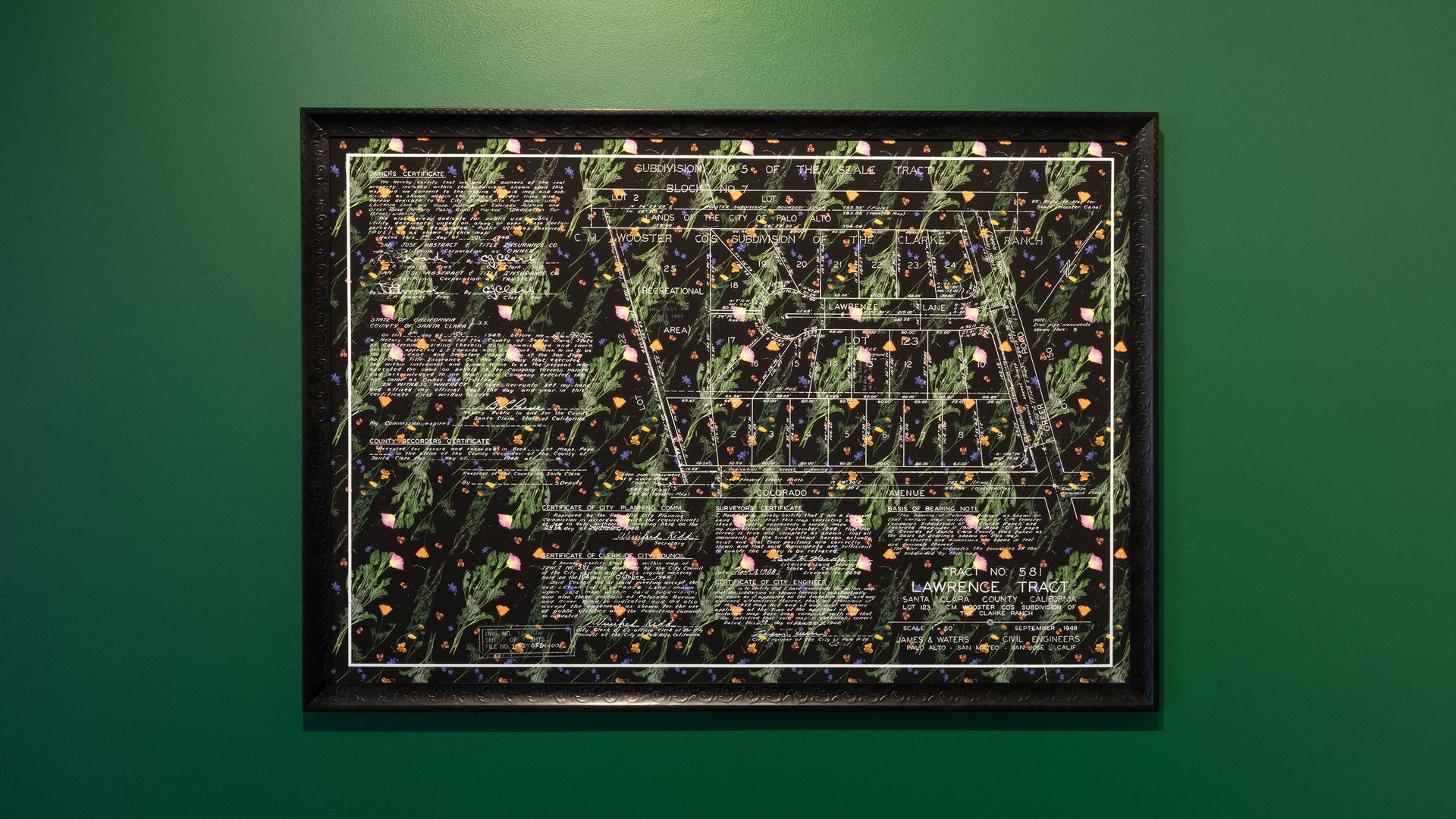
Untitled Lawrence Tract artwork by Kija Lucas, depicting a map of the neighborhood. Photo: Kija Lucas
In Palo Alto, just south of San Francisco, lies a parcel of land that served as an experiment for interracial living in the 1950s.
Why it matters: The project aimed to integrate white, Black and Asian Americans amid segregationist policies, redlining and exclusion.
Flashback: In 1945, the Palo Alto Fair Play Council was founded in a bid to help Japanese Americans re-acclimate after the U.S. incarcerated them during World War II. They also sought to provide housing for African Americans who had served during the war.
- Within five years, it had developed a plan that was unheard of for its time: create a racially integrated housing tract at the time white flight was swelling across the U.S.
- Council members contributed down payments to purchase over 20 lots in the south end of a segregated Palo Alto and decided that each participating racial group — white, Black and Asian — would own roughly one-third of the lots.
- It would come to be known as the Lawrence Tract, in honor of Paul Lawrence, a Black Stanford student who helped start the neighborhood.
"I felt the tract was segregation itself, but a different type, a beneficial type. It was the practice of a mild discrimination so that a vicious discrimination might be prevented," teacher Willis Williams, a Black tract resident, said in the book "Revenge of the Tipping Point."
Friction point: The effort launched before the U.S. Supreme Court struck down racially restrictive covenants that prevented property sales to people of color, and many white Palo Alto residents were staunchly opposed.
- They didn't want Black or Asian neighbors, and they feared their home values would drop once they moved in.
- Gerda Isenberg, a council leader, recalled getting "unpleasant phone calls" and being accused of building a "N-word shack town," the Peninsula Times-Tribune reported in 1980.
Case in point: People who burned down the home of a Black person in Redwood City also threatened one of the people heavily involved in the Lawrence Tract, according to University of Oregon Ph.D. candidate Nanosh Lucas, who grew up in the tract with his sister in the 1980s and is writing about it for his dissertation.
- "I, a couple generations later, got some of the residuals ... that were definitely beneficial in ways that I don't think I understood as a kid," Kija Lucas, Nanosh's sister and an artist who created installations about the tract, told Axios. "But thinking about it from today's perspective, it's just like, 'Oh, it's really messed up that they had to go through that.'"
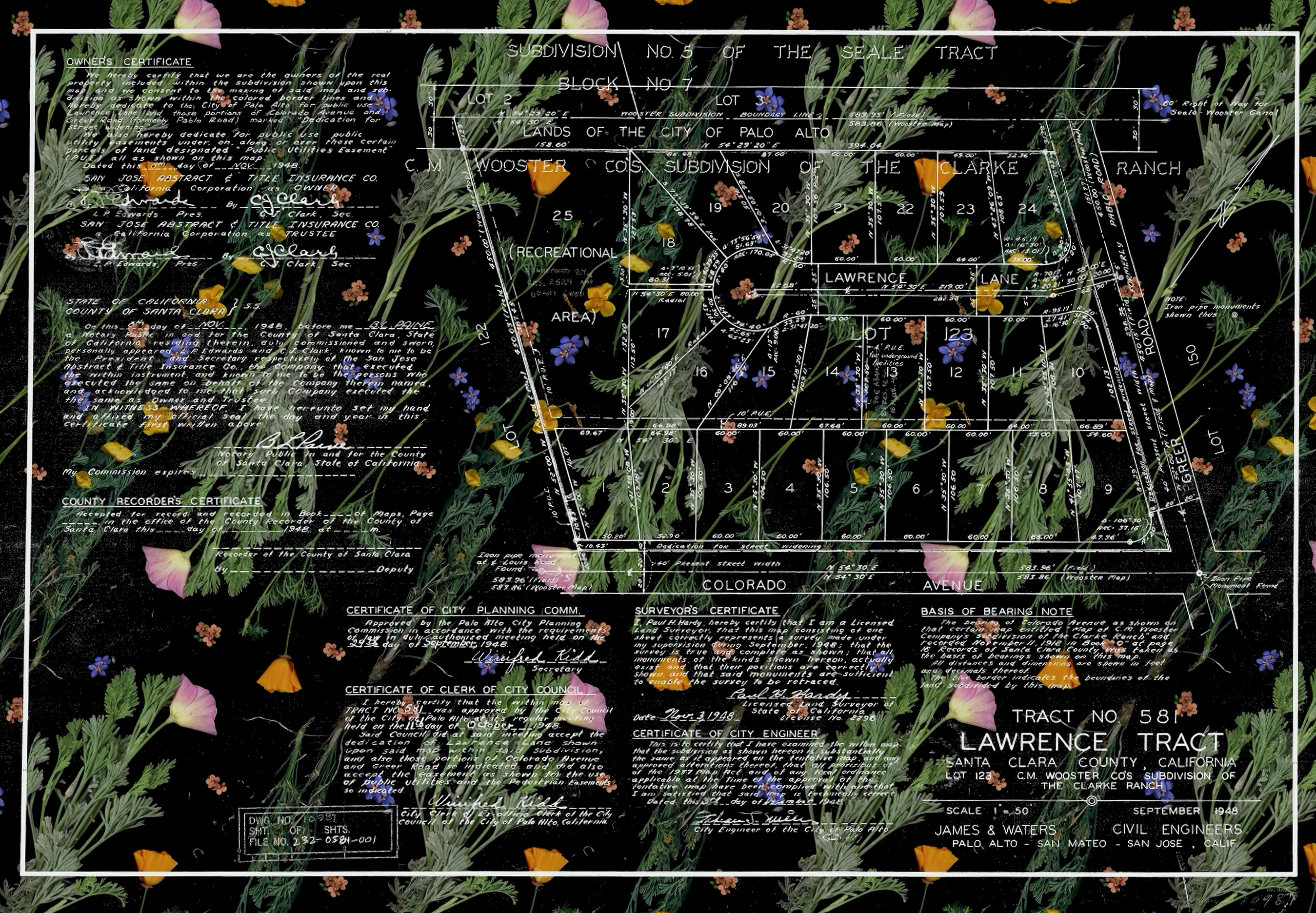
Zoom in: The Lawrence Tract's first iteration comprised seven homes occupied by white people, nine by Black people, six by Japanese Americans and one by Chinese Americans.
- It "wasn't a utopia," said Nanosh, who interviewed several residents for his research. They still had to live with encountering "the worst of abuses" and hostile people outside the neighborhood.
- "But kids grew up under the objective for which the tract was founded in an interracial neighborhood. They grew up in the environment we wanted for them," Chinese American Jack Gee, who was one of the first tract residents, told the Times-Tribune.
- Many of those children kept in touch as adults.
The intrigue: There were other attempts to build racially integrated neighborhoods across the Bay Area during the 1950s, with mixed results, according to Lucas.
- In the case of the Lawrence Tract, "there was no central builder" opponents could lobby complaints to, which Lucas said contributed to getting it off the ground.
Reality check: By 1980, the tract was predominantly white again.
- They'd attempted to maintain the one-third quota by having residents sell to people in their racial group, but it ended up falling through over the years.
What they're saying: 'Their goal was to be a model for other folks to replicate. But housing costs went up, and there were the same forms of racism that existed, like in real estate for example," Nanosh told Axios.
- Still, the project shows how "a group of dedicated individuals acting in unison, even if they're not all ideologically completely on the same page about everything, can accomplish quite a bit."