San Francisco's rush hour traffic is getting worse


Add Axios as your preferred source to
see more of our stories on Google.
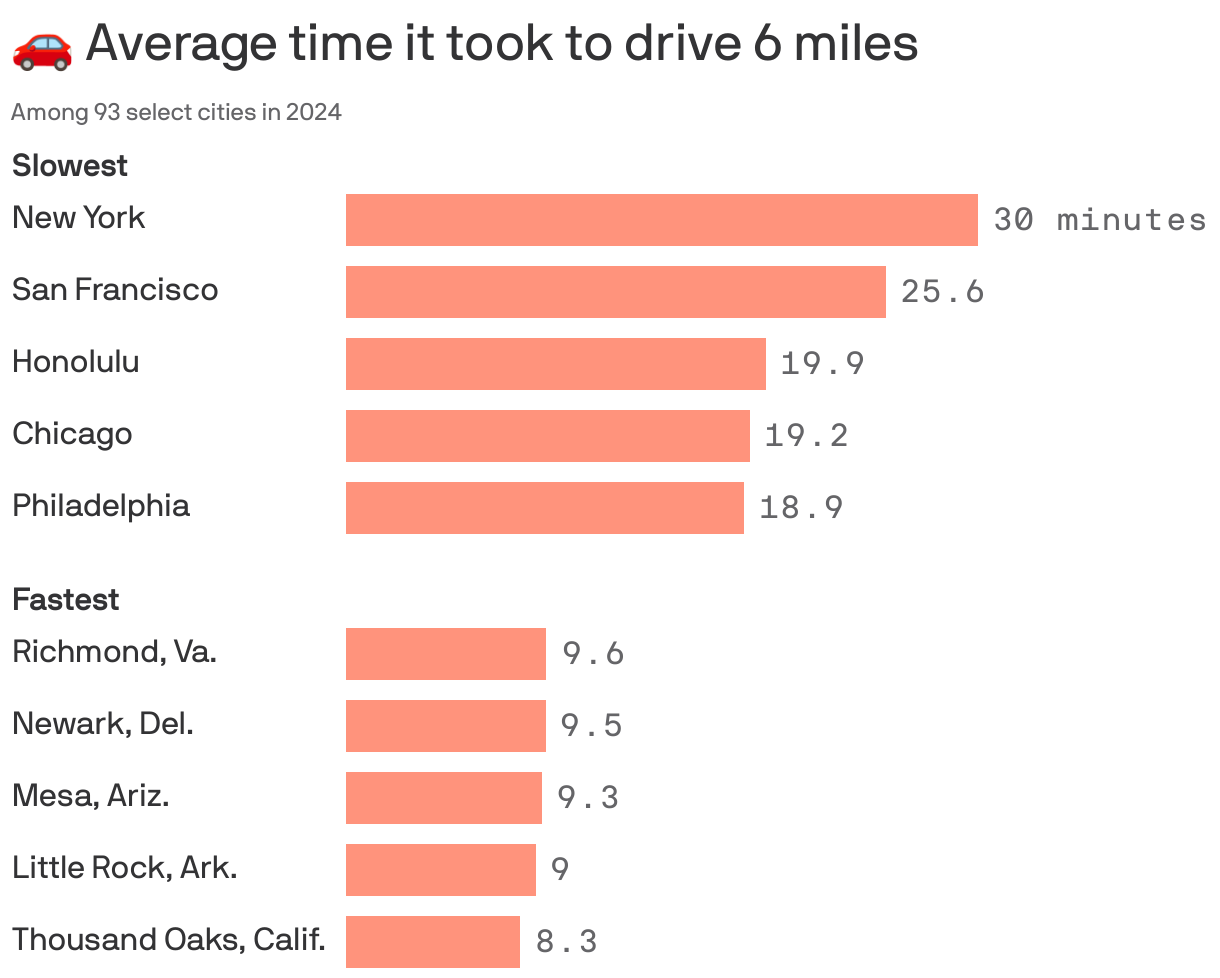
Much to no one's surprise, San Francisco is home to some of the country's worst rush hour traffic, a new report finds.
Why it matters: Who likes being stuck in traffic? Nobody.
Yes, but: Public transit and pedestrian advocates might point to these numbers as evidence that some cities, including ours, are overwhelmed by cars and need to get serious about alternatives.
By the numbers: Last year, it took an average of nearly 26 minutes to drive 6 miles in San Francisco, according to TomTom's annual Traffic Index, released Tuesday. That's even longer than it took in 2023.
- Drivers here, on average, spent a staggering 81 hours a year in rush hour traffic, based on a twice daily six-mile trip. That's over three days of bumper-to-bumper misery.
- Among the city centers studied in the index, San Francisco ranked second in slowest average time to drive 6 miles. Only New York City took longer.
- In the heart of the Big Apple, drivers took about 30 minutes to cover 6 miles. Meanwhile, those in Honolulu — which came in third — took nearly 20 minutes.
The other side: Richmond, Virginia, is a veritable autobahn by comparison, with drivers making the same distance trip in under 10 minutes on average.
Between the lines: Lots of factors go into how quickly you can drive in a given city, including congestion, construction and weather.
- Local officials have increasingly encouraged residents to take public transit, bike and carpool in a bid to reduce traffic and the risk of accidents.
What we're watching: San Francisco has previously explored downtown congestion pricing, which would involve charging people fees for driving into certain areas of the city during rush hour.
- Revenue would go toward improving transit services.
- New York City's recent adoption of a similar pricing program could revive the debate over implementation, the San Francisco Chronicle notes.
The fine print: The report is based on a representative sample of data collected by "over 600 million devices" and "over 61 billion anonymous GPS data points around the world," the company says.
- The numbers above are based on city centers — "the densest areas that capture 20% of all trips within the city-connected area," per TomTom.