How San Francisco ranks in health outcomes

Add Axios as your preferred source to
see more of our stories on Google.
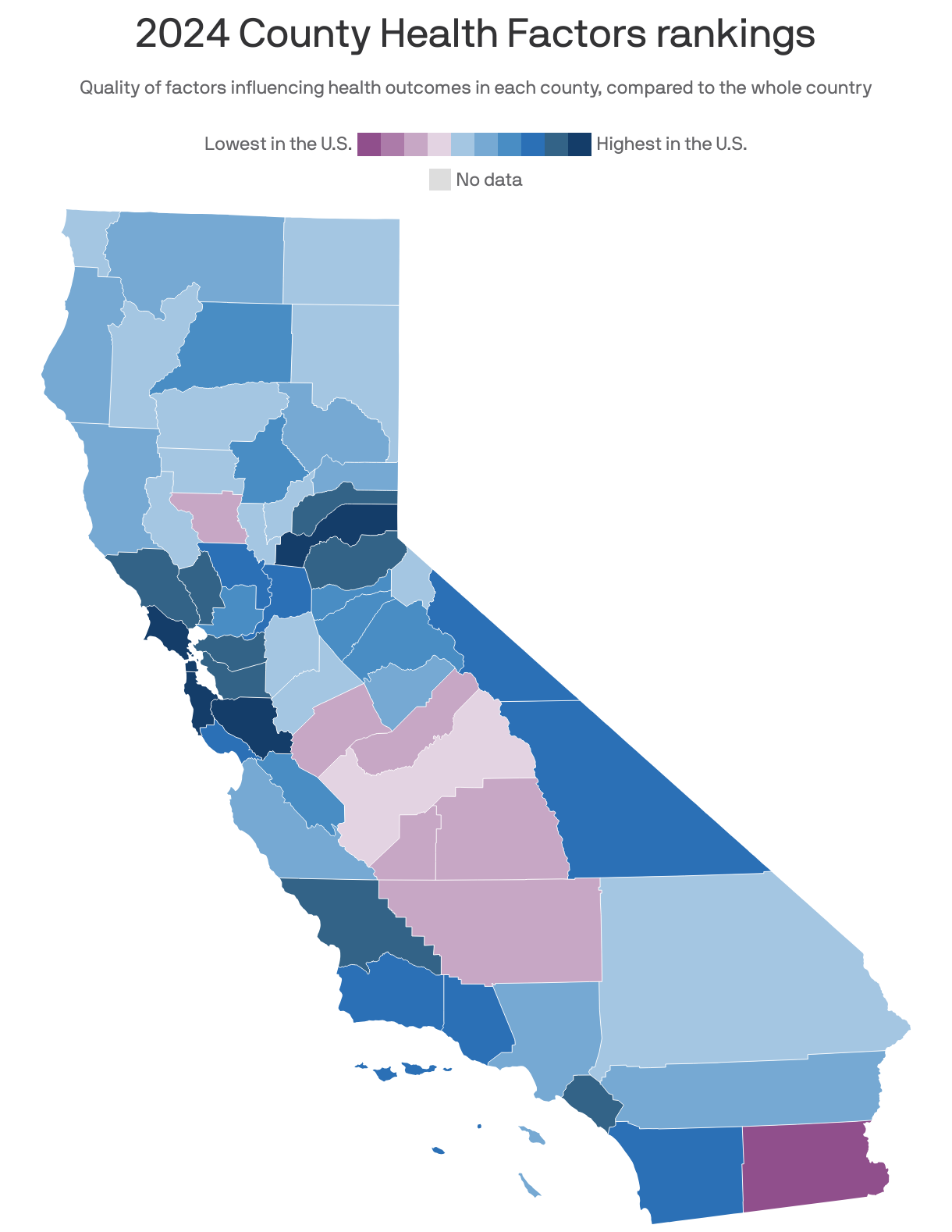
San Francisco has among the best health outcomes in the nation when it comes to factors like the quality of clinical care, socioeconomic indicators and physical environment, according to a new report.
Why it matters: Our county, which comprises only the city of San Francisco, has a lower rate of premature death, a higher life expectancy and a lower share of adults who report that they're in poor physical health when compared to the average U.S. county.
- That's according to County Health Rankings & Roadmaps, a program of the University of Wisconsin Population Health Institute.
Zoom in: San Francisco's premature age-adjusted mortality is lower than the average U.S. county at 270 deaths per 100,000 people age 75 or younger — though that figure increases significantly for Black, Hispanic and Indigenous residents, per the report.
Yes, but: San Francisco County has a much higher rate of HIV prevalence — 1,590 of every 100,000 residents 13 and older compared with 382 for the average U.S. county.
- Its rate of drug overdose deaths is also more than twice the rate of the average U.S. county.
- The two public health issues have been a focal point for local officials over the last few decades, with mixed results.
- Researchers also found that San Francisco ranked lower than the average U.S. county on several other health behaviors, including adult smoking, adult obesity and physical inactivity.
Between the lines: Although San Francisco gets overall high scores when it comes to health outcomes, those outcomes aren't always distributed equally.
- Researchers note that the county contains neighborhoods that experienced "intentional disinvestment" through redlining in the 1900s, which contributed to disparities that persist today.
- The county also ranked below the average U.S. county on some physical environment and socioeconomic factors.
- In San Francisco, 23% of households experienced severe housing problems, defined as overcrowding, high housing costs, lack of kitchen facilities or a lack of plumbing facilities. That's compared with 17% nationally.
The fine print: The health indicators measured in the study included social and economic factors, like high school completion and unemployment rates, as well as pollution levels, access to doctors and commute lengths.
What they're saying: Counties with strong civic infrastructure, such as broadband internet access and public libraries, "are often healthier," the County Health Rankings & Roadmaps program said in a recent news release.
- "These counties are often located in the Northeast and Western regions of the country and tend to also experience more social and economic opportunities and longer life expectancy," per the news release announcing the findings.
- "On the other hand, exclusionary practices, such as laws and practices that limit voting and organized labor, can be detrimental to health."