San Francisco to use federal grant to plant more street trees

Add Axios as your preferred source to
see more of our stories on Google.
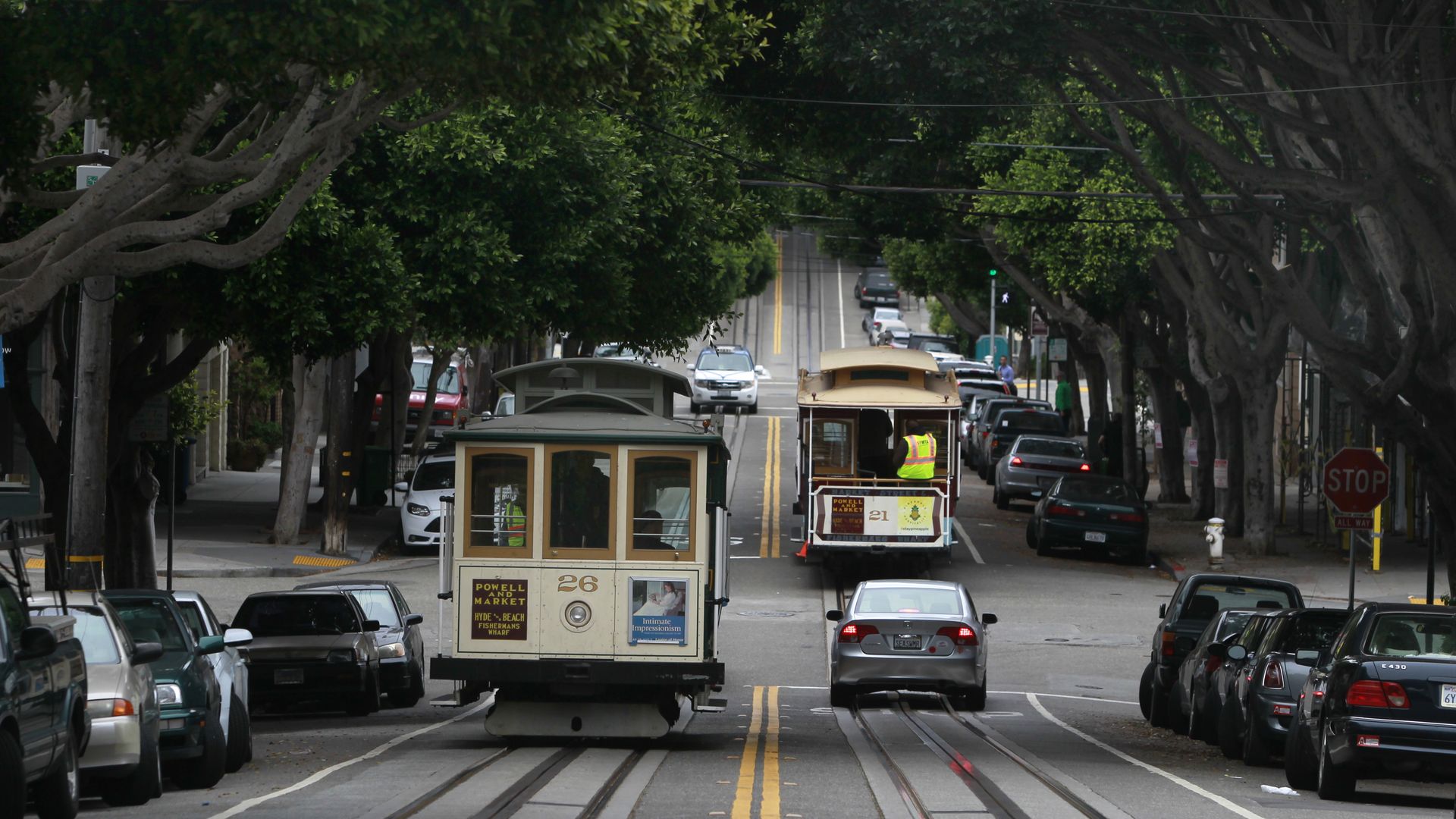
Trees line Hyde Street. Photo: Paul Chinn/San Francisco Chronicle via Getty Images
San Francisco has one of the smallest urban tree canopies in the country, but a new grant will enable the city to beef up its tree cover and plant thousands of new street trees.
Driving the news: The city received a $12 million grant from the U.S. Department of Agriculture's Forest Service as part of the Inflation Reduction Act, Mayor London Breed's office announced yesterday.
- San Francisco plans to use the funds to plant and maintain street trees throughout the city, and hopes to strengthen the urban canopy in Bayview-Hunters Point, the Tenderloin and SoMa, "which lack the benefits that street trees can bring," Breed said in a written statement.
Why it matters: Trees in urban landscapes help reduce air pollution, prevent stormwater runoff and cool homes and streets, but not all trees are distributed equally.
Plus: Historic redlining, a discriminatory housing practice, has led to more people of color living in areas with less tree canopy cover, which can exacerbate health problems, per a 2021 study, Axios' Ayurella Horn-Muller reports.
- That's been the case in San Francisco, where only 8% of the ground in underserved communities is covered with tree canopy, compared to 15% canopy coverage in other census tracts, according to the mayor's office.
- Overall, just 13.7% of the city is sheltered by trees.
Between the lines: StreetTreeSF, run by the city's public works department, is responsible for maintaining and caring for the more than 125,000 street trees throughout the city.
- Yes, but: The $19 million in current city funding is only for the maintenance of the trees, not planting new ones.
What to watch: The city currently plants about 1,000 to 1,500 trees annually but hopes to double that number, Rachel Gordon, a policy director with San Francisco Public Works, tells Axios.
- The plan is to begin planting new trees within the next year, "and likely sooner," Gordon said.