San Diego County measles vaccination rate falls short of herd immunity


Add Axios as your preferred source to
see more of our stories on Google.
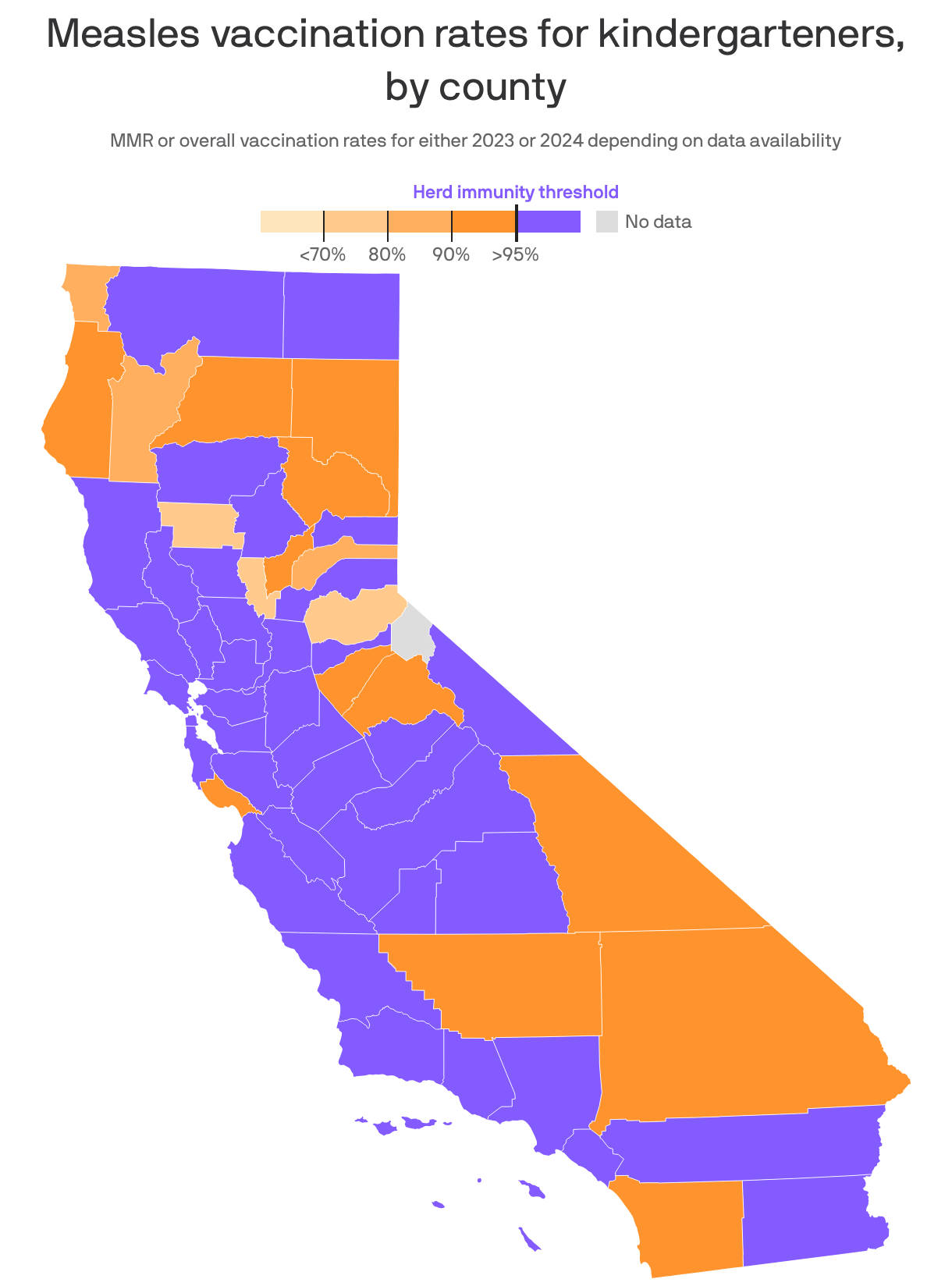
San Diego County's measles vaccination rate has slightly increased since the pandemic, but it's one of 18 counties in California that doesn't hit the 95% threshold experts say is needed to stop the disease from spreading.
Why it matters: The battle against infectious diseases like the flu and measles has taken a hit with sinking vaccination rates for children in many parts of the U.S., per new data collected and analyzed by the Washington Post.
The big picture: Vaccination rates for school-age children have plunged in hundreds of counties as confusion reigns over vaccination schedules.
- The new figures offer stark evidence of the extent of the backlash that began during the pandemic against such public health mandates.
Catch up quick: Plunging vaccination rates contributed to a spike in measles cases, and set the U.S. up to to lose its coveted elimination status for the first time in decades.
- In July, the Centers for Disease Control and Prevention (CDC) released data showing that vaccination coverage among American kindergartners decreased for all reported vaccines during the 2024–25 school year.
Zoom in: The vast majority of San Diego County schools' MMR vaccination rates reached the herd immunity threshold, the data show.
- But with dozens of schools (both public and private) below that threshold, overall the county falls just short at 94% of students vaccinated.
Threat level: Nationally, only 815 of the roughly 3,100 American counties have reached the herd immunity threshold, which multiple public health authorities say is necessary to contain the virus' spread.
- At least 5.2 million kindergarten-age children live in counties where vaccination rates are below the herd immunity level, according to the Post's data.
- Vaccination rates were most consistently high in New England, Arkansas, California and Texas.
Caveat: Some states only had data most recently available for 2023; others were 2024. And while some states had MMR-specific rates, some only provided overall vaccination rates.
Between the lines: In California, fewer kindergartners are getting vaccine exemptions, bucking a national trend.
- The state's strict mandate, which bans any non-medical exemptions, has made it hard to avoid vaccinating kids. But that's being challenged by the Trump administration.
Zoom out: The decline in childhood vaccination rates comes as Health and Human Services Secretary Robert F. Kennedy Jr. and President Trump have moved to overhaul U.S. policy regarding vaccine schedules.
- In September, Kennedy's advisers voted to shift how the combined measles, mumps and rubella shot is distributed to children. His handpicked advisory panel also voted to limit access to a combined shot for measles, mumps, rubella and varicella, the virus that causes chickenpox.
- In December, that same panel voted to end the decades-old federal recommendation that all infants receive the hepatitis B vaccine at birth.
- In January, the Trump administration cut the number of federally recommended shots from 17 to 11. Though, six leading medical organizations plan to challenge that revision in court.
Yes, but: San Diego County follows the American Academy of Pediatrics' vaccine schedule, saying it's "committed to ensuring residents continue to have access to safe and effective vaccines that are based on credible, transparent, and science-based evidence."
More from Axios:
Vaccine rates for kindergartners fall as exemptions rise
RFK Jr. blows up America's vaccine policy
Trump calls for change in childhood vaccine schedule. Here's what the CDC recommends