Trump calls for change in childhood vaccine schedule. Here's what the CDC recommends

Add Axios as your preferred source to
see more of our stories on Google.
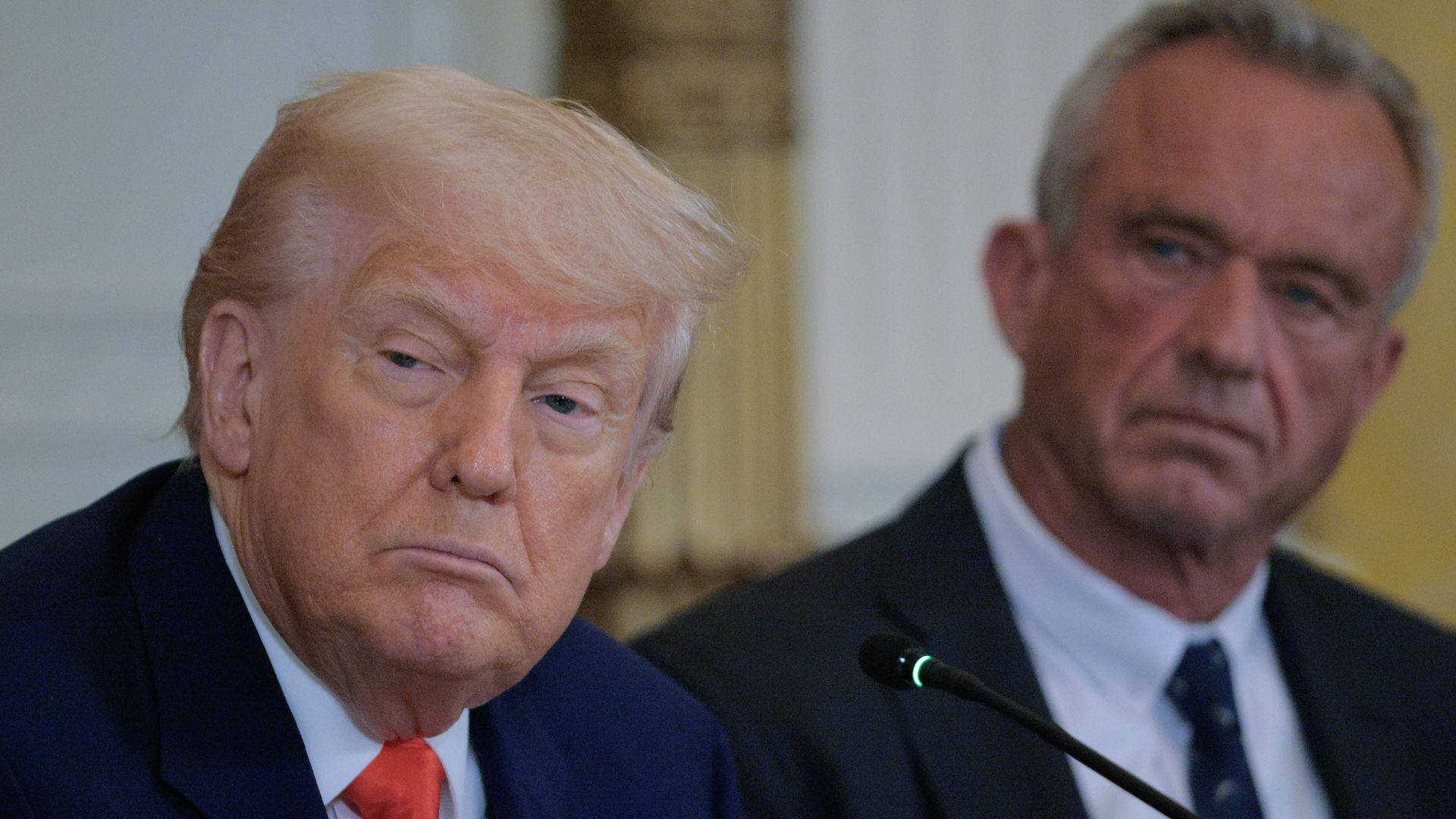
President Trump and Health Secretary Robert F. Kennedy Jr. attend a White House event unveiling a report on childhood health. Photo: Chip Somodevilla/Getty Images
President Trump on Friday called for changes to the childhood vaccination schedule and how the combined measles, mumps and rubella shot is distributed to children.
Why it matters: Health Secretary Robert F. Kennedy Jr.'s advisors recently voted to limit MMRV access, renewing debate over vaccine timing.
Driving the news: A Trump post on Truth Social Friday backed doing away with that the combined shot for measles, mumps, rubella and varicella, the virus that causes chicken pox. He also argued against giving newborns the Hepatitis B vaccine.
- "TAKE CHICKEN P SHOT SEPARATELY, TAKE HEPATITAS B SHOT AT 12 YEARS OLD, OR OLDER, AND, IMPORTANTLY, TAKE VACCINE IN 5 SEPARATE MEDICAL VISITS!" he wrote.
Context: The MMR and MMRV vaccines have been central to recent policy moves by Kennedy.
- Kennedy's panel of advisers recommended against giving the MMRV vaccine to children before the age of 4, and suggested those kids get the MMR shot and the varicella shot separately. The recommendation still has to be approved by the CDC, which lacks a full-time political leader.
Reality check: Many doctors already give the vaccine shots separately, but make the combination vaccine available to parents, Axios' Tina Reed writes.
- The CDC says the MMR and MMRV vaccines can be taken at the same time as other vaccines. But health care providers can offer more specific timelines for each shot and when to get it.
- "Most people who are vaccinated with MMR [and] MMRV will be protected for life," the CDC says on its website. "Vaccines and high rates of vaccination have made these diseases much less common in the United States."
Here's what the CDC says about MMR and MMRV vaccine schedules.
What is the MMR shot?
The MMR shot contains combined vaccines for measles, mumps and rubella, per the CDC.
- There are two MMR vaccines available in the U.S. — the M-M-R II and PRIORIX. Both are recommended by the CDC.
Schedule for MMR vaccines
The CDC recommends children receive two doses of the MMR vaccines — first dose at 12 to 15 months old and the second dose at 4 to 6 years old.
- Older children and adults also need one or two doses of the MMR vaccine if they don't show signs of immunity, the CDC says.
- Those doses should be given 28 days apart.
The CDC also suggests the MMR vaccine to anyone traveling internationally.
- Infants aged 6 to 11 months should get an early MMR shot before travel, followed by two doses after age 1, CDC says.
- Additional shots may be needed for those at increased risks of a mumps outbreak.
What is the MMRV shot?
The MMRV includes the vaccines for measles, mumps, rubella and varicella (or the chickenpox), per the CDC.
- This vaccine is only licensed for children who are 12 months old through 12 years old, the CDC says.
Schedule for MMRV vaccines
The CDC says children who are 12 months to 12 years old can receive two doses of the MMRV vaccine.
- First dose: 12 to 15 months old.
- Second dose: 4 to 6 years old.
More from Axios:
