The California loophole for betting on the Super Bowl


Add Axios as your preferred source to
see more of our stories on Google.
Illustration: Brendan Lynch/Axios
Sports gambling isn't legal in California, but there are ways local residents can wager money on Super Bowl LIX through daily fantasy sports platforms.
Why it matters: As online sportsbook companies have proliferated in the U.S., they've tapped into markets in states that don't allow sports betting by creating games that aren't considered gambling.
- Yes, but: They offer limited options and smaller payouts.
How it works: DraftKings Pick6 is a fantasy sports game in which players pay to compete against each other by selecting multiple athletes and whether they'll go over or under a particular statistic, like a number of yards or touchdowns.
- Players pay an "entry fee" of any amount and win a prize based on that amount and the odds of their picks.
Between the lines: It's essentially a parlay — the multipart wager that Americans can't resist and betting companies are making a killing on — except this is even more tilted in those companies' favor.
Follow the money: In states where sports betting is legal, someone can place a bet or parlay on DraftKings for Philadelphia Eagles running back Saquon Barkley and Kansas City Chiefs tight end Travis Kelce to both score a touchdown.
- A $10 wager will win $36 if that happens.
- On DraftKings Pick6, someone can pay $10 to pick the same two events to happen, but the payout is $25.
- That's a 36% lower payout on the same outcome. Other picks have even more severe differences.
The intrigue: California residents can also use the prediction market Kalshi, which is not considered a sports betting app and allows users to buy and trade contracts on the outcomes of various events.
The big picture: Football season is the peak for sports betting, and it builds tax revenue for states where it's legal.
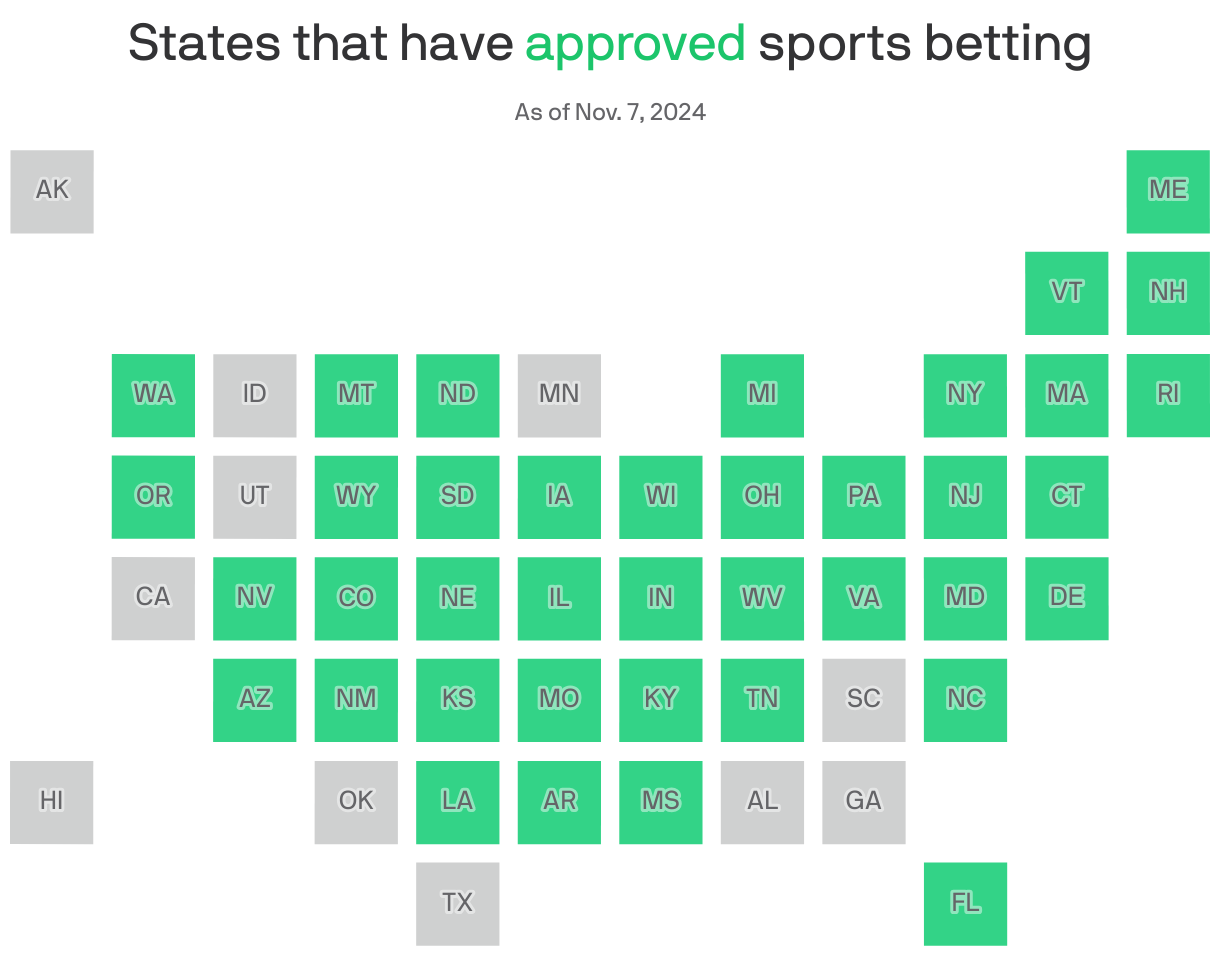
- California is one of 11 states that remain holdouts, even though it'd immediately become a top market in the country if it legalizes betting.
- Americans are expected to wager a record-breaking $1.39 billion on the Super Bowl — an 11.2% increase from last year's projection.
Threat level: A 2024 UC San Diego study found that legalized sports betting increases irresponsible gambling behavior, which it defines as spending a high proportion of income on gambling.
- That's especially true among lower-income consumers, per the study.
- The flashy deals and ease of placing bets through online sportsbooks and gaming platforms are also attracting local college students and can lead to anxiety, gambling addictions and serious financial troubles.
Yes, but: It hasn't stopped gaming operators from pushing for legalization in California.
Catch up quick: A consortium of operators, including FanDuel, spent heavily to get Proposition 27, which would've legalized online sports betting, on the ballot in the 2022 election.
- It was handily defeated, failing to garner 20% support, and was opposed by tribal nations who maintained that they should have exclusive gaming rights in the state.
- Those rights date back to a 1999 contract with the state that restricted gaming to federally recognized reservations in a bid to give tribal nations a measure of self-reliance and financial security after facing decades of loss due to forced displacement and colonization.
- In exchange, the state would receive a cut of casino revenues.
What to watch: It seems that FanDuel, despite banking on California, has recognized the need for tribes to take the lead on legalization.
- It won't be on the 2026 ballot, though, and must require agreement from all tribal communities in California, according to California Nations Indian Gaming Association chair James Siva.
- Tribes have "come too far and have too far to go to rush into this complex sports betting [issue]," Siva said at an Indian Gaming Association conference last month.
If you or someone you know has a problem with online gambling, get help at 1-800-GAMBLER (1-800-426-2537), text 800GAM or chat at 1800gamberchat.org.
- Reach out to California helplines and support groups.