New study: Climate change reversing air-quality gains


Add Axios as your preferred source to
see more of our stories on Google.
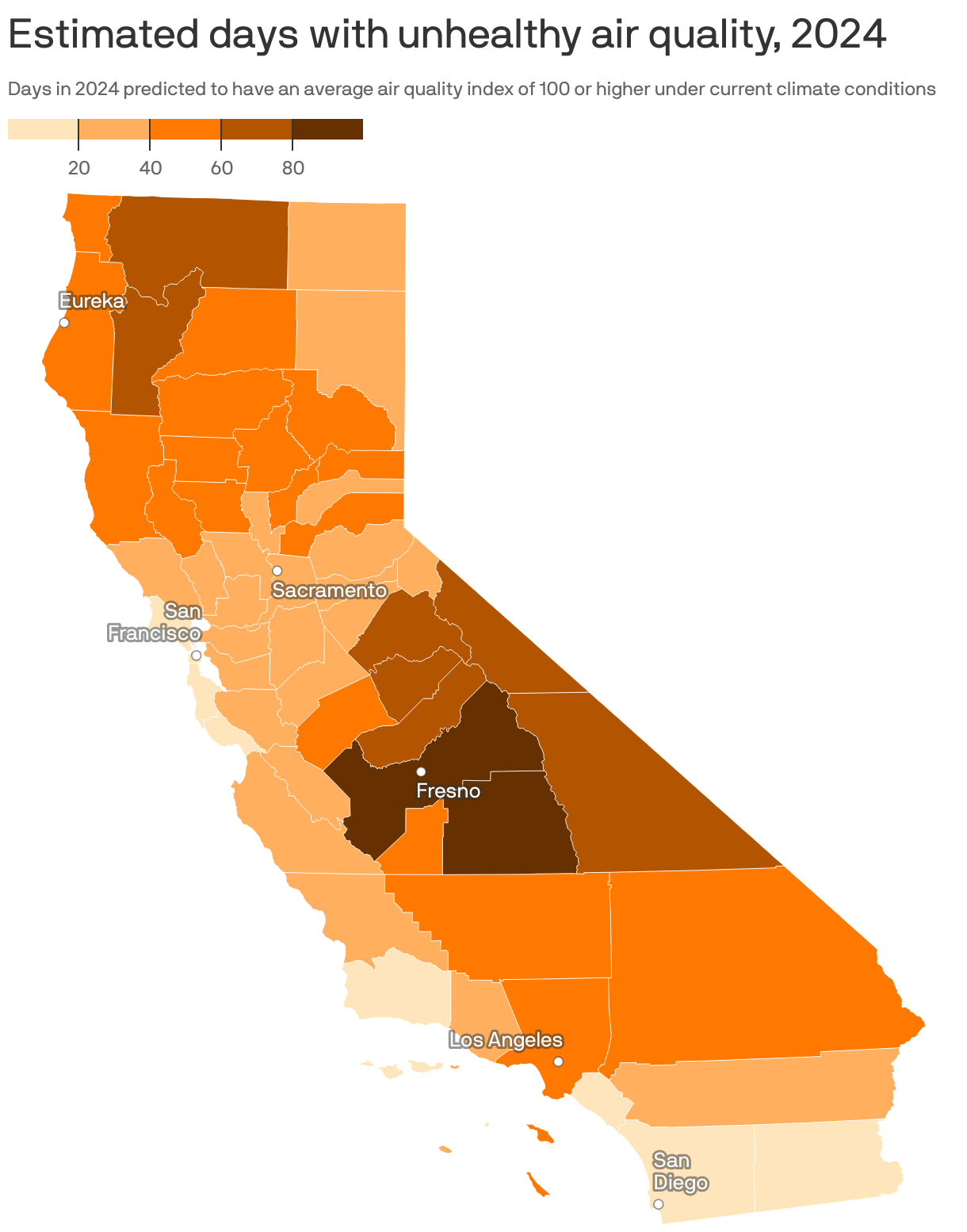
After decades of progress toward cleaner air, California will see steady deterioration through 2054, as climate change-related events are reversing those gains, per a new report.
Why it matters: An increase in large wildfires in the West, along with heat waves and drought, already are yielding a growing "climate penalty" to air quality.
- California is projected to see some of the worst air-quality impacts, chiefly from wildfire smoke.
What they found: New research from the nonprofit First Street Foundation is part of a hyperlocal air-quality model showing shifts down to the property level between 2024 and 2054.
- It suggests that climate change is increasing the prevalence of two air pollutants most harmful to human health: particulate matter (PM2.5) and tropospheric ozone.
- PM2.5 are tiny particles emitted by vehicles, power plants, wildfires and other sources. They can lodge in people's lungs and enter the bloodstream, causing or exacerbating numerous health problems.
- The West will be particularly hard hit by increasing PM2.5 emissions, as wildfires become more frequent and severe.
Zoom in: The study predicts hundreds of thousands of San Diego County residents will have 14 days with unhealthy air quality this year. That's worse than much of the country but among the lowest in California.
- "Unhealthy" means residents will see an average air quality index of 100 or higher, which ranges from "unhealthy for sensitive groups" — including people with heart or lung disease, older adults, children, and people with diabetes — to "hazardous."
Be smart: Check the local air-quality forecast here.
Zoom out: In California, the number of "good" and "moderate" days (green and yellow on the air quality index) decreased, with significant upticks in more harmful days, from 2000 to 2021.
- California's number of days with hazardous air quality (maroon — the most concerning category) has increased by more than 1,100% since 2000.
What's next: The new air-quality model's findings have been translated into risk levels known as "air factor" for individual properties in the U.S., Jeremy Porter, head of climate implications at First Street, told Axios.
- The ratings will be available on large real estate listing sites.