How Miami's new coin gallery made me an enthusiast

Add Axios as your preferred source to
see more of our stories on Google.
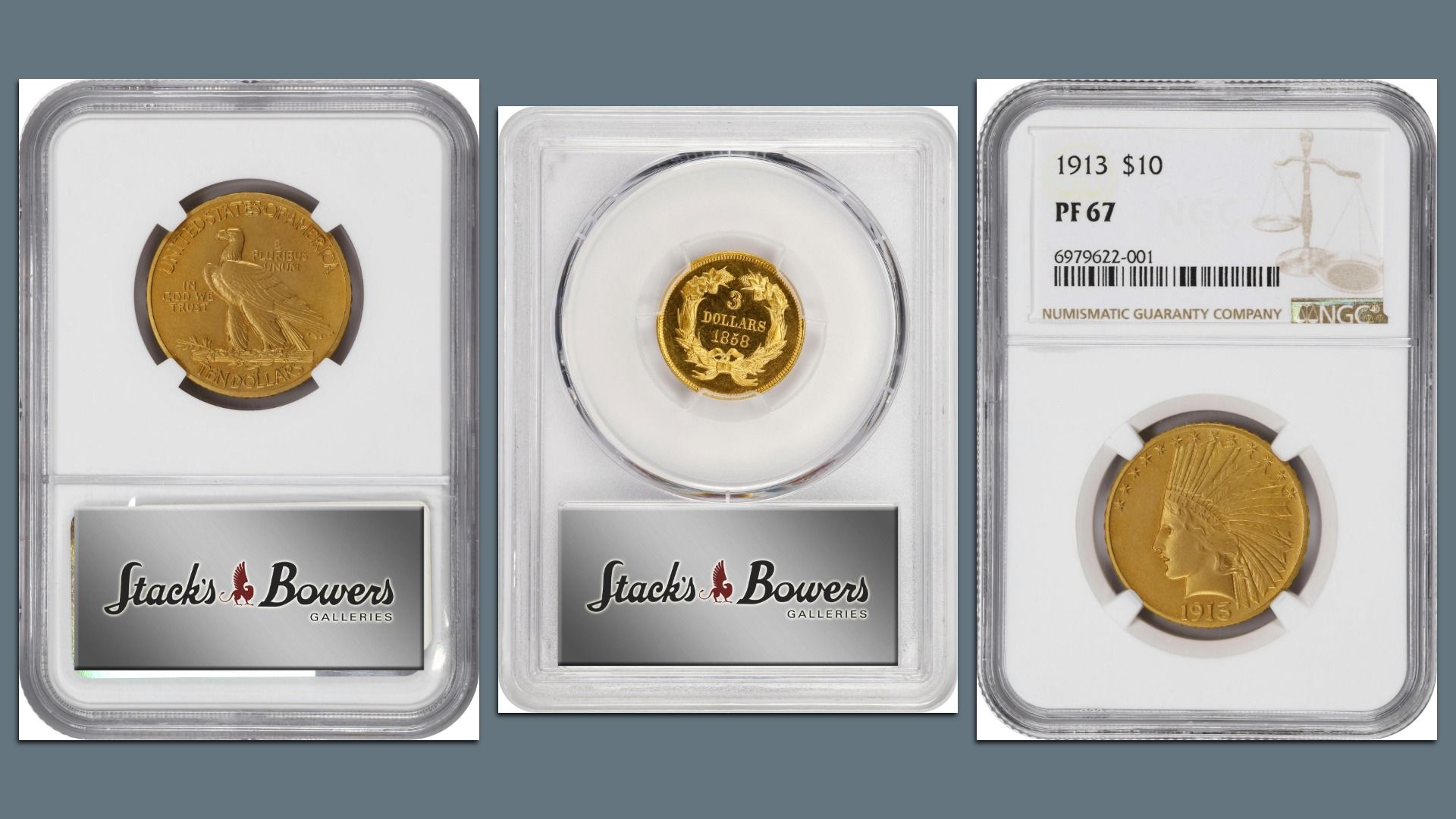
The center coin is the 1858 $3 proof. Only about 15 exist today. Photo: Courtesy of Stack's Bowers Galleries
At the end of August, I visited Stack's Bowers Galleries in Brickell, having no knowledge of the rare coin industry or really any understanding of what attracted folks to coin collecting in the first place.
- But by the end of my one-hour visit, I was a converted coin enthusiast.
Why it matters: With galleries all over the world and the U.S. — including New York City, Philadelphia, Boston, and Costa Mesa, California — the industry's oldest rare coin auctioneer and dealership recently opened its first location in Miami (with complimentary valet!).
- The reason? Miami is "quickly becoming one of the country's key financial hubs," partly because of its easy access to Central and South America, William Conroy, the head numismatist at the Miami gallery, told me.
- That and the sheer amount of wealth that's concentrated in a city like Miami, he added.
The big picture: The industry spans across countries. But Conroy, a U.S. expert, said what brings folks to it, regardless of how involved they get, is usually an interest specific to the person.
- "There's so many niches in this industry; it'll blow your mind," he said. There are dealers (it's a male-dominated field, he acknowledged) "who only buy copper half-cents and large cents from 1792 to 1857. That's all they do."
Meanwhile, collectors also have their niches, he said: Some may collect "first-year types," while others collect only silver dollars from 1878-1921.
- Others still, usually those of great wealth, he added, try collecting the "finest known collections," meaning they try to purchase the highest-grade coins in the marketplace."
The industry, he said, is "just as personal as people who collect art, cars or anything else."
Zoom in: The gallery, which is open to the public and welcomes walk-ins, displays pieces ranging from a $3 coin proof — one of about 15 remaining in the world! — to $500 and $1,000 bills to coins that date back to the early Republic of Colombia and the 1500s in Latin America.
- Some coins I saw were from 1810 in Mexico, during the revolution.
Between the lines: Much of Stack's Bowers' inventory is stored in the Costa Mesa store, but the company can have specific items — say, 120 gold pieces from the 1800s, for example — in the Miami gallery by the next day.
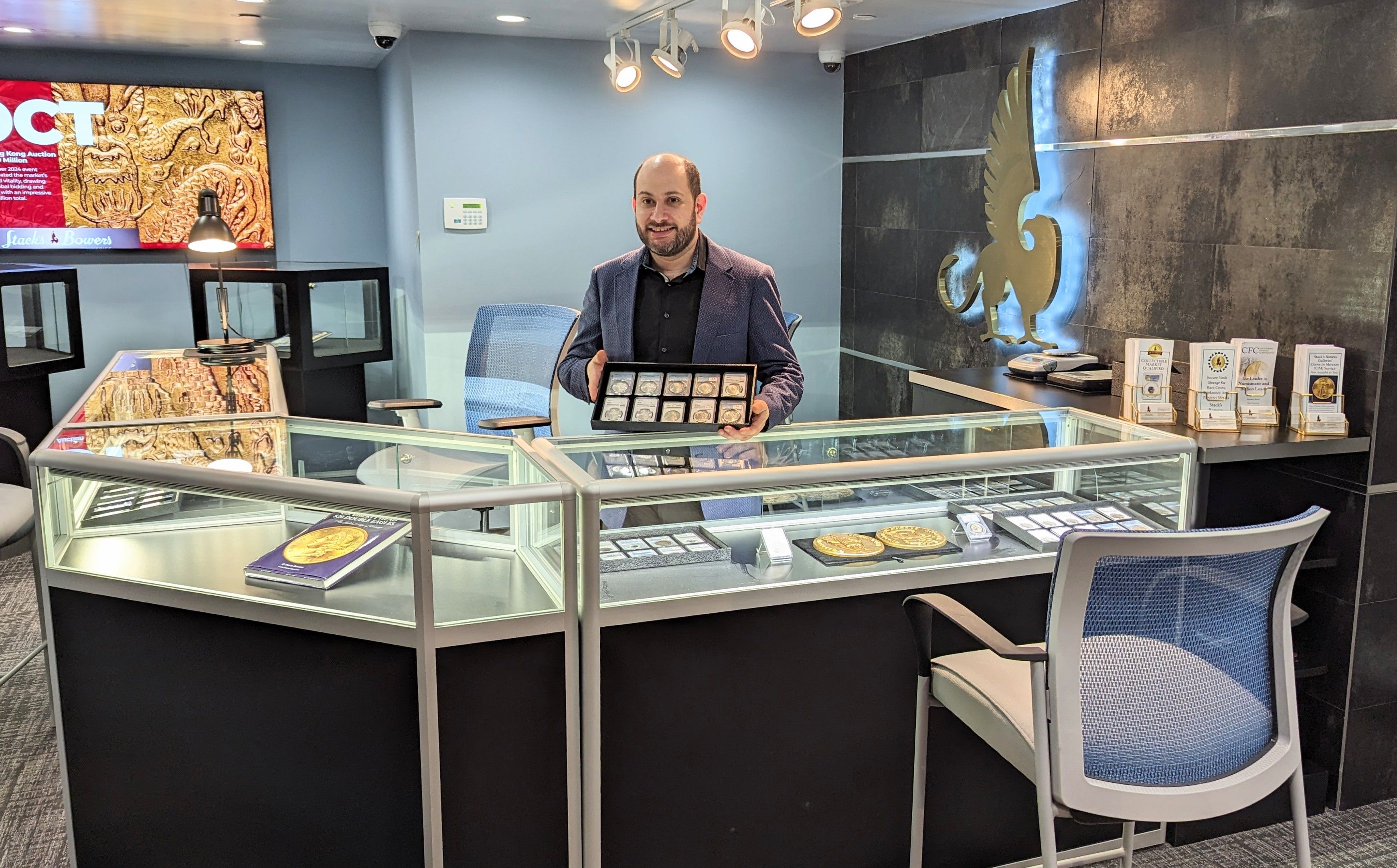
The intrigue: While the coins themselves were interesting, it was the history and stories Conroy told me about each that drew me in — like that of the 1933 double eagle $20 coin, the last $20 gold piece the U.S. government made.
The tl;dr: After President Franklin D. Roosevelt in 1933 made it illegal to hoard gold, about 200 $20 coins were minted.
- The government asked for them back, but not everyone returned what they'd purchased. Those remaining coins were considered illegal.
- In the years that followed, the Secret Service confiscated them whenever they'd pop up at auctions.
- One coin, though, was bought by King Farouk of Egypt under an export license, meaning the U.S. government allowed it to be owned.
Fast forward to 2002, after the rogue coin was smuggled back into the States.
- It sold at a collaboration between Stack's and Sotheby's for $7.59 million and again in 2021 for more than $18.8 million. (How could this not pique your interest?)
The bottom line: "Unless you get curious about coins, you probably don't know about all the varieties of coins that have been made [in the past] or are contemporarily made," Conroy said.
- But if you're anything like me (you love history and a good story), check out the collection at Stack's Bowers Galleries.
- Who knows, maybe you're a secret coin enthusiast, too.