Miami's coldest days are getting warmer


Add Axios as your preferred source to
see more of our stories on Google.
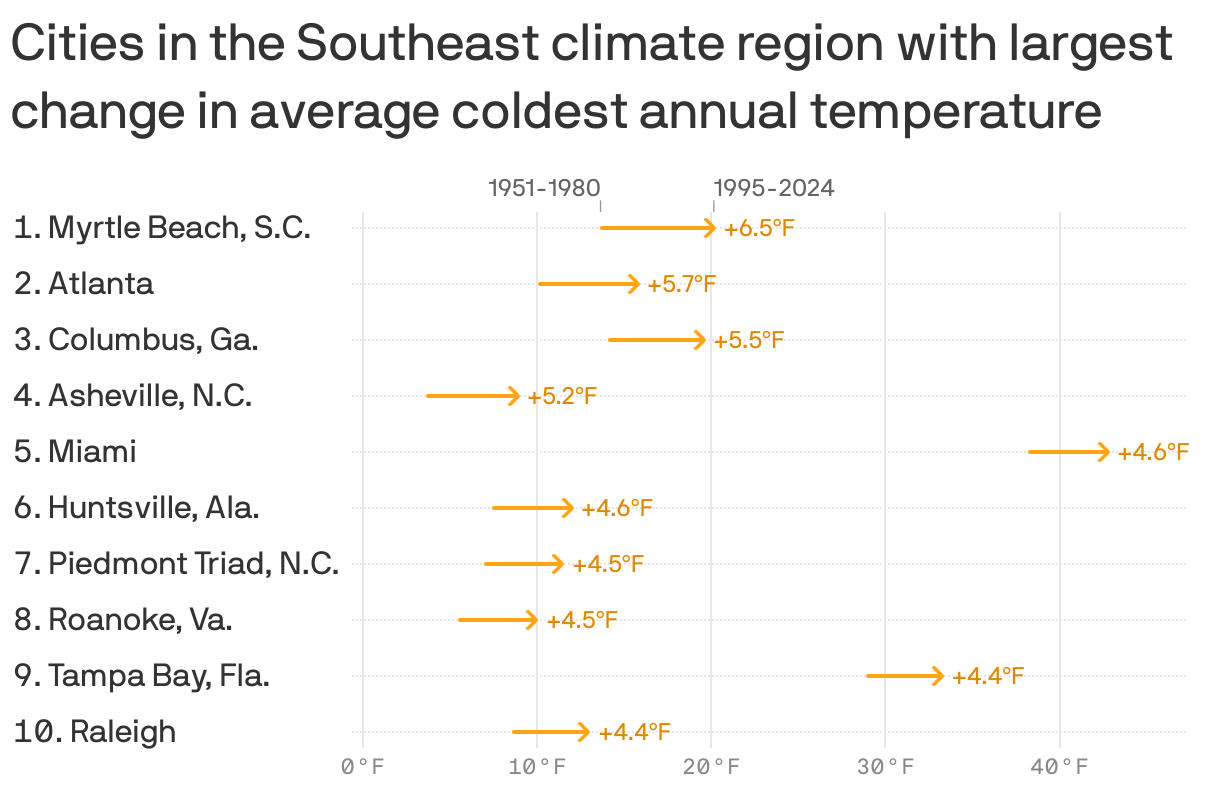
Thirty-year average coldest temperatures are rising across the country, including in Miami, a new analysis found.
Why it matters: Such a shift can affect us in a variety of ways — changing which plants and insects thrive in our neighborhoods, for example, amid other impacts of climate change.
- Much of the U.S. was categorized into warmer plant hardiness zones with the latest USDA map update in 2023, as Axios' Jacque Schrag reported.
Driving the news: The 30-year average coldest temperature for 1995-2024 compared to 1951-1980 was higher in 97% of the 243 locations analyzed by Climate Central, a research and communications group.
- Among the locations with an increase, the coldest annual temperature was 3.7°F higher on average.
Zoom in: Miami saw a +4.6°F increase in average coldest temperature between the two 30-year periods.
What to watch: The group also used climate modeling and NASA data to project future change between the 30-year period of 1995-2024 and the 2036-2065 period.
- It predicts that the 30-year average coldest temperature will rise in every single one of the 243 locations analyzed between those periods, with an average gain of 5.6°F.