10 minutes with NASA chief Jared Isaacman

Add Axios as your preferred source to
see more of our stories on Google.

NASA Administrator Jared Isaacman was inspired to go to Space Camp by the 1986 film. Photo: Derek Lacey/Axios
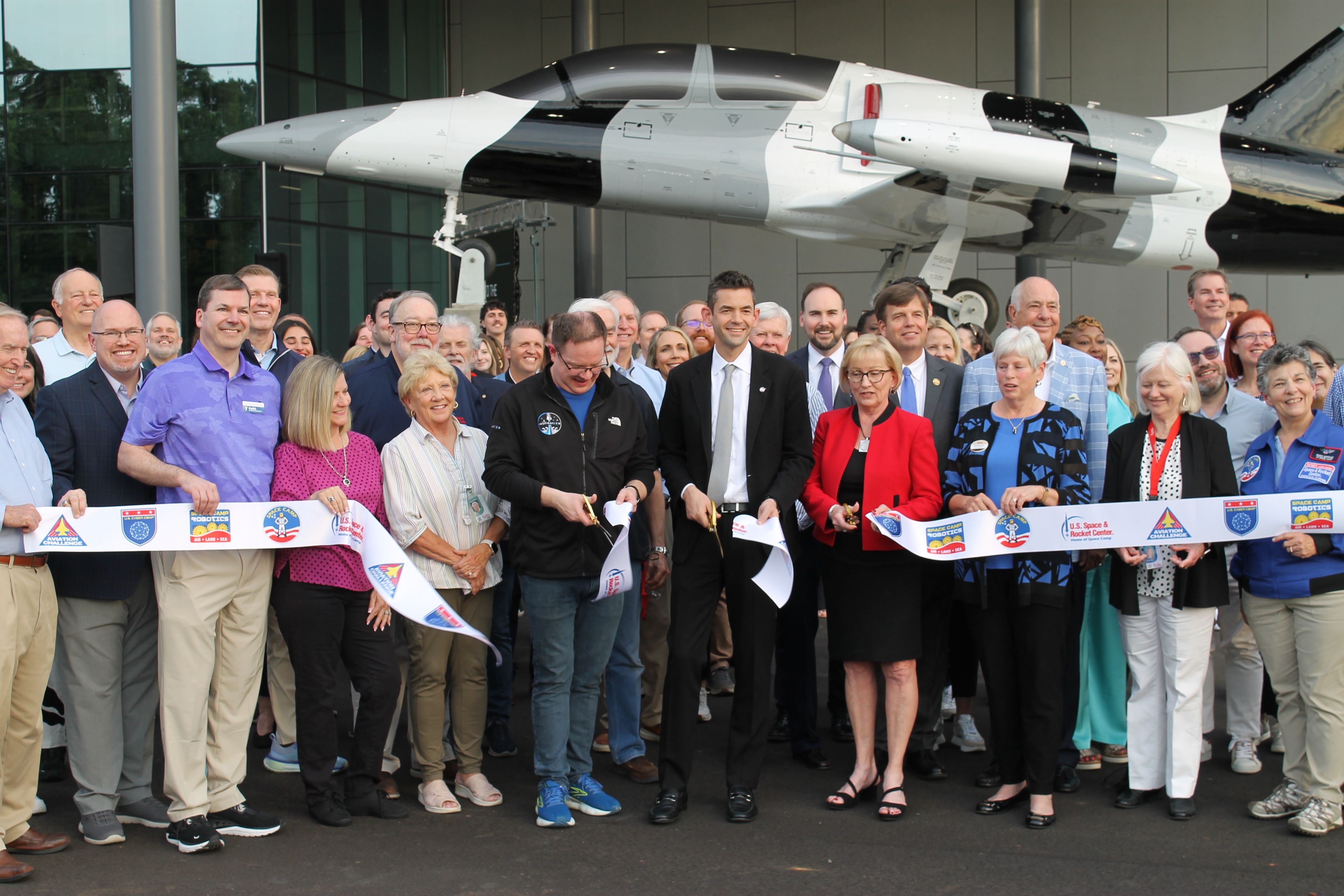
NASA Administrator Jared Isaacman returned to Huntsville last week to cut the ribbon on Space Camp's new Innovation4 Skills Training Center.
Why it matters: He spoke to local media ahead of the event, telling Axios about NASA's efforts to bring more roles in-house, its work with private sector space companies and more.
Driving the news: An alum and major supporter, Isaacman calls Space Camp a "national treasure." He donates his annual salary as NASA administrator to Space Camp, and donated $25 million to the new facility and a new dormitory.
Rebalancing NASA's workforce
In a memo earlier this year, Isaacman detailed a directive to restore NASA's core competencies as in-house positions, saying the agency has become increasingly dependent on vendors and contractors.
- "This is not a reduction in force," he told Axios. "This is just surveying the landscape and what I would say is proper rebalancing."
Context: NASA's Marshall Space Flight Center is one of the area's top employers, with more than 6,000 employees and an annual budget of about $5 billion.
- Isaacman said that across the entire agency, the mix is roughly 75% contractors and 25% civil servants, and while every center is different, he said some are made up of as much as 90% contractors.
- "I don't want to go as far as to say it'll be 50-50, but that seems certainly more ... directionally correct," he said.
Space Camp's role
Space Camp is a launch pad for future astronauts, pilots, scientists and engineers, including Isaacman as well as fellow alum and Artemis II Astronaut Christina Koch.
- Isaacman said Space Camp is what propels people from that initial spark of interest to a real career pipeline via a "hands-on experience that you can't get anywhere else."
- "That's what's going to carry ... the camper, the student, to their career path in college, where maybe they'll interact with a NASA grant, you know, build some hardware that goes to the Moon."
Private sector mix
Isaacman, billionaire entrepreneur and private astronaut, has navigated both the private and public space sectors and said the relationship between the two "just comes back to balance."
- He told Axios May 15 that he had been in St. Louis at Boeing earlier in the day, where the 1960s-era Mercury and Gemini spacecrafts are on display.
- "I bet during that time period there weren't the same questions of, 'Well, where does Boeing fit in with NASA?'" he told Axios. "No, we do this together."
Zoom in: Isaacman said there are places where NASA can "hand it off to industry where competitive forces make the product better and bring costs down," naming launch as a specific example.
Yes, but: "What industry should not be doing is trying to figure out how to launch a nuclear reactor and build giant nuclear-powered spaceships to send astronauts to Mars, because there's no obvious business case for it," he said.
LEO post-ISS
The International Space Station is set to cease operations and de-orbit in 2031, and Isaacman said that "what's important" is ensuring the U.S. never gives up its presence in low-Earth orbit.
- "I want nothing more than to see a world where there's lots of commercial space stations out there, and NASA is again recalibrating to do what others can't," he said, citing a Moon base and mission to Mars as prime examples.