The next space station era starts in Huntsville

Add Axios as your preferred source to
see more of our stories on Google.
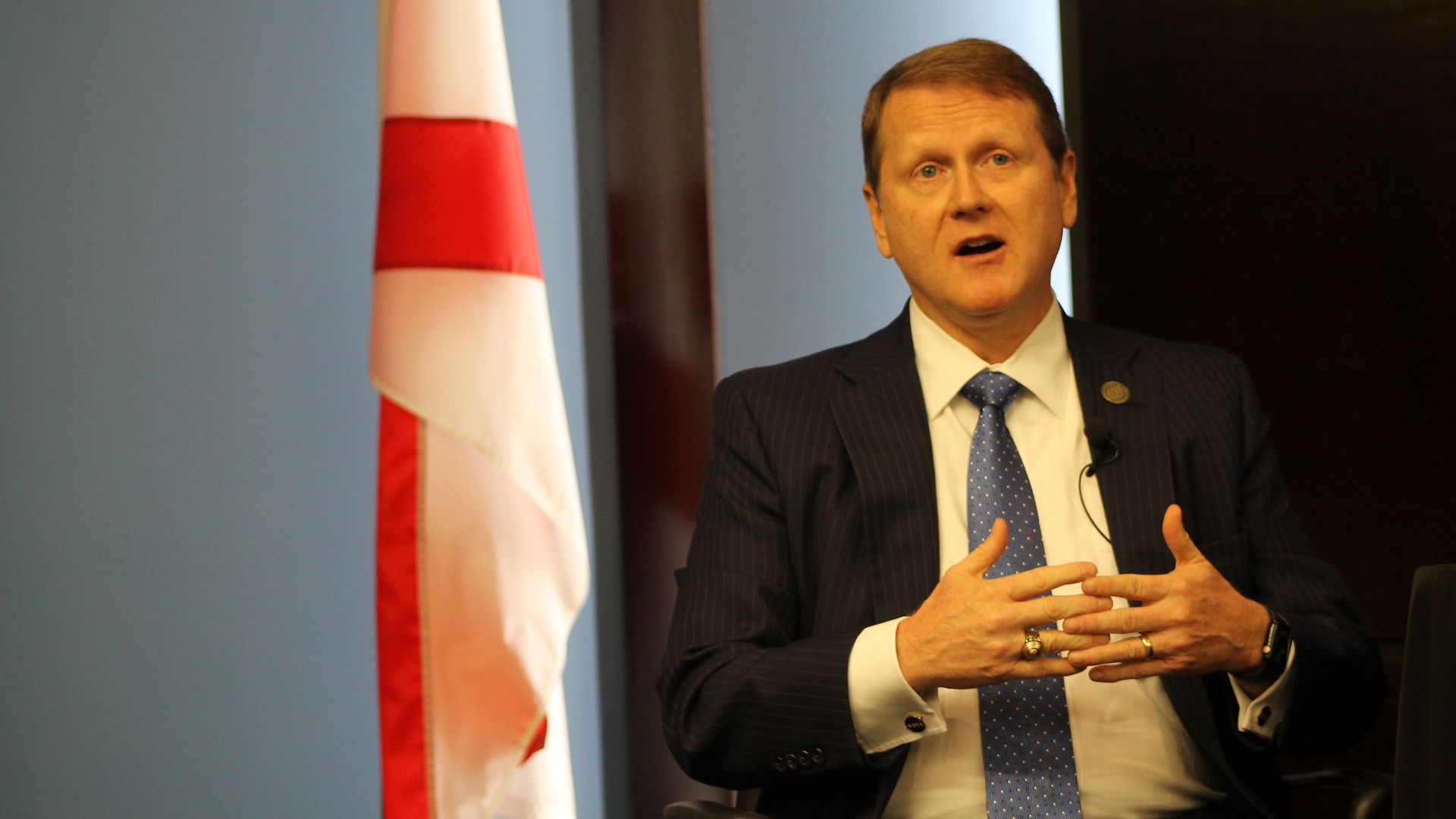
Rich Boling of Redwire said he's taking orders for space-made meniscuses. Photo: Derek Lacey / Axios
The era of commercial space stations is here — and Huntsville will play a central role in shaping America's future in low-earth orbit.
Why it matters: The International Space Station is set to be decommissioned in 2030, and private companies are working with Marshall Space Flight Center in Huntsville to maintain the nation's competitive edge in space.
Driving the news: The Huntsville/Madison Chamber of Commerce brought leading companies together Tuesday to talk about the challenges and opportunities for public-private partnerships in low-earth orbit.
- "The shift from ISS to commercial space stations is not just a transition for NASA, it's a chance to grow a thriving economy in space," said Nick Case, manager of partnerships and opportunity development at MSFC.
- "That means new business models, new international collaborations and new opportunities right here in North Alabama."
Context: MSFC in Huntsville is home to the Payload Operations Integration Center, "the heartbeat for space station research operations," per NASA.
- It's also NASA's leader in public-private partnerships, with more than 400 active agreements, said Davey Jones, center strategy lead at MSFC.
Zoom in: "We have about four years before ISS is going to be decommissioned, and four years for a company of any of our sizes is a tight timeline," said Taylor Armentrout, vice president of government relations for Axiom Space.
- She and others on the panel stressed the need for clarity from NASA and Congress on space station development — including how assets are going to be indemnified and how mission authorization will work.
- Axiom plans to have multiple operational space stations addressing various needs in 10 years, she said.
China's Tiangong Space Station is advancing on a faster timeline — and that's a major concern, said Eric Stallmer, EVP of government affairs and public policy at Voyager Technologies.
- Twenty countries are lined up to work with China on Tiangong, crewed by members of the People's Liberation Army, he said, "so China's an enormous threat."
- The issue brings both sides of the aisle together, he said, and "I think with that commonality, we'll find other commonality.… I think you'll see another Golden Age in space."
What we're watching: Low-earth orbit operations will be key as the U.S. transitions to the moon and Mars, said Megan Green, government relations director with Blue Origin.
- "It provides the … foundation for us to take further and further leaps," she said, noting the ability to de-risk technology solutions in life support systems, avionics, solar arrays and more.
Work in low-earth orbit has applications on Earth too, with Rich Boling, vice president at Redwire Space, which has 10 payloads onboard the ISS today, noting biomedical and semiconductor manufacturing.
- Think bio-printing meniscuses, cardiac patch manufacturing and space-based drugs from "compounds that really can't be made here on Earth."
Editor's note: This story has been corrected to say that Voyager Technologies' Eric Stallmer said that 20 countries (not 20 companies) are lined up to work with China on the Tiangong Space Station.