AI could be the next space mission copilot

Add Axios as your preferred source to
see more of our stories on Google.
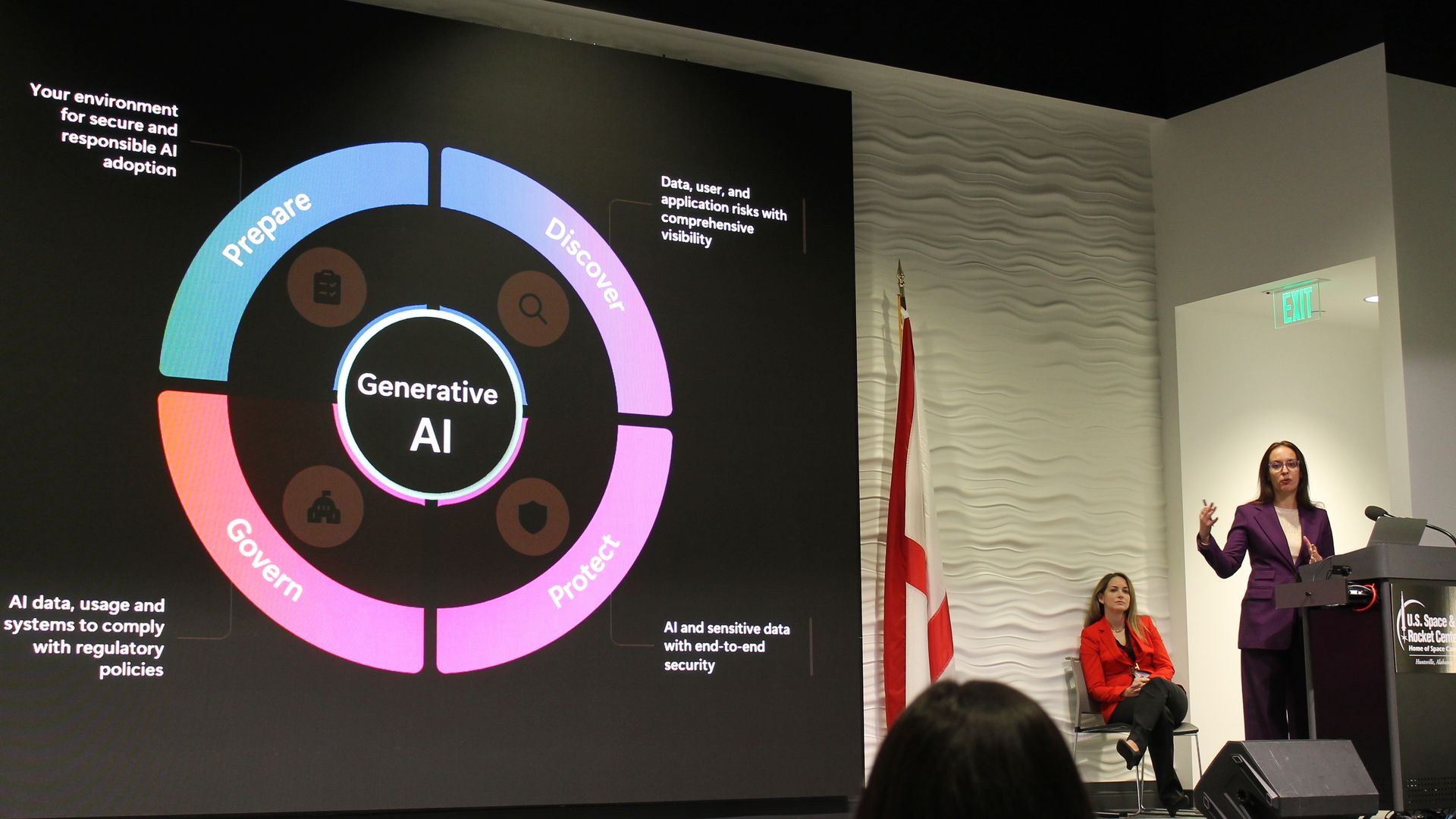
Microsoft AI director Nelli Babayan speaks at the U.S. Space & Rocket Center's AI Symposium on Wednesday. Photo: Derek Lacey/Axios
An artificial intelligence agent may be the next crucial member of a space mission.
Why it matters: As NASA and private companies look to make deeper strides in space or establish new space stations, quick-thinking AI agents could provide valuable assistance.
Catch up quick: Speaking at the U.S. Space & Rocket Center's AI Symposium Wednesday, top Microsoft AI leaders showed how AI is currently being used by NASA and how it might be deployed in space.
How it works: Agentic AI is more than prompt-and-response, said Heidi Connelly, Microsoft's federal, cloud and AI platform leader.
- "Agentic AI represents a major shift: moving from systems that simply respond to instructions to systems that can take direction, carry out end-to-end workflows," she said.
- Instead of an AI that can tell someone how to order a laptop for a new employee, an agent can tell there's been a hire, confirm their address and order the laptop for delivery.
Zoom in: Applications for space missions run the gamut, from mission operations and spacecraft health to data processing and ground operations.
- The AI agent could autonomously do "telemetry triage," Connelly said, absorbing and analyzing the flood of systems and other data during a mission.
- "Agents can scan all of that telemetry that's being generated, detect anomalies, prioritize alerts by criticalities and propose mitigation steps, so it's not a human trying to analyze all that information that's coming in very, very rapidly."
- AI agents could replan science activities based on resource constraints or new data, Connelly said, or autonomously plan maneuvers like engine burns and docking.
Case in point: At a demonstration Wednesday, Nelli Babayan, Microsoft's AI director, showed how AI could provide answers quickly for astronaut health issues in space.
- She presented symptoms of a hypothetical astronaut, getting a detailed response, pulled strictly from NASA documents, that was automatically emailed to her.
- "This is pretty basic," Babayan said. "You can also have a multi-agentic system that sends an email, goes over the reports, checks for something and then sends it for review, reviews it and then goes through those additional workflows."
Another use case is Microsoft's Magma, an AI foundation model "designed to process information and generate action proposals, both from the digital and from physical environments," Babayan said.
- The model could be used for a lunar or Mars rover to take stock of its surroundings and suggest specific actions based on what it sees.
Zoom out: She also noted ways NASA is already working with Microsoft AI products, including identifying drought conditions and data, and analyzing the impact of Hurricane Ida in New Orleans by identifying homes with blue tarps on their roofs.