From orbit to Rocket City: Astronauts highlight Huntsville's ISS role

Add Axios as your preferred source to
see more of our stories on Google.
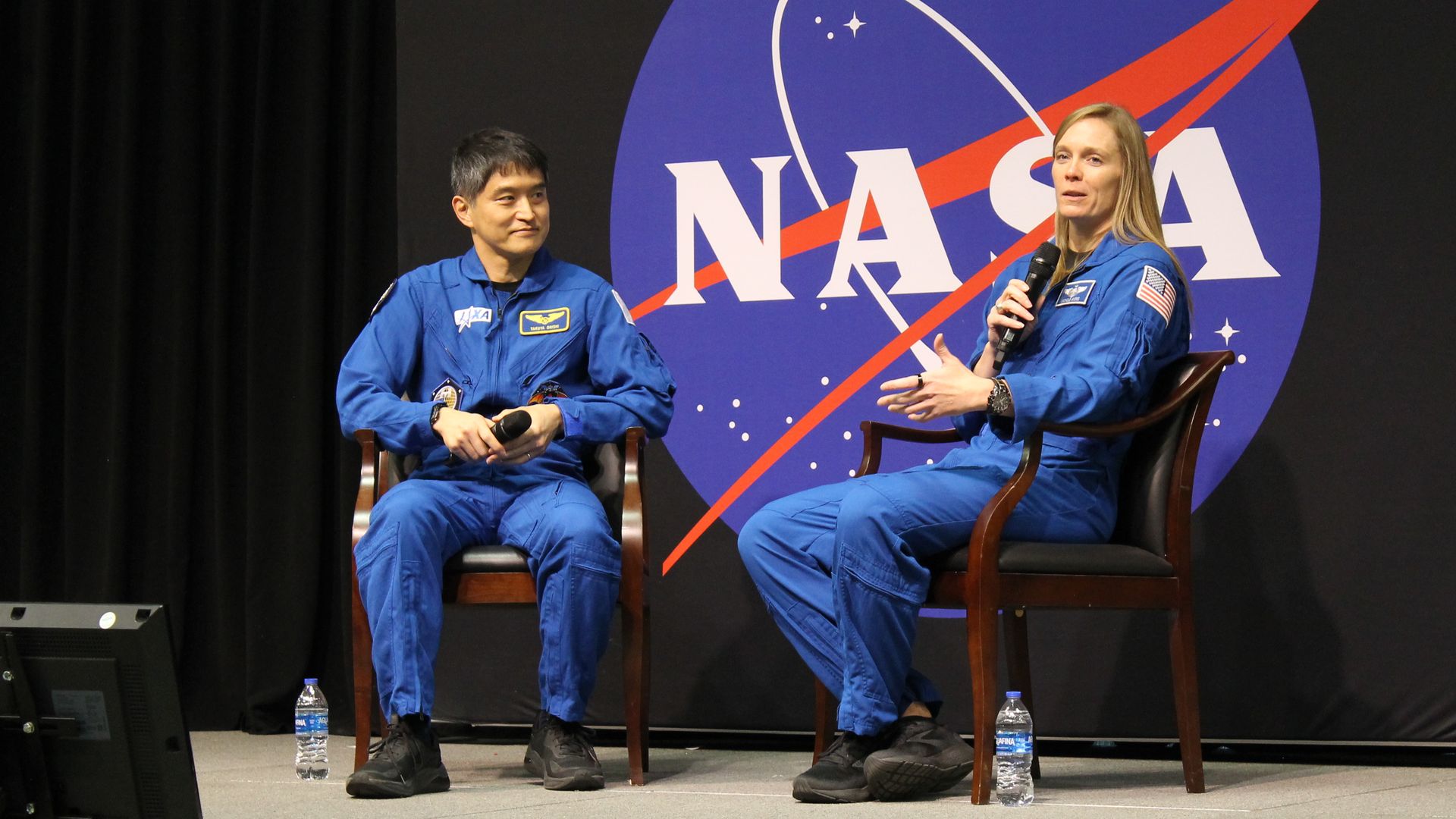
Nichole Ayers completed a five-hour, 44-minute spacewalk during the mission. Photo: Derek Lacey/Axios
NASA astronauts Nichole Ayers and Takuya Onishi returned to the Rocket City Friday, sharing insight from months in space with the folks who helped make it possible.
Why it matters: NASA's operations in Huntsville are key to work that happens on the International Space Station (ISS).
Zoom in: The two astronauts took questions from employees at Marshall Space Flight Center in Huntsville Friday about their experience aboard the ISS.
- The NASA facility is home to the Payload Integration Operations Center (POIC), "the heartbeat for space station research operations."
What they're saying: "You guys help us every single day," Ayers said Friday. "If we have a question, we can just call Huntsville and ask."
- "We are so happy to be back here to see our friends," Onishi said, noting the crew visited Huntsville before the mission to meet the team and get some last-minute payload training. "Doing scientific experiments is one of the primary objectives that we are doing onboard the ISS."
Catch up quick: Space Camp alum Ayers and Japan Aerospace Exploration Agency astronaut Onishi were part of NASA's SpaceX Crew-10, spending nearly five months aboard the ISS from March to August 2025.
- At Marshall on Friday, they walked the crowd through their mission and answered questions on everyday work and life aboard the ISS, from exercise and food to photography and hygiene.
Driving the news: NASA is turning its focus deeper into space, with the Artemis II launch just weeks away, and taking every advantage to begin testing the waters for longer missions.
- "I think it's going to be a huge challenge," said Onishi, answering a question about what the astronauts' ISS mission taught them about the psychological impacts of extended stays in space.
- Onishi said it's important to go back to the Moon to test new technology or polish existing technology to prepare for a trip to Mars.
- "Our connectivity on the Space Station is pretty phenomenal ... It's easy to call Huntsville or Houston, but that's going to change," Ayers said. "We really have to hone the deep space network if we want to continue to have even something similar."
What we're watching: NASA will decommission the ISS in 2030, ushering in the age of commercial space stations.
- "The commercial companies are going to come on board and continue the science ventures and continue the technology demos in their own way," Ayers said. "They're going to provide a service that NASA can then use."
- She said the focus is now on deeper space, including the Moon and Mars, "so I'm really excited to see what the commercial companies are doing."