How religious is Colorado

Add Axios as your preferred source to
see more of our stories on Google.
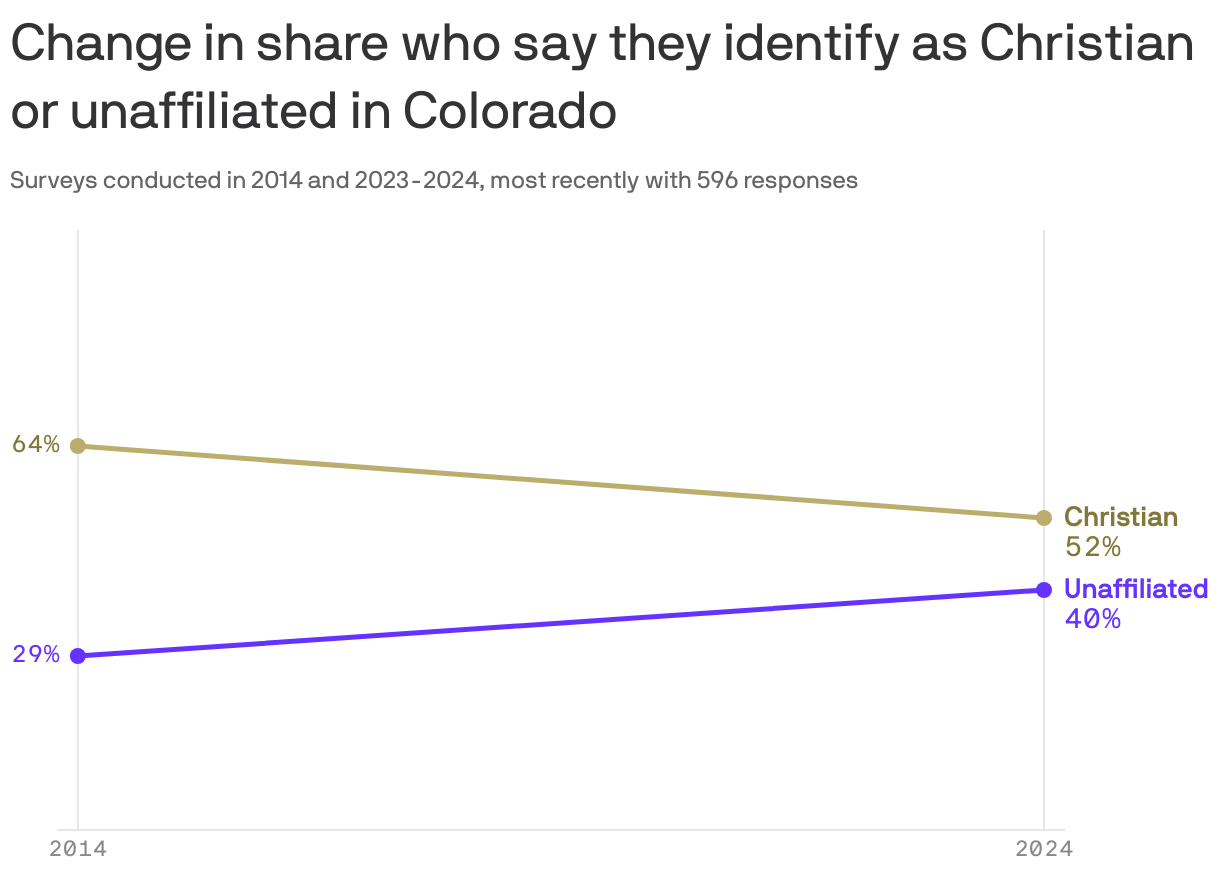
Coloradans are less likely to identify as Christian now compared to a decade ago.
Why it matters: Religiosity is a part of America's social fabric and the new findings represent "a broad-based social change," says Alan Cooperman, director of religion research at the Pew Research Center, which conducted the study.
By the numbers: Christian affiliation at the state level fell from 64% to 52% in the decade ending in 2024. At the same time, people who don't identify with any religion increased significantly to 40% from 29%.
- In Denver, the numbers are similar at 53% Christian and 39% religiously unaffiliated.
What they're saying: "We've had rising shares of people who don't identify with any religion — so-called 'nones' — and declining shares who identify as Christian, in all parts of the country, in all parts of the population, by ethnicity and race, among both men and women, and among people at all levels of the educational spectrum," Cooperman says about the survey findings.
The big picture: Nationally, 29% of U.S. adults are religiously unaffiliated, up from 16% in 2007, according to Pew.
- And 7% of U.S. adults identify with other religions than Christianity, up from 5% in 2007.
Between the lines: More than one-third of U.S. adults have switched religion since childhood, according to the study. "It's not surprising," Penny Edgell, professor in the sociology department at University of Minnesota, tells Axios.
- Fewer self-described liberals say they're Christian, 37% down from 62% in 2007, than are religiously unaffiliated. For conservatives, the decline is much smaller from 89% identifying as Christian to 82%.