New tax plan will test voters' appetite for rate hike

Add Axios as your preferred source to
see more of our stories on Google.
Denver leaders want voters to increase local taxes this fall, pushing the city's overall rate past 9%, and testing taxpayers at a time when consumer spending has slowed.
The big picture: Denver Mayor Mike Johnston wants a 0.5% sales tax raise to generate $100 million annually to meet the city's affordable housing needs. Meanwhile, Denver Health, the city's safety net hospital, seeks a 0.34% hike to raise $70 million annually to cover operating costs.
The intrigue: Denver voters don't often reject proposed tax increases, something economist Chris Stiffler of the left-leaning Colorado Fiscal Institute said might be due to how inconspicuous the additional money can be when added to something like a grocery bill.
- Unlike property or income taxes, Stiffler said sales taxes often go unnoticed by consumers: "Sales tax is a drip that tends to add up."
- This may explain why Denver voters have approved seven tax hikes since 2014, according to the right-leaning Common Sense Institute.
By the numbers: The two latest measures would raise the city's overall rate from 8.81% to 9.65%, which includes state and regional taxes.
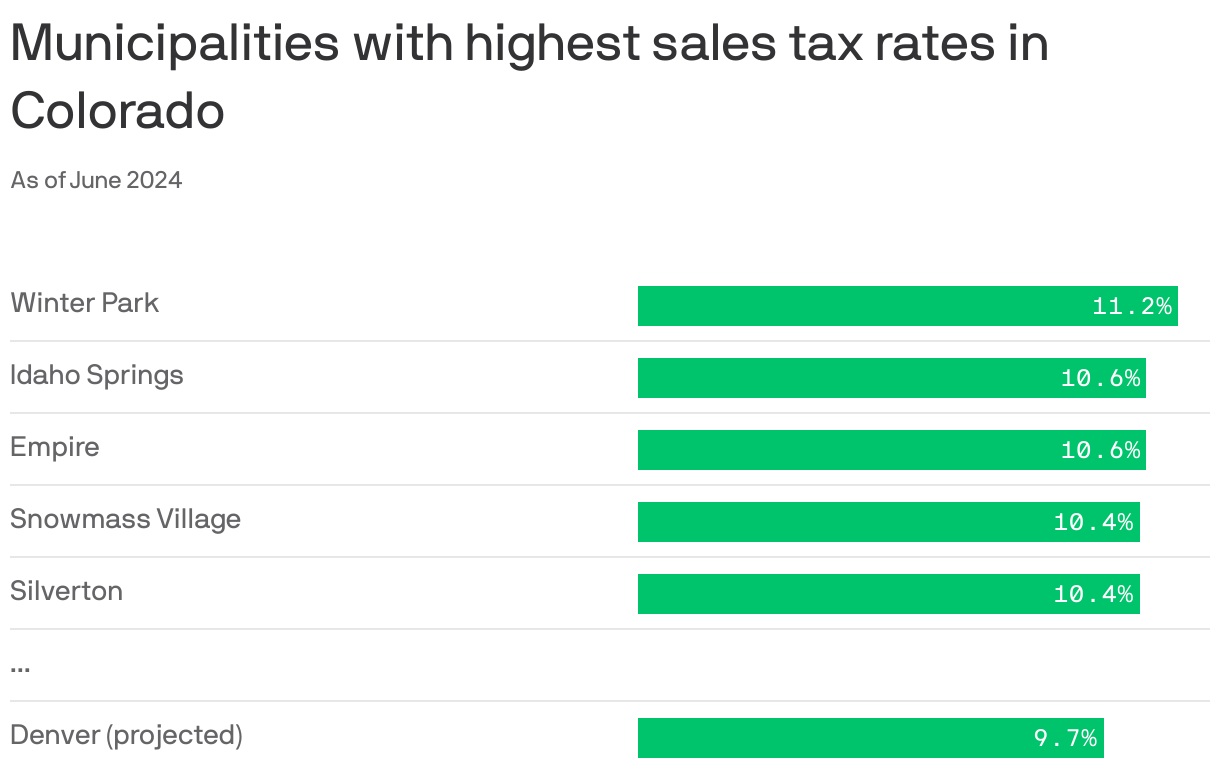
- It's a rate Johnston said keeps Denver "competitive" in the region. He added it's not the highest in the state, which is true; Winter Park's 11.2% rate tops the state.
Yes, but: It would still push Denver's rate among the highest in Colorado.
Between the lines: Sales taxes can be regressive, Stiffler says, because lower-income earners pay a significant chunk of their income toward taxes.
- Johnston said his plan would mean the average family would spend about $2 more a week, and would exempt spending on food, fuel, medical supplies and personal hygiene products.
Context: A new poll shows a plurality of Denver voters (35%) believe city government taxes are way too high, but the majority (56%) say they're acceptable or about right.
- Another 8% consider them lower than expected.
What they're saying: "It would be safe to say that there probably is additional concern about taxes ... but … most [Denver] voters believe that their tax burden is acceptable," Kevin Ingham of polling firm Aspect Strategies said.
- Stiffler says sales tax increases tend to "poll better" than potential increases to income or property taxes.
Follow the money: Sales and use tax are the city's most crucial revenue stream, comprising over half of its $1.633 billion general fund last year, per Denver's finance department.
- Roughly 75% of the city's general fund comes from taxes.
Friction point: The city anticipates "softening" tax revenue, meaning money generated from taxes isn't growing as much as previous years, finance department spokesperson Laura Swartz tells us.
- The department projects a 1% jump from 2024 to 2025, slightly less than the 1.6% growth for the current year.
The bottom line: Johnston said his plan will help pay for an additional 44,000 housing units over the next 10 years.
- "We are doing this now because Denver can't afford to wait," Johnston said Monday.
What's next: Denver City Council this summer will formally consider whether to put Johnston's plan on the fall ballot.
- The council has not received a formal bill or proposed ballot language for the plan as of Wednesday.