COVID cases are climbing — but here's why you should wait to test for it

Add Axios as your preferred source to
see more of our stories on Google.
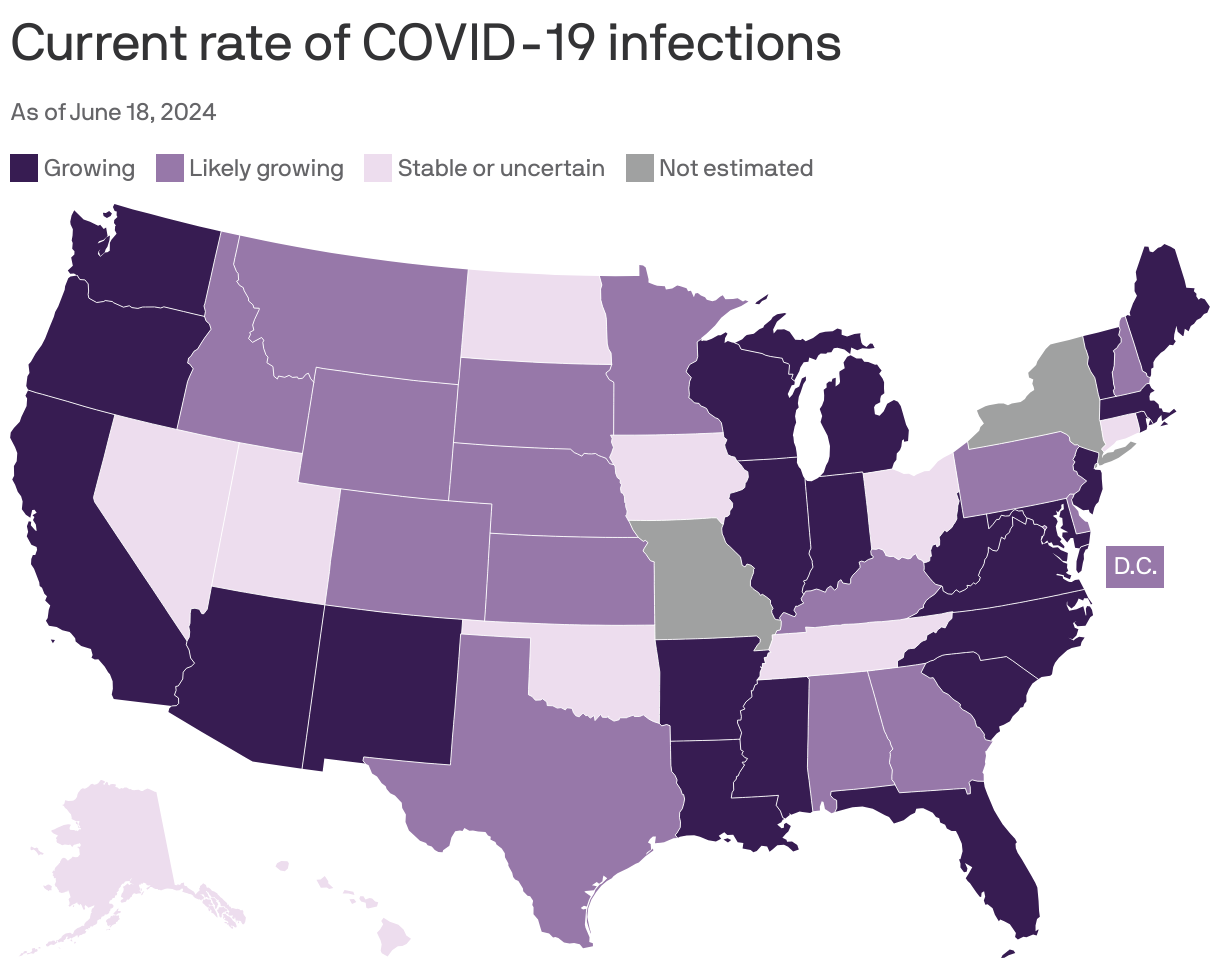
As COVID cases climb across the country, a new study from the University of Colorado Boulder suggests you shouldn't test for the virus as soon as you start feeling sick.
What they found: In a paper published this month in the journal Science Advances, researchers found it's best to wait two days after symptoms arise to take a rapid test, since the virus is likely undetectable until then.
- That's because most people's immune systems now react quickly due to prior exposure, but new variants in people with some immunity develop slower than the original strain.
By the numbers: Patients with Omicron variants received a false negative as much as 92% of the time when they tested immediately, but that figure dropped to 70% when they waited 48 hours.
- Taking a second test on the third day lowers the false negative rate even further, to 66%, researchers found.
Yes, but: For flu and RSV, it's best to take a rapid test as soon as symptoms show up, first author Casey Middleton said in a statement.
- Flu and RSV viruses multiply rapidly when symptoms first start, so there's plenty to make a test show up positive from the get-go.
What they're saying: "This is the conundrum," according to senior author Daniel Larremore.
- "If you go in right away and test for all three, you can learn a lot from the flu and RSV tests, but you may have swung too early for COVID. If you wait a few days, the timing might be right to catch COVID but you are too late for flu and RSV."
State of play: Colorado's COVID rate remains low, but cases have been ticking up over the past several weeks, state health officials say.
- "We have seen a shift away from JN.1 to newer KP1.1, KP.2, KP.3, and other strains," Kayla Glad, a spokesperson with Colorado's health department, tells us.
- "Those could be causing some of these increases, in addition to other factors such as summer travel and spending time indoors with air conditioning," she says.
The bottom line: If you do test positive for COVID, CU Boulder researchers recommend a "test to exit" strategy, in which you test until you receive a negative result, instead of following the CDC's previous "five-day isolation policy," which it abandoned in March.
- "The five-day isolation policy made people isolate for too long in most cases," said Middleton. "Test-to-exit does a good job releasing people early who aren't going to transmit but holding those who still have high amounts of virus."
- State health officials recommend testing twice, 48 hours apart if you do have symptoms or three times, each 48 hours apart, if you aren't showing signs.