Colorado explorer's frozen camera revives 50-year-old Aconcagua mystery

Add Axios as your preferred source to
see more of our stories on Google.
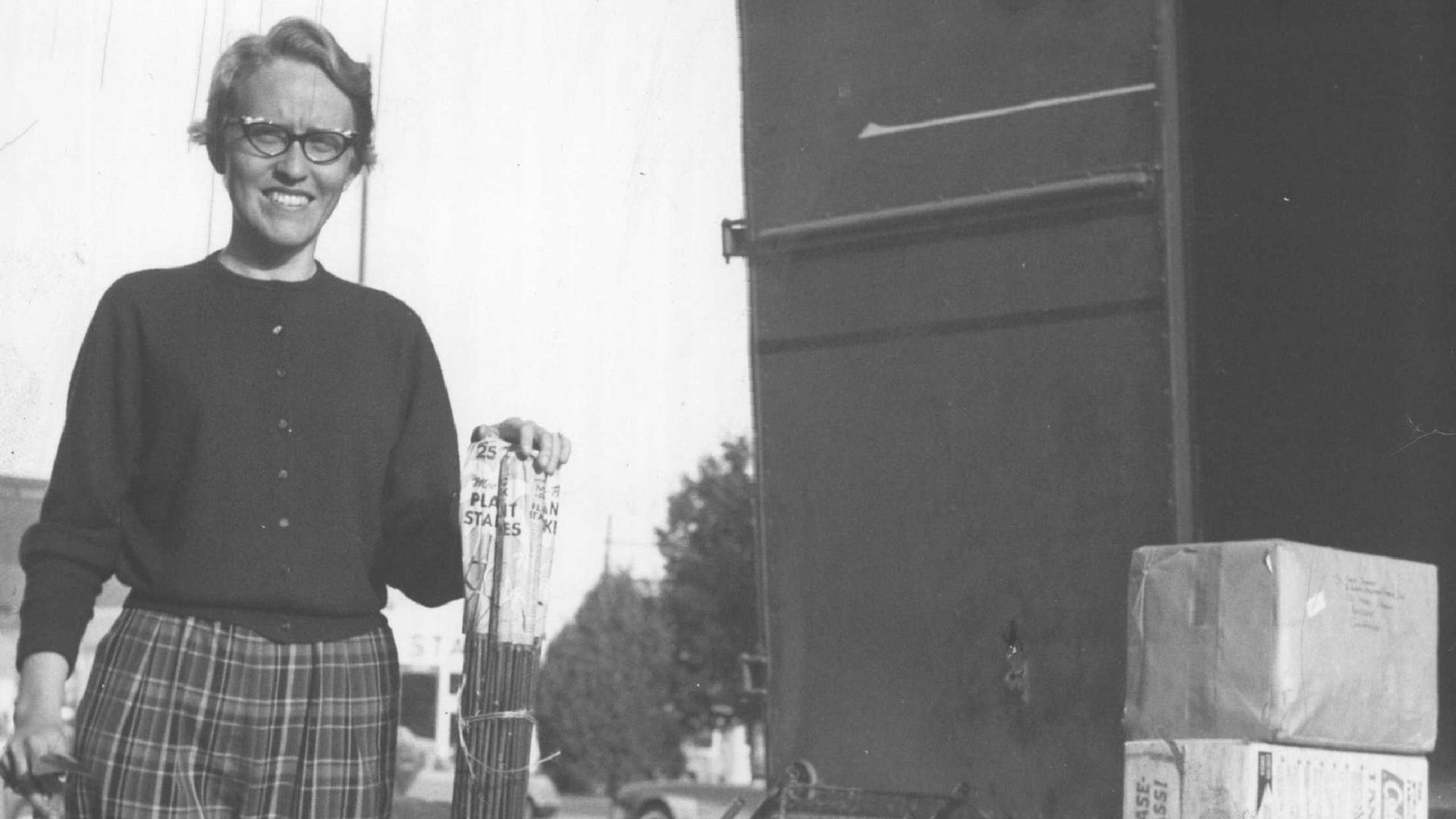
Janet Johnson preparing for an expedition with members of the Colorado Mountain Club to the Peruvian Andes in 1963. Photo: The Denver Post via Getty Images
The mysterious death of a Denver woman 50 years ago on the flank of the highest mountain in the Western Hemisphere is alive again after the discovery of her lost camera in a receding glacier.
Why it matters: 36-year-old Janet Johnson's disappearance on Aconcagua in Argentina is a legendary tale at 20,000 feet — some say unsolved murder — that riveted the world in 1973.
Driving the news: Her camera, with her name and 1259 York St. Denver address, embossed in blue tape, was discovered in the Polish Glacier below the peak's summit in February 2020 by a climber.
- Nearby, they later found her decomposed left arm with a Rado watch and a scattering of her belongings — down mittens, a red jacket and canister of used Kodak film.
- A photographer at the mountain's base camp passed the camera and film to the New York Times, which published the photos Saturday as part of an investigation into the case.
What's new: The glacier remarkably preserved the film, which features 24 images in the camera and 36 in the canister.
- They show the crew progressing up the mountain and feature three photos the night before her mysterious death. All were composed and focused, suggesting she wasn't significantly suffering from altitude effects, the Times writes.
The backstory: An eight-person American crew attempted to summit the 22,831-foot mountain, the highest outside the Himalayas, drawing international attention.
- The expedition team quickly became fractured amid personality conflicts. And illness and ability level meant only four made the summit attempt.
- Johnson, a teacher and accomplished climber who is one of the first 20 women to climb all of Colorado's 14,000-foot peaks, was arguably the most experienced.
- She died just above the group's high camp in circumstances unknown, along with John Cooper, a NASA engineer who helped guide the lunar module in the Apollo missions.
The intrigue: The two climbers with them gave contradictory stories of what happened on the mountain, blurred by hallucinations and fatigue. Autopsies showed Johnson and Cooper died of a brain injury, the Times wrote.
- Johnson reportedly suffered a fall down the glacier, her colleagues said. But her body was found in 1975 with a battered face, blood stains on her jacket and a rock on top of her body — in the middle of an ice field. Her arm was left in the ice at the time by the recovery team.
- Cooper died on his own descent to camp, seemingly frozen onto the mountainside. But the autopsy later found a hole in his abdomen. It was round, dispelling talk that he potentially fell on his ice ax, and it reached all the way to his spine.
What they're saying: The unsettling details spurred new theories about what happened.
- "They were killed," Daniel Araujo, an assistant to the medical examiner on the autospies, told the Times. "Both of them. These kinds of injuries were not self-inflicted."
- The last remaining member of the expedition, John Shelton, said recently the idea of foul play is "hogwash."
The bottom line: The newly published photos raise more questions than answers. And the mystery remains.