These downtown Denver office buildings could become housing

Add Axios as your preferred source to
see more of our stories on Google.
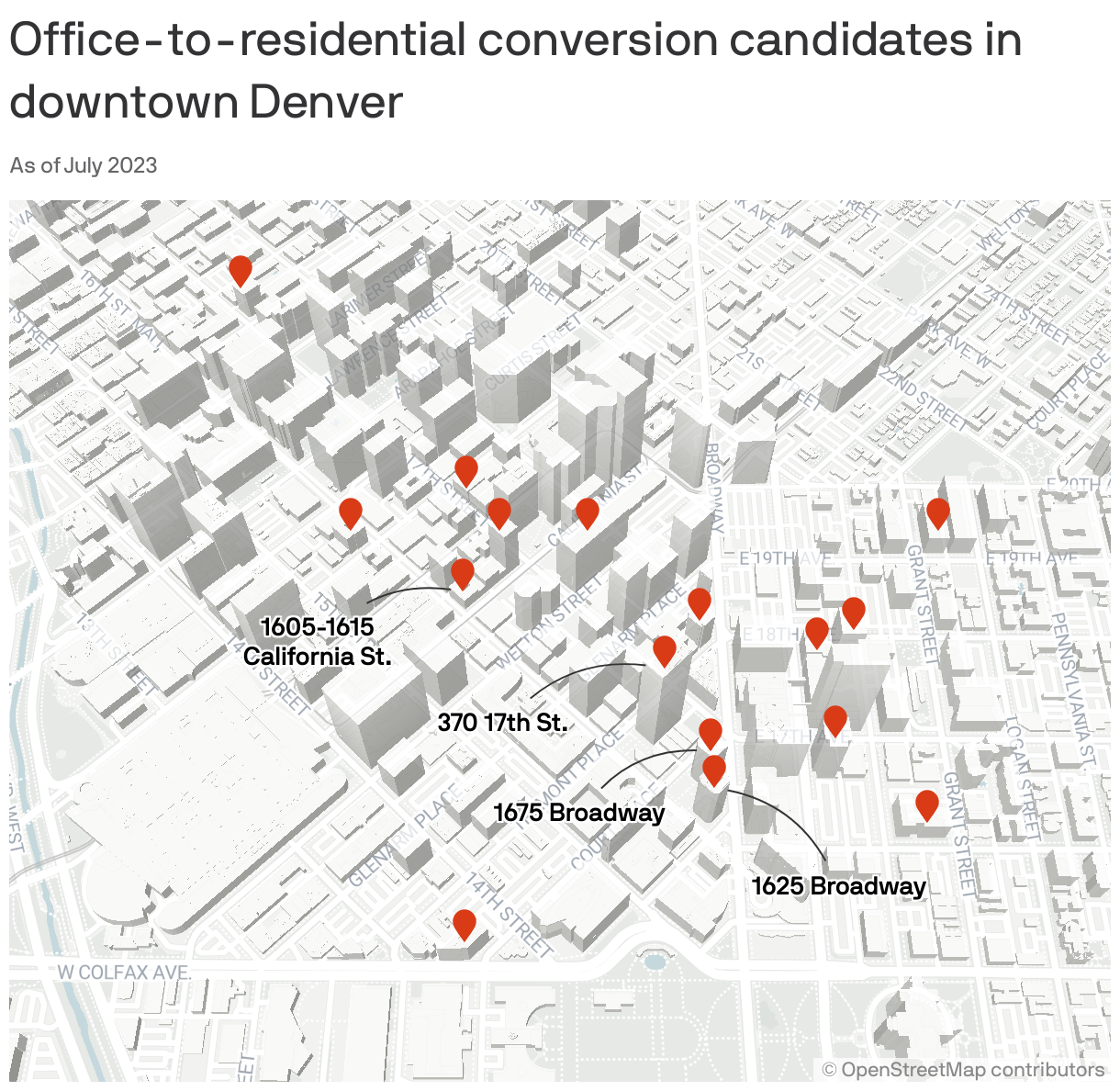
At least 16 downtown Denver office buildings — including the city's tallest skyscraper — are top targets for conversion to residential housing.
Driving the news: A study released Wednesday shows these buildings are the viable options due to their proximity to transit, natural light, their shape, existing window-to-wall ratio, and ease of window replacement, according to a statement from Denver's planning office.
Why it matters: Converting office space to residential units could add to the local housing stock and provide more places to live downtown.
State of play: The conversions would make significant strides toward turning the Central Business District, where the majority of the buildings are located, into a more livable neighborhood instead of an area solely focused on commercial and business spaces.
- This is a priority for the city's planning office, executive director Laura E. Aldrete said in a statement.
Details: The study was paid for using federal pandemic money. It looked at 27 total buildings in five downtown-area neighborhoods.
- It was completed by architectural firm Gensler, which notes the study is not comprehensive or exhaustive.
By the numbers: If the top 16 properties reviewed in the study were converted, it would add 5,124 housing units to downtown.
- The study notes for Republic Plaza, the tallest building in Denver, all but one of its 56 floors would be available for conversion.
- The iconic structure recently received a significant drop in its appraisal.
Between the lines: Parking availability is a market driver for residential leasing in Denver, so buildings without it will face challenges, according to the report. Three of the top 16 lacked on-site parking.
Of note: Downtown office buildings have struggled with vacancy rates, while foot traffic continues to lag compared to pre-pandemic levels — a likely side effect of remote and hybrid work.
The bottom line: It's up to a property owner to decide whether to convert a building, which can be costly, with some estimates ranging from $472,000 to $633,000 per unit.
- The city will use the study's findings as part of a newly launched pilot program for adaptive reuse, according to a statement.