Economic uncertainty clouds Colorado's state budget outlook

Add Axios as your preferred source to
see more of our stories on Google.
State lawmakers are bracing for an austere spending bill in the upcoming legislative session, one restrained by taxpayer refunds and the prospect of an economic downturn.
Driving the news: Two economic forecasts presented Tuesday to the legislative budget committee show slowing state revenues.
- The governor's office forecasts growth in discretionary spending from the general fund at 2.1%, while nonpartisan legislative economists put it closer to 4%.
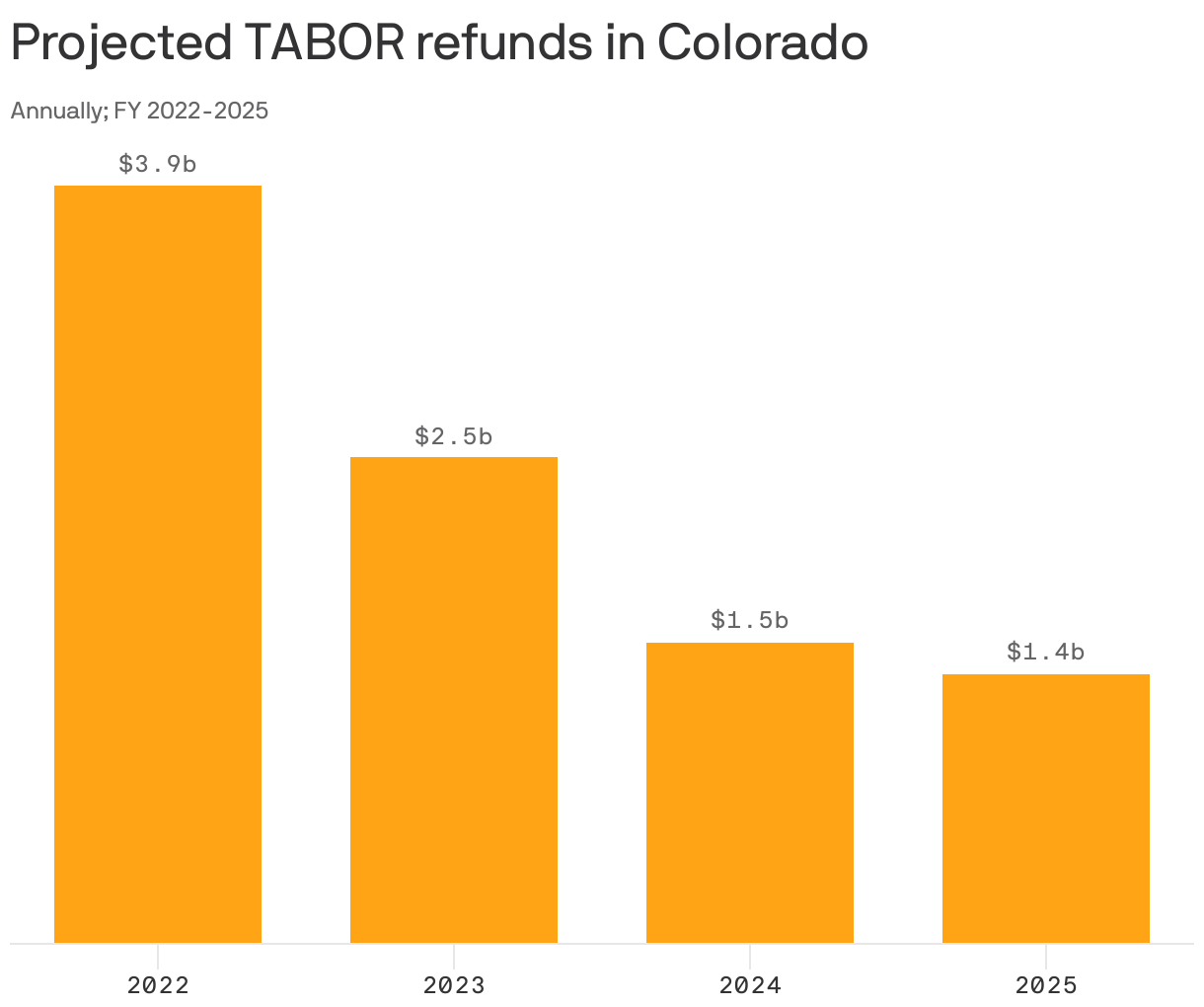
Why it matters: Either way, the increase is not enough to cover the costs of rising goods and services, particularly given the state is refunding nearly $4 billion to taxpayers because of TABOR caps.
- Moreover, uncertainty looms. "Our [budget] forecast doesn't include a recession," chief legislative economist Greg Sobetski told lawmakers. "We think a recession is very possible."
Details: The numbers serve as the baseline for legislation and the annual spending bill. So far in the current budget year, the state is facing a minor deficit of $56 million, falling just short of its required 15% reserve level.
What they're saying: "Today's forecast is a reminder that while Colorado's economic outlook remains strong, we are facing fiscal challenges that will test our limits and put enormous pressure on the state budget," Joint Budget Committee chair Rachel Zenzinger (D-Arvada) said in a statement.
Of note: The taxpayer refunds are expected to continue, though projections are split.
- On top of the TABOR refunds issued in August, the state will return $796 million more when taxes are filed in 2023, and as much as $5.4 billion in the next three years.