Colorado's summer of COVID subvariants heats up

Add Axios as your preferred source to
see more of our stories on Google.

Illustration: Brendan Lynch/Axios
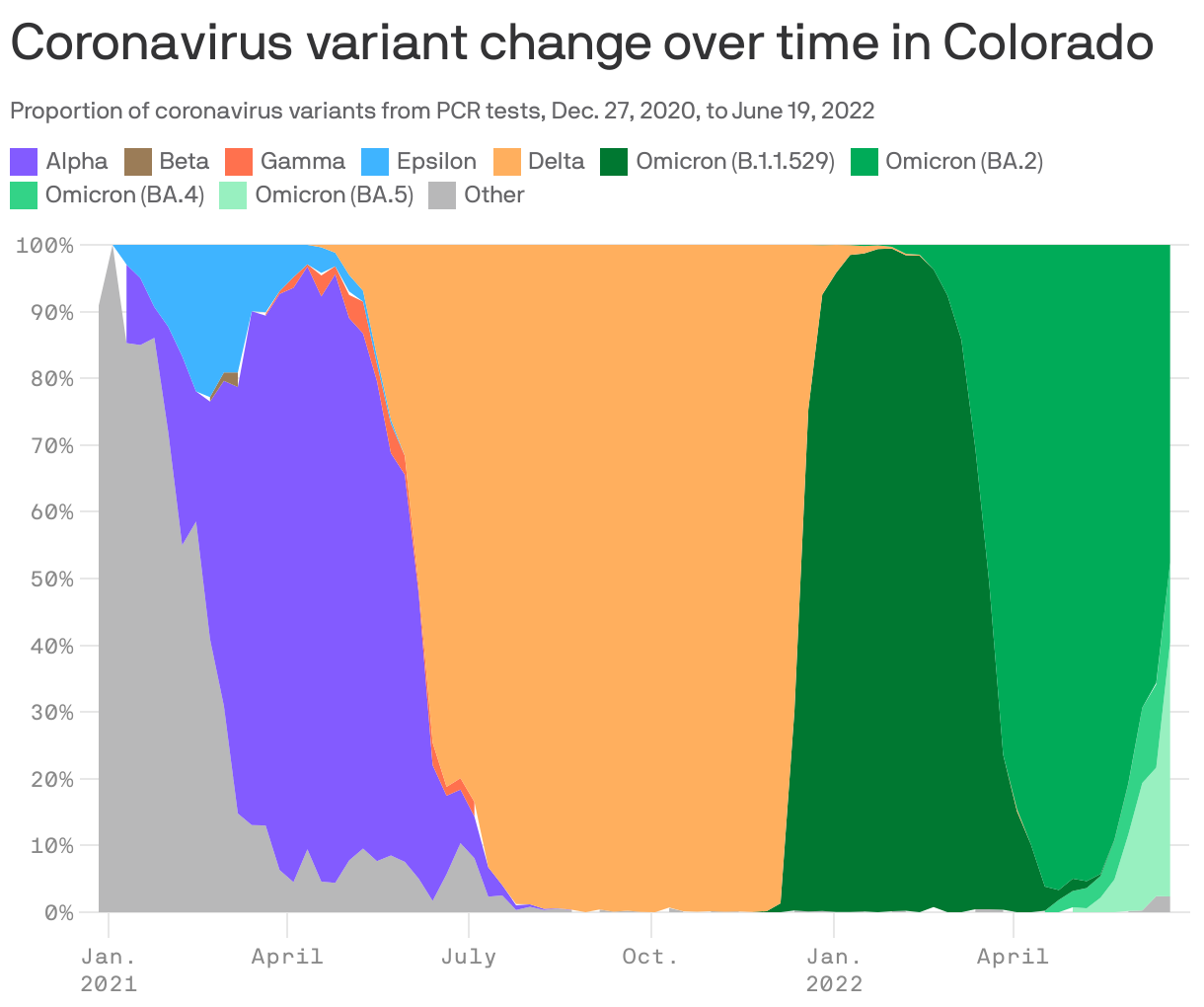
As Colorado temperatures tick up this summer, cases of new COVID-19 variants are rising with them.
Why it matters: Another summertime surge could prolong the pandemic, after most public health precautions were lifted and many mass vaccine sites closed.
- Meanwhile, vaccines are losing their power to protect against the fast-changing coronavirus.
- And new research shows reinfection may raise risks of other illnesses, including lung and heart problems.
Details: The latest subvariants of Omicron, BA.4 and BA.5, are the most transmissible yet, and have become the dominant strains circulating nationwide, including in Colorado.
- They are so contagious — and different enough from previous versions — that even those with immunity from prior Omicron infections are falling ill again.
State of play: Despite their weakening efficacy, state health officials still say COVID vaccines are the best weapons in this fight.
- The state is using social media, text messaging alerts and an advertising campaign to encourage higher vaccination rates for kids under age 5. Only 4.2% of them have received their first doses as of July 6, per state health department spokesperson Paul Bishop.
What's next: Planning is underway in Colorado for a fall vaccine campaign, when the formulas are expected to be recalibrated to fight the latest variants, Bishop tells Axios Denver.
- Health officials plan to erect several community vaccination sites across Colorado and deploy a new statewide media campaign to get the word out, though timing will depend on when the reformulated vaccines become available.
- In Denver, health officials are "much better prepared" to push out boosters this fall compared to when vaccines were first introduced in 2021, city spokesperson Courtney Ronner tells Axios Denver.
- Once the new doses are ready, the city plans to focus its outreach on people at the greatest risk for severe disease through targeted vaccination clinics, Ronner says.