Browns' Brook Park stadium gets $200 million pricier

Add Axios as your preferred source to
see more of our stories on Google.
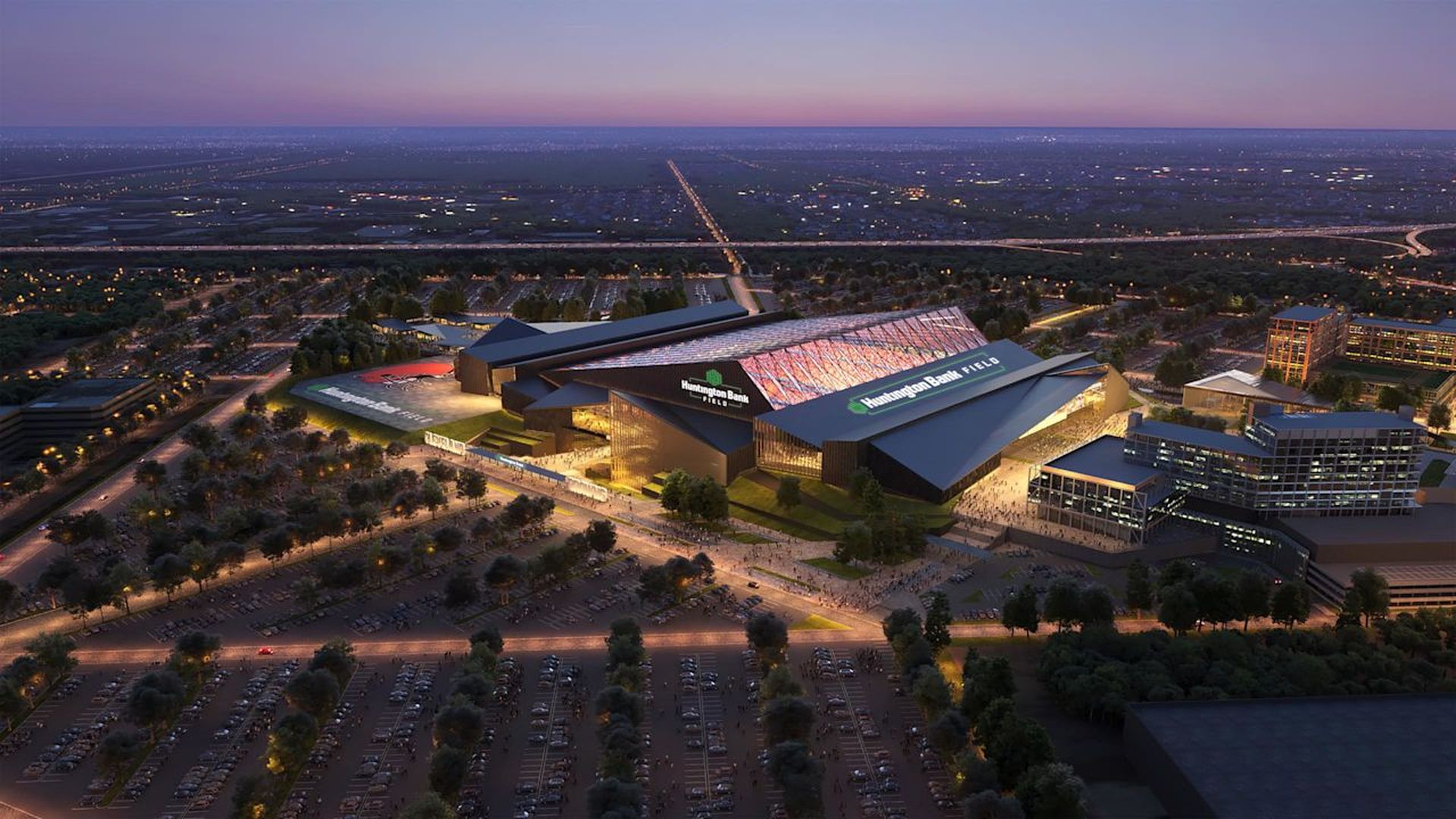
The proposed covered Browns stadium in Brook Park. Rendering: Courtesy of HKS Architects/Cleveland Browns
The Browns' new stadium in Brook Park just got more expensive, and the Haslams want credit for taking on an increased slice of the funding pie.
Driving the news: The price tag for the domed facility and its surrounding development has climbed to $2.6 billion, up from $2.4 billion. The Haslams said last week these increases are tied to roofing upgrades that will enhance the natural light.
Why it matters: The public is still on the hook for hundreds of millions of dollars for a private development.
- And the Haslams aren't hurting for cash. Their flagship asset — the Browns — is worth $5 billion more than when they bought it in 2012.
What they're saying: "This is a 50- to 75-year project, and it's really important to get it right from the outset," Jimmy Haslam told reporters in Arizona last week. "Almost everything we did was to make a better experience for the fans."
Between the lines: Team owners and local elected leaders argued for decades that public subsidies for stadiums were taxpayers' civic obligation, as the Cleveland pro sports facilities were all publicly owned.
- Though a pseudo-public entity will be created to "own" the Brook Park facility, this is hardly a public project.
- The Haslams' suburban relocation includes the creation of a stadium district that will capture even more revenue from ancillary commercial and residential properties which they will also control.
By the numbers: Under the updated plan, the Haslams' total contribution will be $1.76 billion (roughly two-thirds of the project cost).
- $600 million from the state via residents' unclaimed funds is currently tied up in court.
- $245 million from the city of Brook Park will arrive via tax-backed bonds.
Zoom out: NFL owners routinely push for as much public funding as they can, even as franchise values soar into the billions.
- The illusion of "public ownership" helps unlock tax advantages, public financing and ongoing subsidies for maintenance and upgrades.
Case in point: Though the Haslams may be ponying up for initial construction costs, they expect the public to maintain the facility as it ages.
- The Browns support tripling the sin tax, which would generate roughly $400 million over 30 years for the team.
What's next: Site work has begun, with a ceremonial groundbreaking set for April and a target opening in 2029.
💭 Sam's thought bubble: In Chicago this week, one of the biggest local debates sounds awfully familiar.
- The Bears are weighing a move out of historic Soldier Field on the Chicago lakefront in pursuit of a larger, privately controlled stadium district.
Why it matters: Like the Browns, the Bears are chasing more control over revenue, and public subsidies wherever they can find them.
Friction point: The relocation decision has created a bidding war between Indiana and Illinois — in what most economists have agreed is a race to the bottom.
- Indiana has already passed a law to help finance a new stadium in Hammond, directly across the state line.
- Illinois lawmakers are now scrambling to respond with their own package.
Axios Chicago colleague Justin Kaufmann tells us the saga has dragged on long enough, but that he and other fans hope there is a way for the team to stay in Chicago.
- "There's nothing like watching a Bears game on the lakefront with the skyline in view," he says. "It'd be a shame for fans to lose that amazing experience over tax breaks."
Reality check: The Bears have said they'll pay for the stadium privately, but are nevertheless seeking $855 million in public funding for infrastructure.
The bottom line: Cleveland knows this playbook all too well. Teams leverage relocation threats to extract public dollars and then frame it as economic development.
What we're watching: U.S. Rep. Greg Casar (D-Texas) and U.S. Sen. Bernie Sanders (I-Vt.) have introduced federal legislation that would require owners of professional sports teams to give their community a chance to buy the team before relocating.