Cleveland's unsolved museum bombing, 55 years later

Add Axios as your preferred source to
see more of our stories on Google.
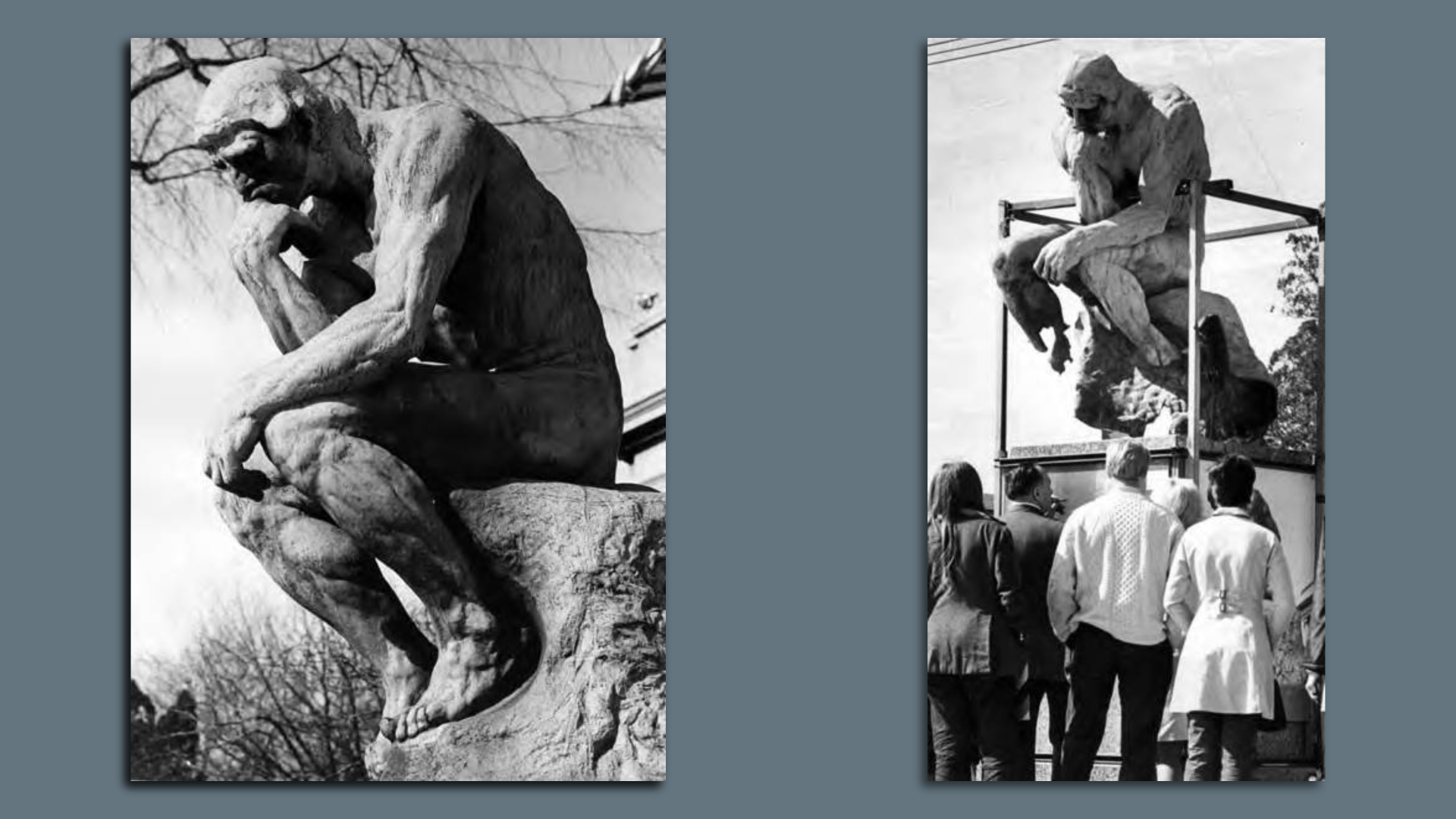
"The Thinker" in Cleveland, before and after the explosion. Photos: The Cleveland Press Collection via the Cleveland Memory Project
Fifty-five years ago this week, unknown parties planted a pipe bomb at the base of Auguste Rodin's "The Thinker" statue outside the Cleveland Museum of Art.
- The resulting explosion — in the early morning of March 24, 1970 — shattered the base of the statue and sent shrapnel flying as far as 500 feet, according to news coverage at the time.
Why it matters: It remains one of Cleveland's most perplexing unsolved crimes.
The big picture: The famous sculpture, crafted as a likeness of the Italian poet Dante Alighieri, was first designed as part of a larger Rodin work, "The Gates of Hell," in Paris.
- The enlarged version in Cleveland was one of fewer than 10 duplicates cast during Rodin's lifetime under the artist's supervision.
Flashback: It was installed outside CMA in 1917, shortly before Rodin's death.
Context: The bombing in Cleveland occurred during a moment of revolutionary ferment across the country, driven by opposition to the Vietnam War and police violence against Black people.
- Six weeks after the bombing, Ohio National Guardsmen opened fire at Kent State University, killing four and wounding nine in what would become one of the most symbolic moments of the Vietnam era.
- On the same day as the shootings (May 4, 1970), the city of Chicago unveiled a rebuilt statue honoring police involved in the 1886 Haymarket Riot — a statue that had been destroyed by a pipe bomb in 1969.
Zoom out: Domestic bombings became increasingly common. In 1976, Cleveland was the most bombed city in the United States, earning the moniker "Bomb City, USA" in the national press.
What they're saying: "Nearly a dozen radical underground groups ... set off hundreds of bombs during that tumultuous decade — so many, in fact, that many people all but accepted them as a part of daily life," Time Magazine recalls.
The intrigue: A message scrawled at the base of the toppled Rodin statue said, "Off the Ruling Class," but none of the radical groups active in Cleveland at the time took credit for the explosion.
- As recently as 2017, CMA received a tip about a potential suspect but was unable to corroborate it.
State of play: The statue was reinstalled in its damaged state after the bombing to serve as a message.
- It "signifies not only the remarkable role that objects play our culture," CMA director William Griswold told the Plain Dealer, "but it is a reminder in its current state of how fragile the social fabric that binds us all really is."