What dismantling the Education Department could mean for Ohio student loans


Add Axios as your preferred source to
see more of our stories on Google.
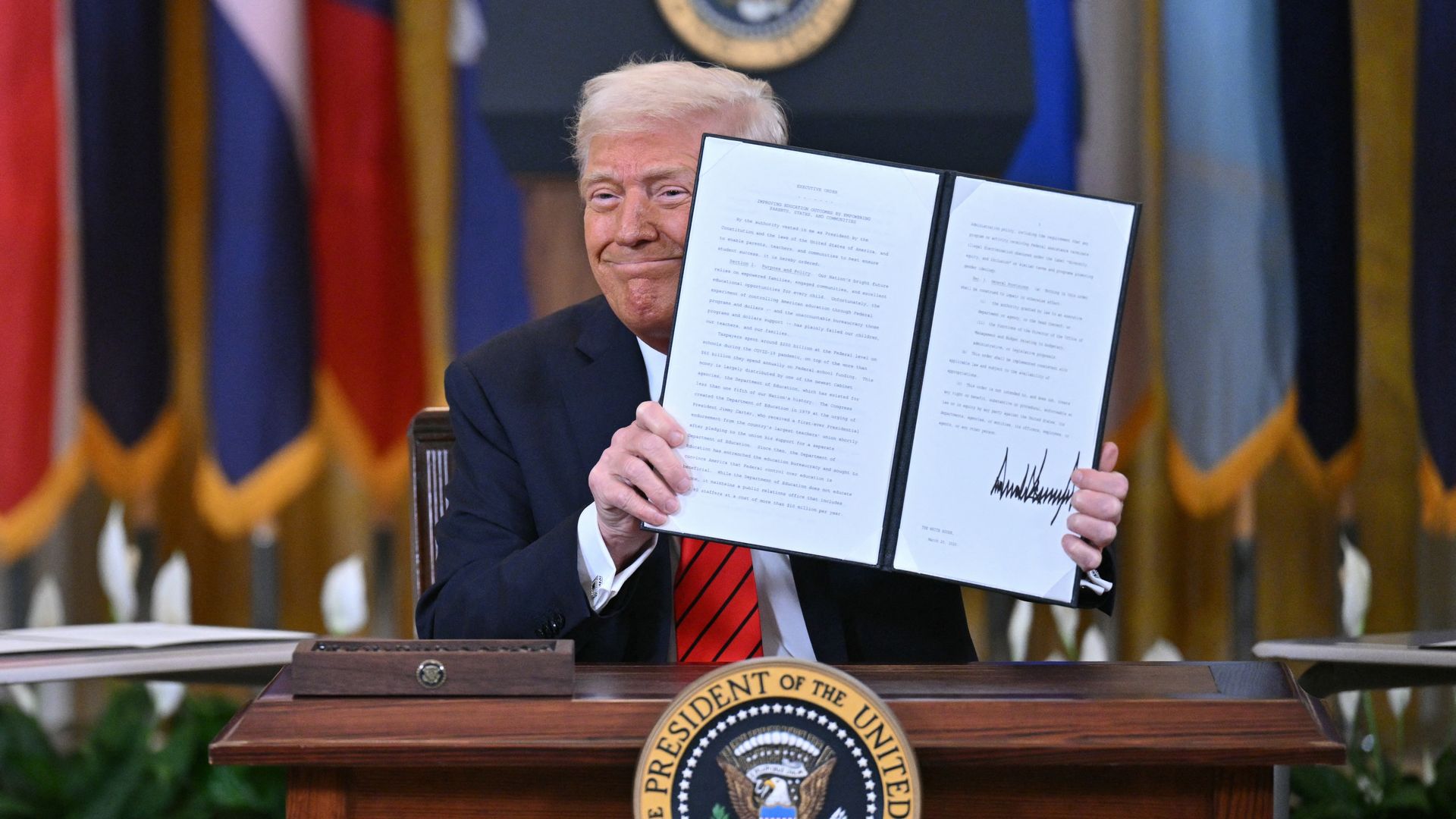
President Trump holds up an executive order signed during an education event at the White House last week. Photo: Roberto Schmidt/AFP via Getty Images
President Trump's executive order last week seeking to close the Department of Education has created uncertainty for student loan borrowers.
Why it matters: The department plays a key role in managing $1.5 trillion in student debt for more than 40 million borrowers, including nearly 1.8 million Ohioans.
- A vast majority of its budget is allocated to the office that oversees student loans.
By the numbers: Ohio borrowers collectively owed $61.7 billion in federal student loan debt as of last year, according to federal data.
- The average debt was about $35,000, per an Education Data Initiative analysis.
Reality check: The directive will likely face legal opposition because eliminating a federal department requires an act of Congress.
- However, the administration can cut key funding in the meantime.
What they're saying: "Democrats want federal bureaucrats to control your child's school," wrote Rep. Jim Jordan (R-Urbana), who represents Mansfield and Ashland, on X.
- "Republicans want to give parents the choice to do what's best for their children."
The other side: Reps. Emilia Sykes (D-Akron) and Shontel Brown (D-Warrensville Heights) are vocally opposed to Trump's plan.
- Rep. Joyce Beatty (D-Columbus) called the department "a pillar of opportunity for students across Ohio and the nation," and pledged to "fight back against any attempt to undermine our children's future."
State of play: Trump is delegating student loan operations to the Small Business Administration.
- The Department of Health and Human Services will oversee special needs and nutrition programs.
Zoom in: During the transition to SBA, there could be slower processing times for loans, applications and payments, and the potential for more administrative errors.
- While it's possible there could be a pause in borrowers' payments for a period, they'd still eventually be due.
Between the lines: Pell grants, subsidized loans and work-study grants are mostly congressionally appropriated. It would take an act of Congress to get rid of them.
- So, if the Education Department shutters, these too would need to be managed by a different agency but wouldn't necessarily go away.
Zoom out: If federal student borrowing is put in jeopardy, some may turn to private loans.
- With federal loans, the interest rate is determined by the year the loan originated, not by the characteristics of the borrower. Everyone gets the same terms.
- There are no student debt forgiveness programs with private loans, and income-based repayment options are not guaranteed.
The bottom line: "If you're a current federal borrower and you're concerned, the best proactive step is to save your information," NerdWallet's lending expert Kate Wood told Axios before the executive order was issued.
- Go to studentaid.gov and screenshot or download your repayment history, she added.
Note: This story has been updated with comment from Rep. Joyce Beatty.