Cleveland City Council passes new ward map

Add Axios as your preferred source to
see more of our stories on Google.
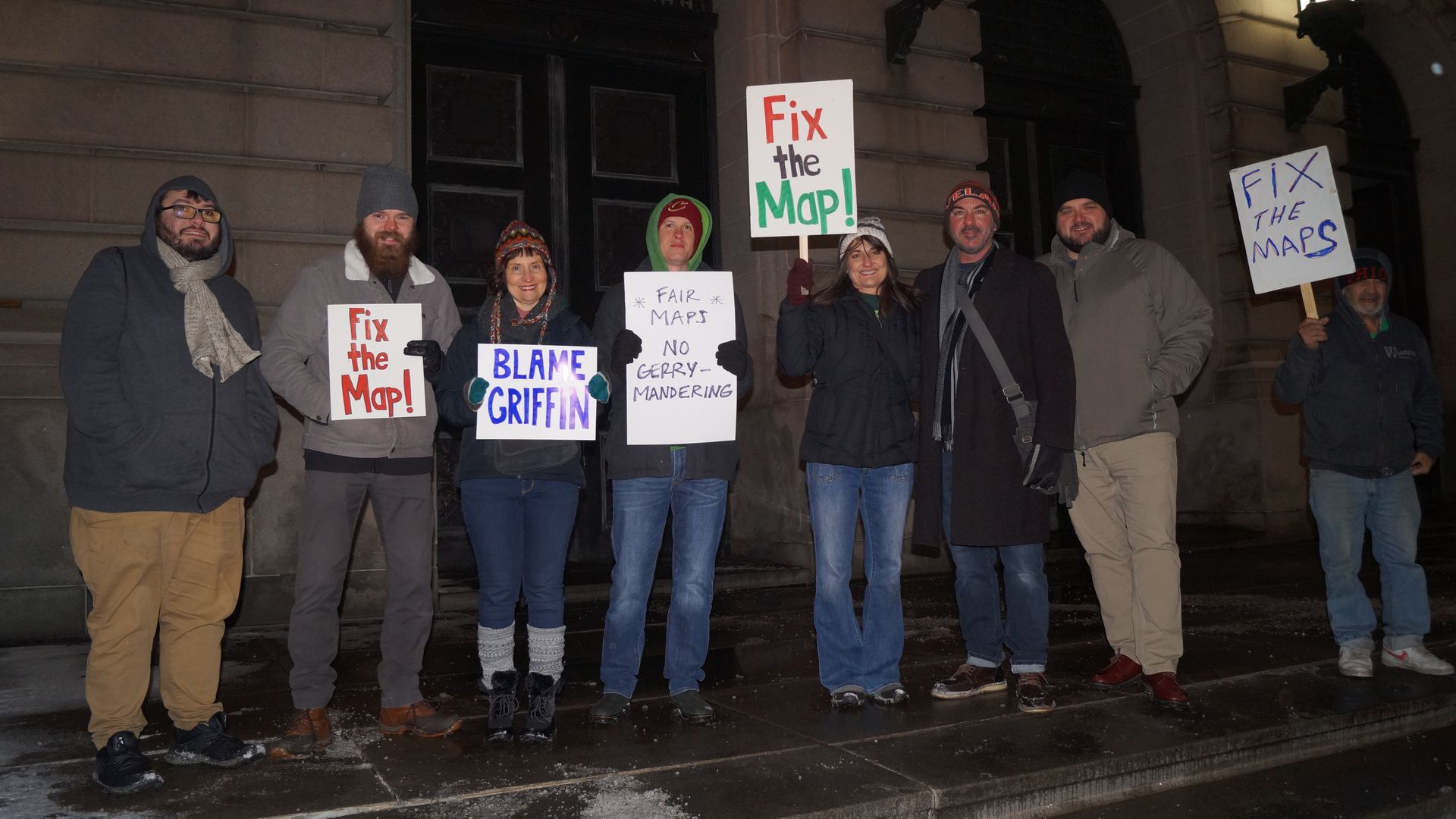
Demonstrators on the steps of Cleveland City Hall protested Monday's passage of a new ward map. Photo: Sam Allard/Axios
Cleveland City Council approved a new ward map Monday evening over the objections of protesters inside and on the steps of City Hall.
Why it matters: The map reduces the number of city wards from 17 to 15 for the 2025 election.
- Councilwoman Rebecca Maurer and Councilman Brian Kazy voted in opposition.
Catch up quick: Cleveland voters passed a charter amendment in 2008 tying the number of wards to the overall population (roughly 25,000 residents per ward). Based on the 2020 census, council is forced to shed two seats.
- Council President Blaine Griffin invited the public to submit maps of their own and has painted the process as more open and transparent than previous efforts, though it has still proved controversial.
What they're saying: "The crux of the problem is that they're splitting up neighborhoods, while targeting potential challengers and protecting incumbents," said Nikki Hudson, of the group Coalition for a Better Cleveland, who protested last week at Shaker Square and again Monday night at City Hall.
- In a statement, the group alleged blocks and institutions will be "gerrymandered" — including CSU, with parts of its downtown campus in two new wards, and Shaker Square, with the western corners of the Square in a different ward than the east.
Friction point: Other groups have also voiced criticism. In a Jan. 2 letter, the League of Women Voters claimed the new map was drawn without meaningful public engagement, that "communities of interest" will be divided, and that wards were drawn to ensure incumbents' reelection.
- "This entire process has been incredibly disappointing considering that City Council unanimously passed a resolution in support of Issue 1, the statewide effort to take Ohio redistricting out of the hands of politicians," the letter read.
- "However, we have not seen that same commitment to fairness, transparency, and public engagement during this process."
The other side: Councilman Kerry McCormack defended Griffin in remarks Monday, saying that perfection would have been impossible in a city as oddly shaped as Cleveland.
- He characterized the resident opposition as "ridiculous and performative" and guided by misinformation.
Between the lines: Local independent journalist Richard Andrews wrote in a weekend dispatch that Griffin deserves credit for repairing the "major monstrosities" of the existing map.
- He claimed that map's contours on the east side were shaped in 2013 by former Council President Marty Sweeney to protect a political ally and punish an opponent.
- Andrews believed it was self-evident, however, that the dismantling of Rebecca Maurer's ward was done on purpose.
The last word: "I understand that when you go from 17 council members to 15, there are going to be politicians who lose. It's going to be musical chairs," Maurer said.
- "But we do not have to play musical chairs with our neighborhoods."