CMHA disputes portions of damning HUD audit

Add Axios as your preferred source to
see more of our stories on Google.
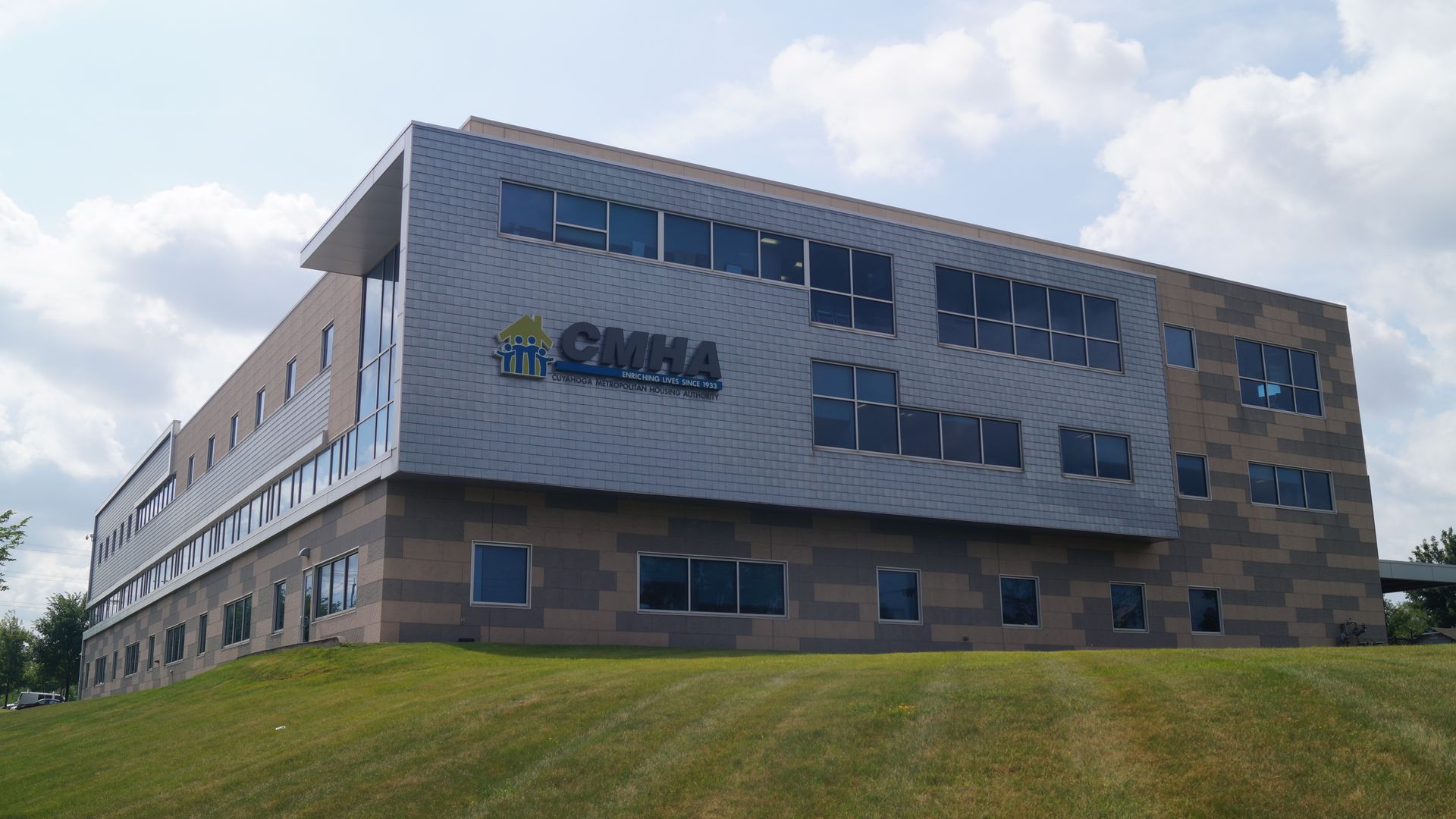
CMHA HQ on Kinsman. Photo: Sam Allard/Axios
Officials with the Cuyahoga Metropolitan Housing Authority (CMHA) have partially rebuked a damning federal audit related to lead-based paint in Cleveland public housing.
Driving the news: Last month's audit, from the U.S. Department of Housing and Urban Development's inspector general, found that CMHA did not adequately communicate lead hazards to tenants and failed to properly investigate 10 cases of children with elevated blood lead levels (EBLL).
Why it matters: Lead-poisoning rates in Cleveland are nearly four times the national average, per Cleveland Clinic, and can cause long-lasting cognitive and behavioral impairments in youth.
- The problem has plagued the city for decades, and the local health department still investigates 300 cases of EBLL every year.
State of play: In response to grassroots local advocacy, Cleveland passed housing legislation in 2019 requiring residential rental units built before 1978 to be certified as lead safe.
- Lagging compliance with the law prompted City Hall to retool its approach earlier this year, focusing on single-family rentals and properties with two or three units.
- CMHA units are under federal oversight and therefore not subject to Cleveland's law.
What they're saying: CMHA CEO Jeffrey Patterson and chief of staff Jeffrey Wade took responsibility during a City Council hearing last week for the communication issues identified in the HUD report.
- But Wade denied the audit's finding that CMHA insufficiently investigated EBLL cases. He said all the proper inspection and safety protocols took place at CMHA units, but that formal reports were not submitted to HUD.
- "The deficiency the IG identified was not one of substance, it was one of form."
Zoom in: Cleveland health director David Margolius said CMHA referred EBLL cases to the city department of public health as required and the department determined that CMHA units were not the source of the lead poisoning.
- "The headline should be that the work to prevent future lead poisoning never stopped," Margolius said.
The other side: "I disagree," Councilman Kevin Conwell replied. "The headline should be that [CMHA] didn't follow HUD protocol."
- Councilwoman Rebecca Maurer wasn't fully convinced by CMHA's testimony either.
- In five of the 10 EBLL cases, the report found, CMHA painted over deteriorating paint in units before an investigation could be completed, compromising results.
- Under questioning from Maurer, Wade said investigations at those units had in fact occurred before painting, but were not documented.
The big picture: CMHA was the first public housing authority in the United States and maintains 10,500 units, more than 6,000 of which were built before 1978.
- CMHA's long-term lead abatement strategy is demolition and reconstruction, said Patterson, its CEO.
What's next: In the meantime, in response to the audit, he said all units built before 1978 will be retested for lead and placed on a new repainting cycle to ensure that old layers of lead paint are sealed.
- Additionally, he said CMHA rolled out a new computer records system to track complaints and automate lead hazard disclosures to tenants.
Between the lines: The grassroots group Cleveland Lead Advocates for Safe Housing submitted recommendations to Cleveland City Council arguing the city should bring CMHA under its Lead Safe Housing law to provide "complementary oversight" alongside HUD.
- Emily Collins, Mayor Justin Bibb's senior adviser on lead, said lawyers would have to determine whether a local law could preempt federal law in this case.
The bottom line: Despite CMHA's reframing of the HUD audit, Councilwoman Rebecca Maurer said the report "opens a wound that has been festering in this city for decades."
- "For generations, we've gone through cycles where this city says, 'We're going to deal with lead. Our children matter. We're going to get this done.' And then it doesn't happen," she said.
- "When the report was released, it cracked that wound wide open."