The state of same-sex marriage in Ohio


Add Axios as your preferred source to
see more of our stories on Google.
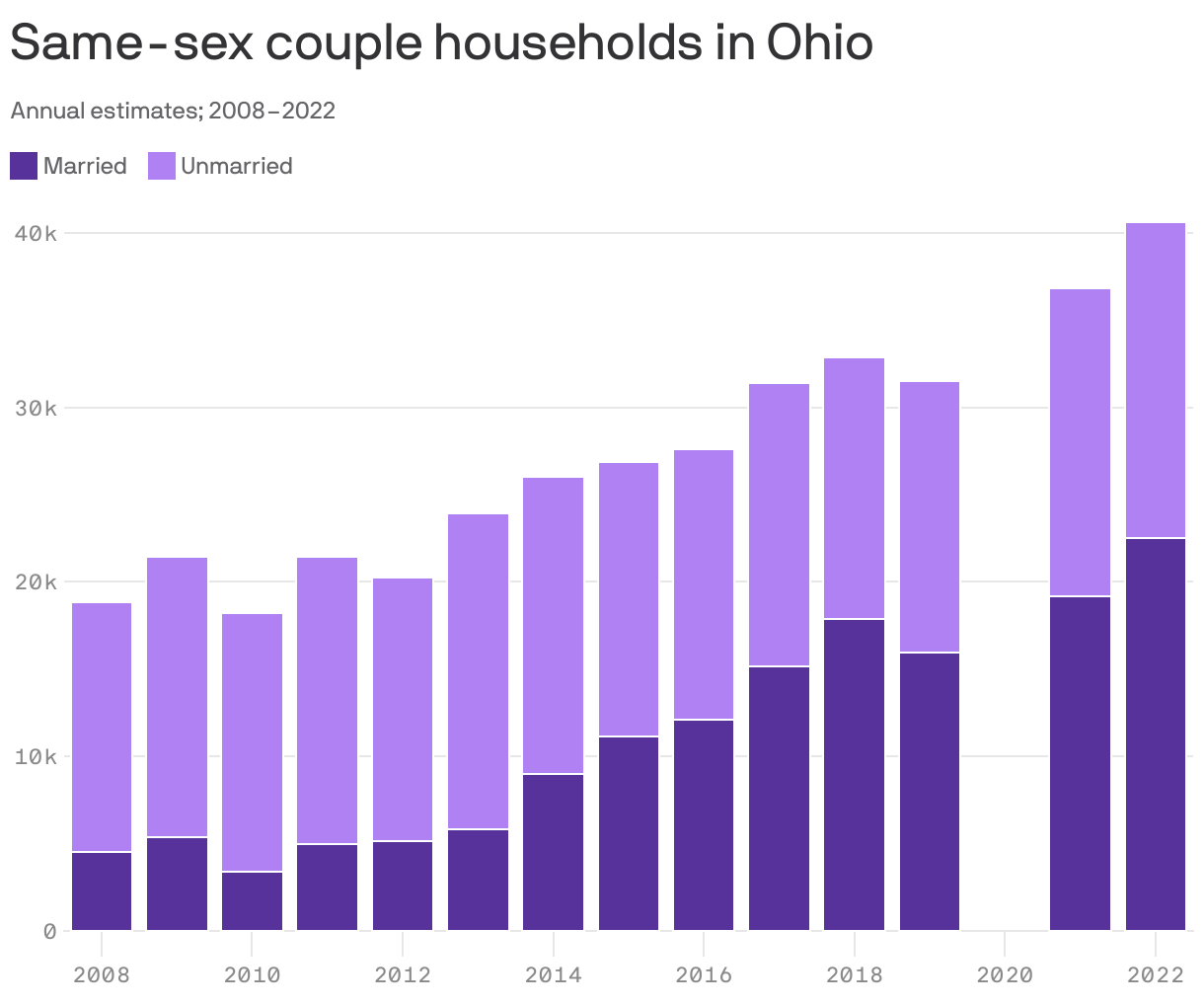
The number of same-sex married couples in Ohio has increased substantially since the Supreme Court's 2015 decision legalizing them nationwide.
Why it matters: The landmark ruling, Obergefell v. Hodges, requires states to license and recognize same-sex marriage, including in Ohio, where 6.2% of the population identifies as LGBT — the 14th-highest percentage of any state.
Flashback: Same-sex marriage was banned in Ohio prior to that 2015 ruling, though several other states had already legalized it.
By the numbers: About 22,500 Ohio same-sex couples identified as being married as of 2022, per the American Community Survey (ACS), up from nearly 9,000 in 2014.
- 55% of same-sex couple households were married couples as of 2022, compared with just 34.5% the year before the ruling.
The big picture: There were about 741,000 married same-sex couple households in America as of 2022, up from about 335,000 in 2014.
- 58% of same-sex couple households were married as of 2022, compared with just 42.8% in 2014.
Zoom out: Among U.S. states, Delaware (81.4%), New Hampshire (72.3%) and Wyoming (70.7%) have the highest share of households with same-sex married couples.
- Washington, D.C. (48.2%), Alaska (48.1%) and Tennessee (47.9%) have the lowest.
Between the lines: An unenforceable ban on same-sex marriage remains in Ohio law.
- The Ohio Revised Code states: "A marriage may only be entered into by one man and one woman" and "Any marriage entered into by persons of the same sex in any other jurisdiction shall be considered and treated in all respects as having no legal force or effect."
Yes, but: Although the U.S. Supreme Court's Obergefell v. Hodges decision cannot change a state law (only lawmakers can do that), it did render the Ohio ban unconstitutional and, thus, unenforceable.
Reality check: Obergefell v. Hodges protected the right to marry at the federal level, but lawmakers in Ohio and elsewhere are still seeking to curtail LGBTQ+ rights in other ways.
- Lawmakers banned gender-affirming care for children and barred transgender athletes from playing on girls' and women's K-12 and college sports teams, but a Franklin County judge temporarily blocked the law's enforcement.