The legacy of Brown vs. Board of Education in Cleveland


Add Axios as your preferred source to
see more of our stories on Google.

Black children and their moms in the early days of Cleveland busing. Photo: Bettman via Getty Images
Racial segregation in schools has increased dramatically nationwide over the last three decades, according to two new reports and an Axios review of federal data.
Why it matters: As the U.S. marks the 70th anniversary of the landmark Brown v. Board of Education ruling today, American public schools — including those in Cleveland — are growing more separate and unequal even though the country is more racially and ethnically diverse than ever.
- Researchers have found school segregation disproportionately hurts Black and Latino students, because those schools tend to have fewer resources, higher teacher turnover and fewer advanced classes.
State of play: Schools on average have become less white and more Latino, Asian American and multiracial.
- But students of color are going to schools with fewer white students and fewer resources, a UCLA Civil Rights Project report found.
- Though 45% of all U.S. students were white, the typical Black student attended a school that was 76% nonwhite in 2021.
- The average Latino student went to a school that was 75% nonwhite.
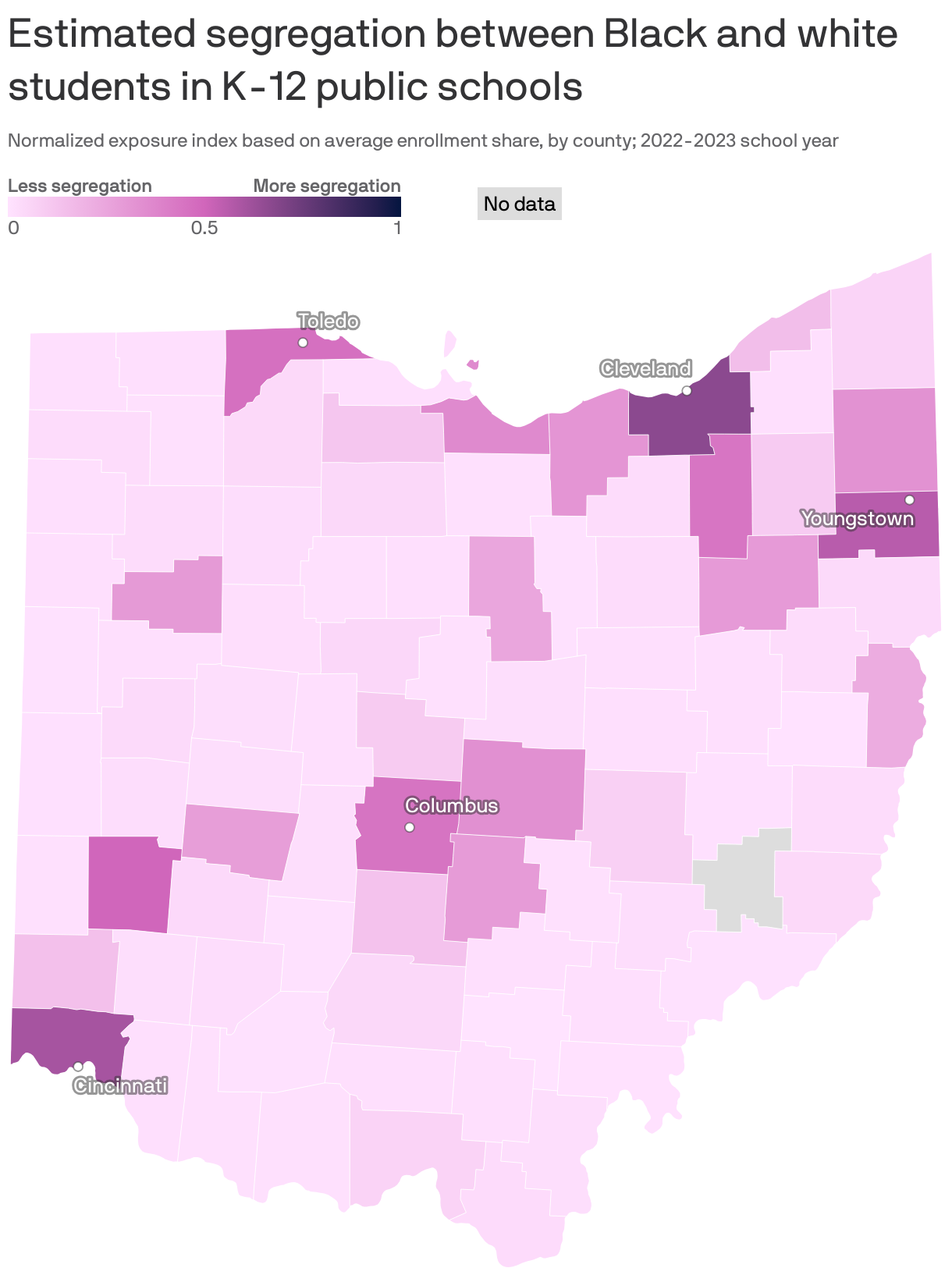
Zoom in: Segregation levels in the Cleveland Metropolitan School District more than quintupled from 1991 to 2022, according to data from The Educational Opportunity Project at Stanford.
By the numbers: CMSD is now only 14% white. Across swaths of the northeast and southeast sides, many Cleveland schools have fewer than 2% white students.
- Schools in Cuyahoga County are the most segregated in Ohio and are among the most segregated nationwide.
Flashback: A federal judge in Cleveland enjoined the school district to desegregate in 1978, setting in motion a contentious busing plan to achieve racial balance.
- Through the 1980s, white families fled to the suburbs, creating a majority nonwhite school district and exacerbating racial divides.
- In 1998, a federal judge declared that "the purposes of [Cleveland's] desegregation litigation have been fully achieved."
The bottom line: Twenty-five years after that declaration, local schools have moved in the wrong direction.