Developers don't expect parking minimums law to change much

Add Axios as your preferred source to
see more of our stories on Google.
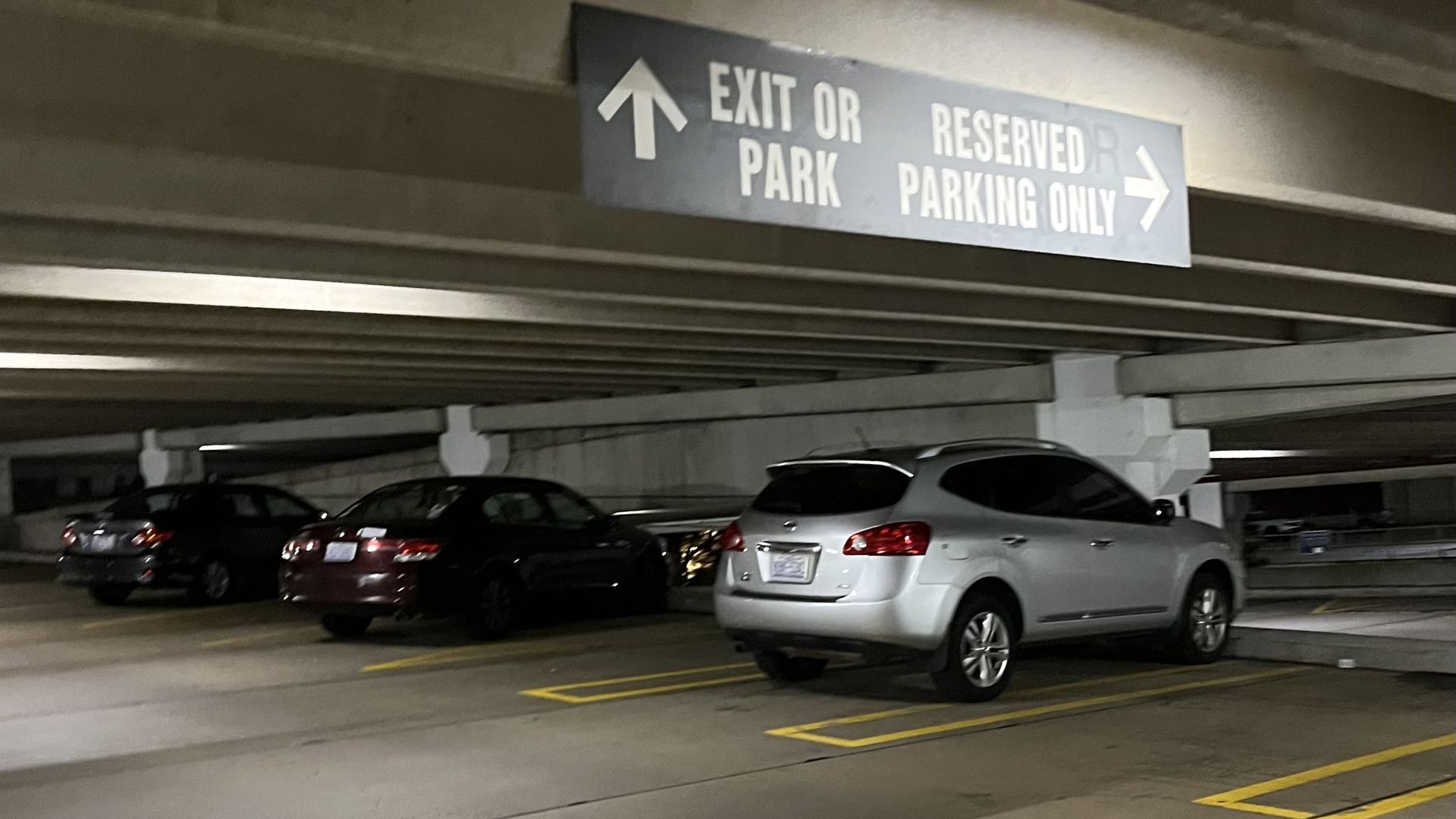
Photo: Alexandria Sands/Axios
Most Charlotte developers don't expect to build less parking after a law eliminates off-street parking minimums for new construction next year.
Why it matters: The law, which passed with overwhelming bipartisan support, has sparked concerns that developers will stop building parking altogether and instead pocket the profits.
What they're saying: Greystar development director Andrew Phelan says that's not the case. He says Greystar bases parking decisions on market demand — not government mandates — and typically builds above municipalities' required parking counts anyway.
- "It's great from a legislative standpoint. It gives you more flexibility," he says. "But in the city of Charlotte, people like to drive."
By the numbers: In Mecklenburg County, 94.2% of households have at least one car, according to U.S. Census data. Only 5.8% have none.
- Greystar typically builds around 1.3 spaces per apartment, or about 13 spaces for every 10 apartments. It will consider dropping to 1.2 in more urban neighborhoods like South End. Any lower than that — even 1.1 — can make a building difficult to lease, Phelan says.
- Phelan says Charlotte's lack of walkability — not parking mandates — is what really prevents developers from reducing parking counts and ultimately passing those savings on to renters.
The big picture: Supporters of the bill say ending parking minimums will prevent excessive paving and lower housing costs.
- Upon signing the bill, Gov. Josh Stein noted North Carolina is projected to be 750,000 homes short of what it needs by 2029. He added that parking lot requirements can add $200 to $300 a month to residents' rents.
Yes, but: Developer David Ravin says even though a single space can cost $20,000 to $30,000, his company Northwood Ravin still usually exceeds the parking minimums set by municipalities.
- He doesn't expect to adjust any plans in the development pipeline to reduce parking until there are more transit options in Charlotte.
- "Especially in the Southeast, people are pretty car dependent, and they're expecting a parking space," Ravin says.
Developer Space Craft is perhaps best known for building minimal parking with its multiple "car-optional" apartment communities along the light rail in Optimist Park.
- "The elimination of parking minimums doesn't mean the elimination of parking," CEO Harrison Tucker says. "It simply gives developers the flexibility to provide the appropriate amount of parking based on the location and the people who will actually live there."
The bottom line: As long as Charlotte relies on cars, this law may not make that much of a difference.
- The law goes into effect Jan. 1.