The federal agency that shook Charlotte left behind few answers

Add Axios as your preferred source to
see more of our stories on Google.
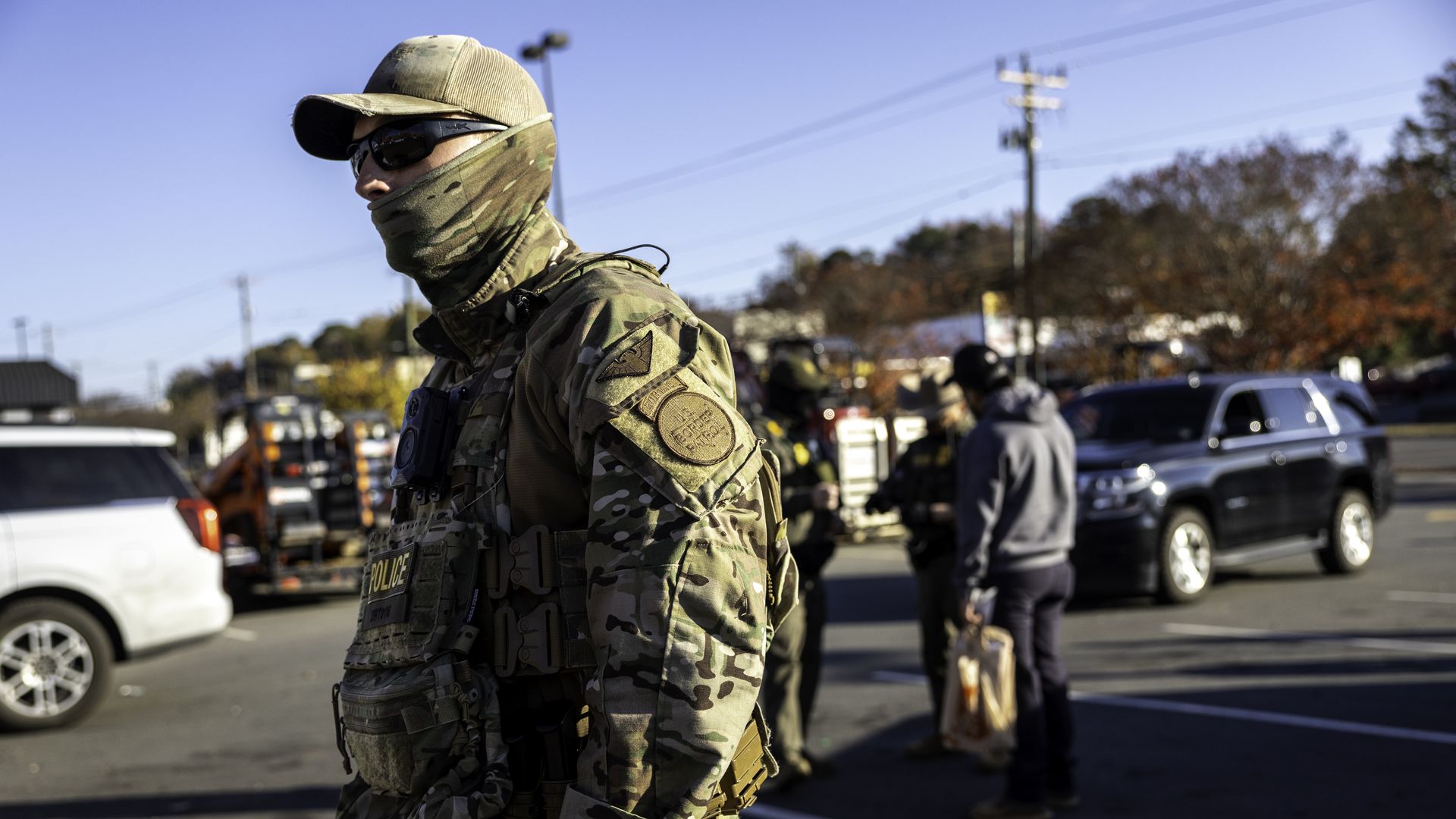
U.S. Border Patrol agents outside a Home Depot on Nov. 19 in Charlotte. Photo: John Moore/Getty Images
Nearly five months after the Trump administration surged Border Patrol agents into North Carolina, the Department of Homeland Security has shared little about Operation Charlotte's Web and its reported 1,300-plus arrests beyond what lawsuits have revealed.
Why it matters: The federal agency that for more than two weeks disrupted daily life, prompting economic upheaval and public school absences, appears to answer to few, critics say, and may be violating transparency laws fundamental to U.S. democracy.
State of play: Much of the information about Operation Charlotte's Web, launched Nov. 15, has emerged from lawsuits.
- DHS put out several news releases, handpicking arrestees to identify to back up its claim that the Charlotte operation was targeting the most violent criminals, blaming the region's Democratic leaders for not honoring ICE detainers.
Case in point: Among the first 44 people detained, for one of the "worst of the worst," DHS mentioned only a bench warrant and an illegal entry charge.
- The agency has directed Axios, when seeking information, to its Freedom of Information Act (FOIA) portal, which says requests are pending. Federal agencies are generally required to respond to FOIA requests within 20 business days.
- A DHS spokesperson didn't respond to Axios' request for comment.
- Greg Bovino, who oversaw the Charlotte operation but was removed from his role as Border Patrol chief earlier this year, defended the agency's local actions as necessary for protecting the public.
What they're saying: Pate McMichael, director of the North Carolina Open Government Coalition, says rather than DHS backing up statements with public records, "we're being asked to take their word for it."
- "It's a very dangerous thing for the government to be doing. It is an abuse of power," he says. "They're not following the law, and that's why they're getting sued, and that's why they're losing."
What they found: The Deportation Data Project, a team of academics and lawyers, obtains data by filing FOIA suits.
- According to an NC Local analysis, just 30% of the more than 1,100 people arrested in North Carolina operations between Nov. 15 and Dec. 31 had been convicted of a crime.
- Less than 40% had pending criminal charges.
Between the lines: DHS is exempt from releasing names and identifying information due to privacy concerns, an attorney with the Deportation Data Project tells Axios.
- However, DHS maintains a "Worst of the Worst" webpage where it highlights some arrests, but it has stopped updating an online dashboard with neutral statistics.
- "DHS is releasing this information when it benefits DHS's narrative," says Kyle Virgien, an attorney with the American Civil Liberties Union Foundation, another organization that often sues for documents. "It's not releasing this information when it might help these people get help."
Zoom out: Immigration attorneys say they are increasingly struggling to get FOIA requests fulfilled to represent their clients.
- The American Immigration Council is suing the U.S. Citizenship and Immigration Services for rejecting requests for A-files, records of immigration history.
- Charlotte attorney Andres Lopez says he's found that DHS over-redacts or withholds documents, preventing cross-examination in court.
- "That's absolutely prejudicial, absolutely contrary to law," Lopez says.
Catch up quick: Even U.S. Sen. Thom Tillis, a Republican, has been stonewalled when trying to find out what happened during Operation Charlotte's Web.
- In February, he wrote a letter to Kristi Noem, then-secretary of Homeland Security, seeking clarification on whether U.S. citizens had been detained and subject to force. He's requested information on stops involving citizens, total arrests and prior convictions.
- "All I asked for — if it had to be anonymized — was information so that I could determine if your hit rate is right," Tillis said in a March 3 hearing where he called for Noem's resignation.
- Tillis' request was prompted by local reporting, including a WSOC story about a citizen who said he was detained twice in the same morning on South Boulevard. The man said he showed his documentation yet was still handcuffed in a van for questioning.
- Since Noem's firing, Tillis has supported her successor, Markwayne Mullin. A spokesperson for Tillis said he is still working to get answers to his questions.
The bottom line: Lopez and others say the lack of transparency raises questions about DHS's intentions.
- "It means that they know that what they do is wrong," Lopez says. "Until Congress does its job of putting some guardrails around their behavior, nothing's gonna change."