Charlotte faith leaders push back on Trump's immigration agenda


Add Axios as your preferred source to
see more of our stories on Google.
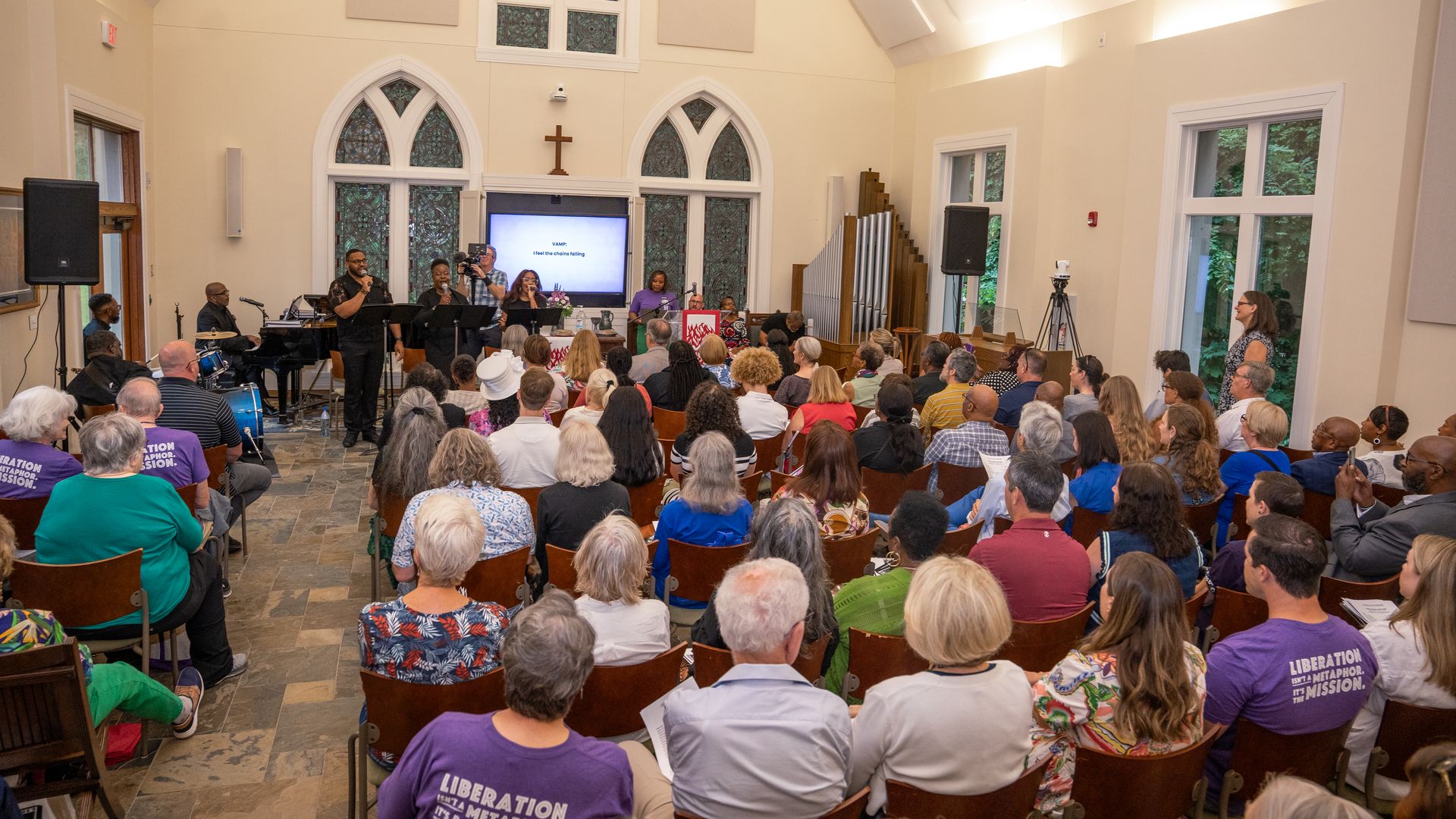
A church service at Collective Liberation Church. Photo: Courtesy of Collective Liberation Church
When asked about President Donald Trump's domestic policies, Charlotte-area pastors often cite Matthew 25:35-40, a Biblical parable that calls for Christians to care for the less fortunate.
Why it matters: Christians, particularly conservative evangelicals, have supported Trump in the past. Now, many moderate and progressive Christians across the U.S., including in Charlotte, are challenging the president's administration around immigration, civil rights and poverty.
What they're saying: The Trump administration's policies are "antithetical to the Bible," which calls for people to treat immigrants as neighbors and to make sure you're not harming them, Collective Liberation Church lead pastor Rev. Benjamin Boswell tells Axios.
Driving the news: News of U.S. Border Patrol agents coming to Charlotte has sent fear throughout Charlotte's large immigrant community.
- Collective Liberation Church has been partnering with the Carolina Migrant Network, which provides free legal representation to individuals detained by Immigration and Customs Enforcement, Boswell says.
- Bishop Michael Martin of the Catholic Diocese of Charlotte, which covers 46 counties in the western half of North Carolina, says the Catholic Church stands with immigrants regardless of their status, per a statement provided to Axios from the Diocese.
- "These are moral issues, and to not deal with them is sinful, according to biblical and faith traditions," Rev. William Barber of the Goldsboro-based Repairers of the Breach told Axios recently.
Go deeper: U.S. Catholic bishops call for end to "dehumanizing rhetoric" on immigrants
Between the lines: White evangelicals still strongly approve of Trump (72%), but that's a drop from the 85% who voted for him in 2024, according to the nonpartisan group Public Religion Research Institute's recent survey.
Zoom in: Charlotte, which has been called the city of churches, has progressive Christian churches, moderate ones and those aligned with Christian nationalism.
- Many pastors in moderate churches are afraid of causing conflict within the church or losing donors who support Trump, Boswell says.
- Axios spoke with a United Methodist pastor who asked to remain anonymous because many in his congregation support Trump. This pastor described the president's policies as "abhorrent ... The fact he has so much support from many people of faith saddens me."
- The United Methodist pastor says he preaches on themes like justice and inclusion rather than directly speaking against the administration's policies.
The other side: The Trump administration recently made an ICE recruiting video with the Bible verse Isaiah 6:8, in which Isaiah responds to God's call by saying, "Here am I, send me."
- MAGA influencers said the video was a call to serve in a capacity that God might want.
- Axios reached out to several area pastors who have shown support for the president or the Republican Party. They either did not respond to our request for comment or declined our interview request.
State of play: Churches across Charlotte have stepped in to help the community amid a lack of resources, such as Supplemental Nutrition Assistance Program benefits, amid the longest government shutdown in U.S. history. While the shutdown recently ended, its disruptions linger.
- "There's only so much that can be done through churches and nonprofit organizations," Boswell says, a sentiment echoed by nonprofits and local government leaders.
- "Instead of fighting poverty, Trump has decided to fight the poor," says Rev. Rodney Sadler, who is also a pastor at Collective Liberation Church.
- The church is working with local nonprofits, including Hope Vibes, which provides hot showers, clean laundry and other resources to those experiencing homelessness in Charlotte.
The bottom line: Martin, of the Catholic Diocese of Charlotte, encourages people to consider whether their political views are shaping their religious beliefs or if their religious beliefs are forming their political views.
- "Jesus calls us to the latter," Martin says.