4 quotes from Charlotte's 4 Black mayors

Add Axios as your preferred source to
see more of our stories on Google.
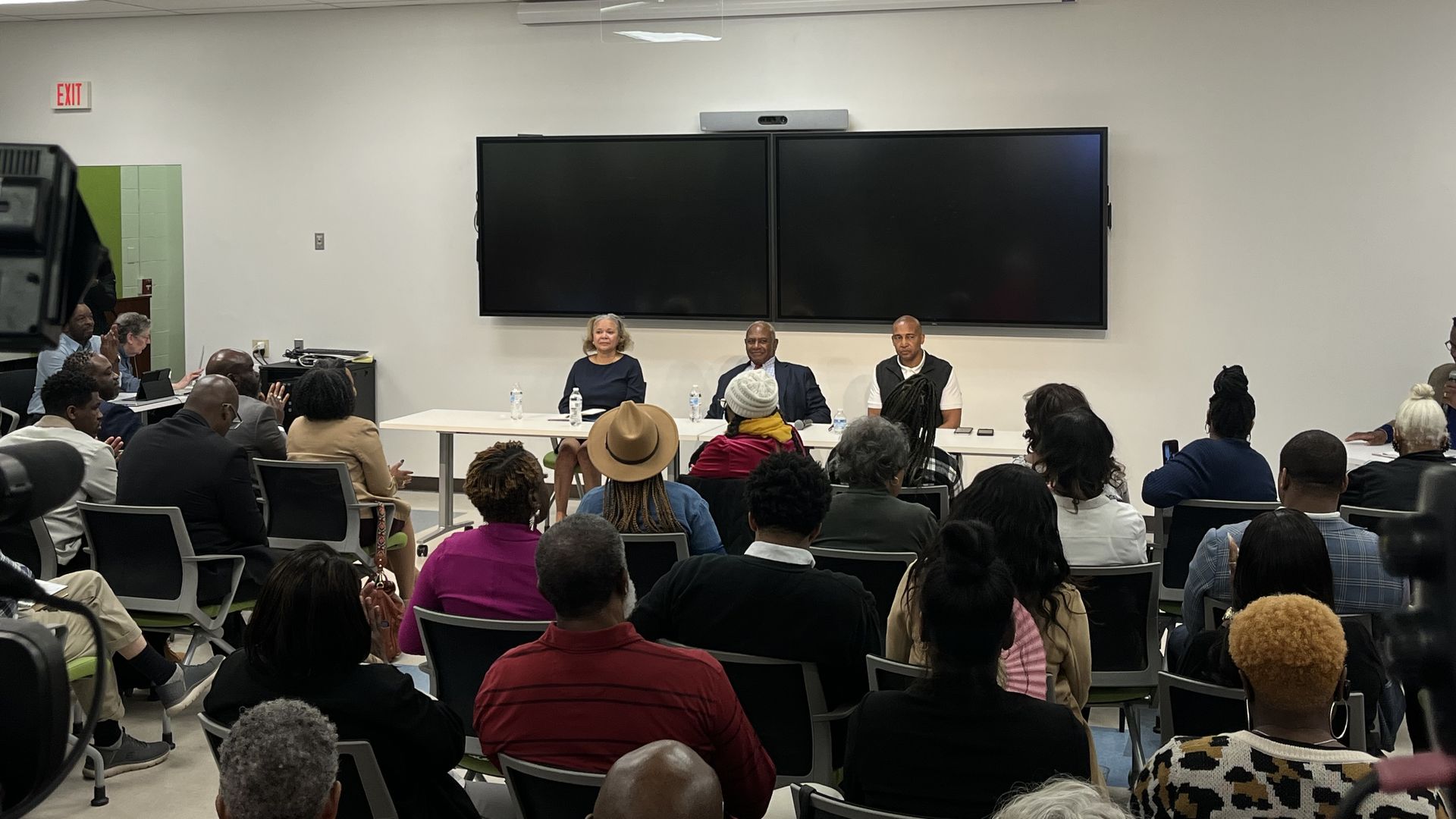
Tuesday's panel drew a packed room to hear from Charlotte's current and former mayors. Seated left to right: Vi Lyles, Harvey Gantt and Patrick Cannon. Anthony Foxx joined briefly via Zoom. Photo: Alexandria Sands/Axios
Charlotte's four Black mayors — some of the city's most prominent living history makers — united for a rare discussion this week at the Sarah Stevenson Tuesday Forum in the Belmont neighborhood.
- During the conversation, they reflected on their upbringings, legacies and the challenges Charlotte faces today. You can watch the full discussion here.
Here are some takeaways from the mayors' remarks:
Vi Lyles: Red Line is "great opportunity"
- 2017 — Present
"If we get the ability to charge that 1-cent sales tax, I promise you this city will change, and it will change for people of color more than anything else."
Why it matters: The Red Line could define the sitting mayor's legacy. The proposed commuter train, connecting Uptown to north Mecklenburg, is decades in the making. The project is finally gaining momentum under Lyles' tenure, and possibly starting construction as soon as 2026.
- Mayor Lyles spoke of how important it is for the city to create a reliable transportation system that moves people to and from work. Mobility is one of the best ways a city can promote economic mobility.
Go deeper: Everything to know about the Red Line
Patrick Cannon: Bring the CIAA back
- 2013 — 2014 (Cannon was arrested in March 2014 after he was elected for public corruption.)
"What sense does it make for us to let something go that's on average bringing in $47 million a year to our city? Creating opportunity for many people that look like us, right? We need to continue to go back, I think, sometimes on some things — not all things — but in order to go forward. And I think we have the leadership here to be able to do that because I believe it's about time for that thing to be up in Baltimore, Maryland. It needs to come back to the city of Charlotte."
Why it matters: The Central Intercollegiate Athletic Association, which has its headquarters in Charlotte, is a historically Black athletic conference that includes Johnson C. Smith University. Charlotte hosted the CIAA's basketball tournament from 2006 to 2020. In 2021, Baltimore outbid the city for the tournament, which was once Charlotte's largest annual event.
- Some suggested the city let the tournament slip away and took it for granted. Bringing it back could be a major boost for Uptown's revitalization and a win for the Black community. The CIAA tournament is described as a celebration of Black excellence and HBCU pride.
- Baltimore is slated to host the tournament through 2026.
- Mayor Lyles says that council member Malcolm Graham reminds her daily, "We're going to get the CIAA."
Anthony Foxx: Still "bullish" on the Gold Line
- 2009 — 2013
- Foxx was the U.S. Secretary of Transportation from 2013 to 2017 under President Obama.
"I'm still very bullish on [the Gold Line]. It has a different challenge than the South corridor line did. The South corridor was built along more or less abandoned industrial sites. The street car's being built in a highly (residential) area. So, the development of it is going to have to be much more careful, and it's got to be done with the community. But we're starting to see the Beatties Ford Road corridor become more of a corridor of opportunity."
Why it matters: The Gold Line, once dubbed the "biggest political football" of Foxx's tenure, faced strong opposition and remains controversial today. Critics argue it fails to move people effectively, and often gets stuck amid traffic.
- Still, CATS is pushing forward with a six-mile expansion, including an additional two miles along Beatties Ford Road. It expects to continue gaining ridership by looking at options like signal priority.
Go deeper: Why CATS is moving forward with the $845M Gold Line streetcar extension
Harvey Gantt: "We have close to a thousand Black millionaires in Charlotte ... Are they visible to you?"
- 1983 — 1987
"We should have gotten to the point where the city is not the major instrument by which we see economic improvement in our people ... I see [the city government] doing the same thing we were trying to do ... 37 years ago. That's not progress to me."
Why it matters: Charlotte's first Black mayor expressed disappointment in the community's partnership toward promoting upward mobility. He says the economy needs the full force of private sector involvement from wealthy Black leaders who build businesses and can join resources.