There's little hope for MeckDems if they can't mend fractures over Black voter turnout

Add Axios as your preferred source to
see more of our stories on Google.
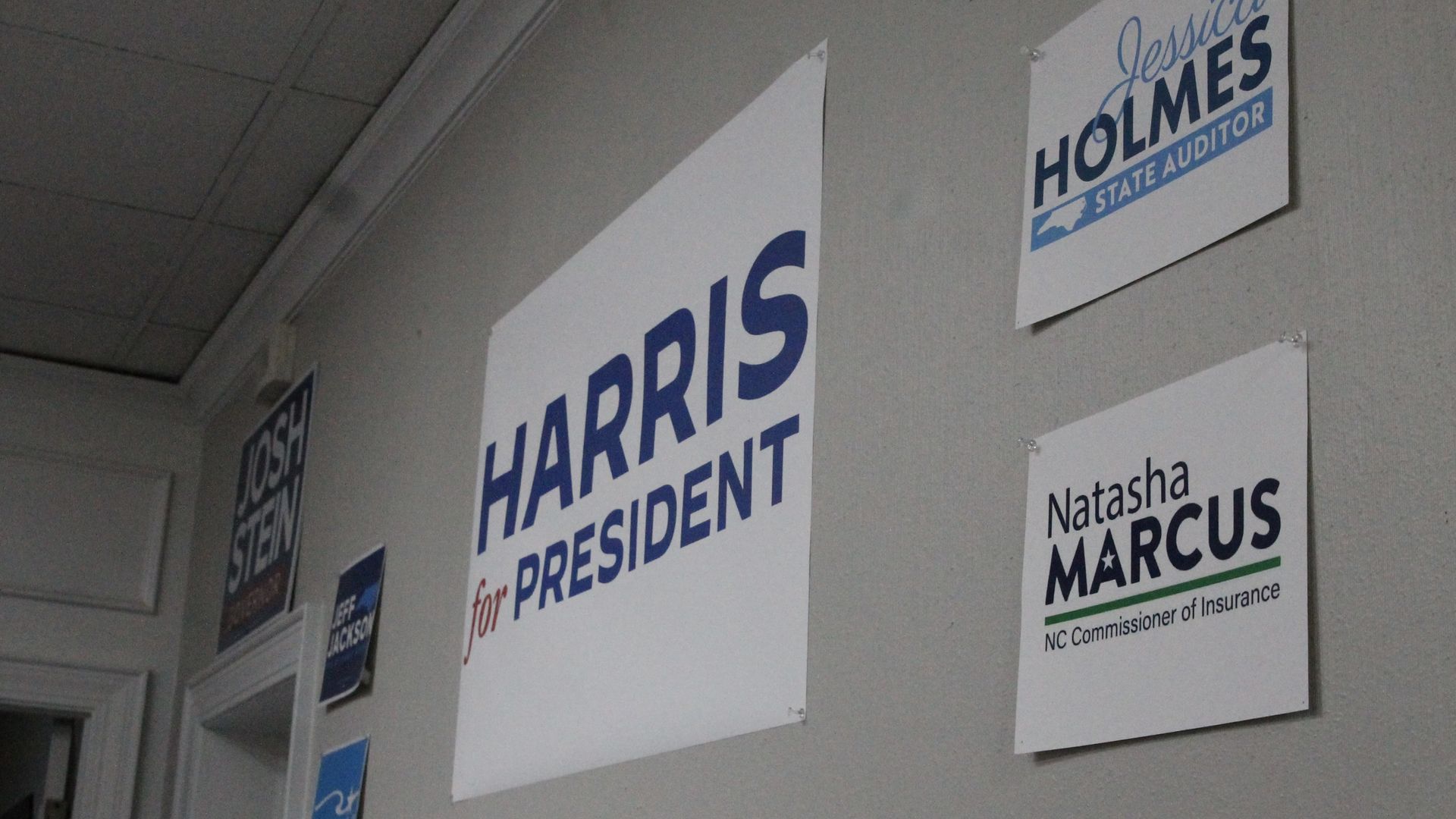
Candidate signs hang in the Mecklenburg County Democratic Party office on East Trade Street. Photo: Alexandria Sands/Axios
Mecklenburg County Democrats' failure to reach Black voters has become a fiery point of contention within the party, fueling and exacerbating dysfunction and racism allegations, Axios has learned through interviews.
Why it matters: If left unresolved, the infighting could be a reason Democrats continue to lose high-stakes elections in North Carolina, even with full coffers and abundant resources.
- Of seven people who spoke to Axios on record, many voiced concerns about seeing the same presidential election outcome in four years.
Catch up quick: The Mecklenburg County Democrats (MeckDems) thought this was their election to help North Carolina win at the top of the ticket. The county has the highest population of registered Democrats and registered Black voters in the state. If it can drive turnout, it can make a difference in the statewide outcome.
- The party raised $2.7 million (compared with $152,000 in 2020), brought on its first paid staff in a decade, and knocked on hundreds of thousands of doors.
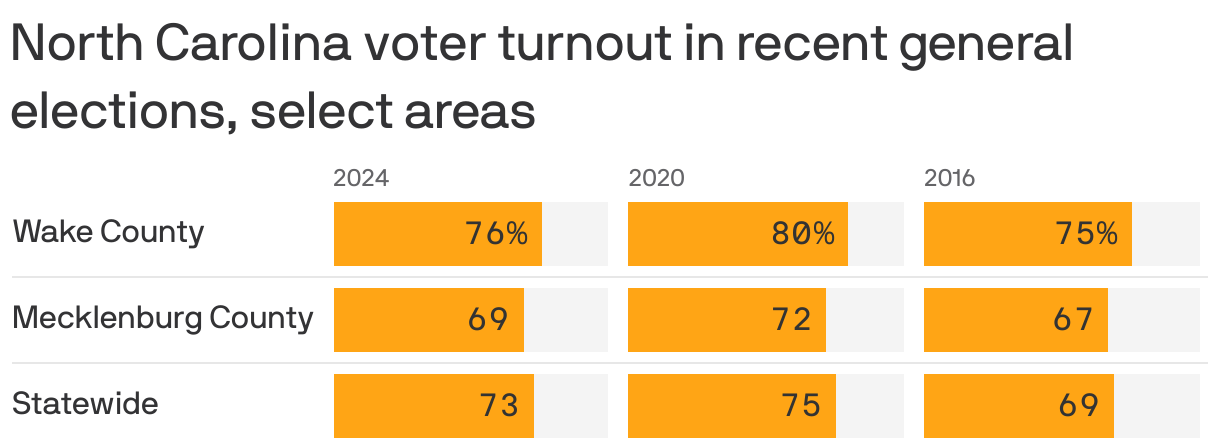
- And still, come Election Day, voter turnout was below 2020 in Mecklenburg. Nearly 13,000 fewer Black voters showed up to cast ballots in 2024 than in 2020, according to Carolina Tracker.
- The day after the election, the party's executive director, Monifa Drayton, stepped down, alleging racism and hostility.
The big picture: Some of the Democrats who spoke with Axios allege that longstanding discrimination and suppression within the organization are intensifying under the current leadership. Although six of nine MeckDems officers are Black, they accuse the leaders of not making it a priority to organize mainly Black precincts and of not understanding how to talk to Black voters.
- "There has been a disrespect, failure to listen, marginalization of Black Democrats," says S.Y. Mason-Watson, president of the African American Caucus of Mecklenburg County. "When that happens, you are breeding intense feelings that are not for the benefits of the party. People are being turned off. People are disengaging. People are not voting."
The other side: Party chair Drew Kromer, elected in 2023, says MeckDems spent more money on increasing Black voter turnout this year than the party raised in all of 2022.
- "We knocked a record number of doors in the Black and brown community," says Kromer, who is white. "We're still waiting to see what the efficacy was of those efforts" by analyzing the board of elections data.
- Among other expenditures, MeckDems opened a volunteer site at the Pauline Tea-Bar Apothecary on Beatties Ford Road and paid just one vendor $24,000 to canvass apartments with Black occupants. It also contributed to the nonpartisan Black Political Caucus.
- But the party did not give to its own Black auxiliary: the African American Caucus of Mecklenburg County.
Between the lines: The party officers and the African American Caucus of Mecklenburg County do not have a functioning relationship, Axios learned through speaking with board members. Although technically separate entities, they need each other to be effective.
- Part of the AAC's responsibility is to help organize precincts where at least 30% of registered voters are Black, according to the North Carolina Democratic Party Plan of Organization.
- "Organized precincts have higher voter turnout, no question," says Tanya Lewis, chair of Precinct 13, where the old Brooklyn neighborhood once was.
- But the caucus leadership says they've received little support from the party officers to accomplish that work, which could even mean buying snacks or coffee for volunteer meetings.
- AAC president Braxton Becoats, who ran against Kromer for party chair, says if more of the African American precincts were organized and mobilized, "Vice President Harris would have been able to get closer to the number that she needed to win."
- Kromer acknowledges the disconnect with AAC. He says they've tried to extend olive branches, but he says those haven't been taken seriously. He says he'd consider a serious funding request from AAC, but so far he has heard only of a request for gift cards as incentives for people to attend precinct meetings.
Per the plan of organization, precinct delegates vote for MeckDems officers and elect the state executive committee. But if Black precincts are unorganized and have no delegates, those areas aren't represented by anyone.
- "They're not having a voice at all, at all, in the inner workings and infrastructure of the Democratic Party," Lewis says. "It's a denial of voting rights."
- Votes are also weighted and dependent upon turnout in some of the elections.
- Kromer says it's difficult to find volunteers who want to be involved. The local party may consider combining precincts, he says, as other counties have done.
Friction point: Democrats who spoke with Axios are frustrated with what they say is a pattern of MeckDems not supporting Black candidates.
- The seeming loss to Tricia Cotham — the Charlotte-area representative who switched parties last year — especially stung. People Axios spoke to were upset about the Democratic Party's decision to recruit Nicole Sidman instead of supporting Yolonda Holmes, who'd run against Cotham previously in the 2022 Democratic primary.
- Kromer says he was impressed with Sidman's proven track record of campaign fundraising and asked four other white prospects to step aside.
- Sidman raised four times more than Cotham between Feb. 18 and June 3, the Observer reported. Behind by 216 votes, Sidman has requested a recount in the race.
Shamaiye Haynes, a 2023 candidate for school board, says it hurt her campaign that many Black precincts were unorganized. Those voters would be her main base of supporters, she says.
- What made tensions worse: Haynes says she was left off the party's blue ballot that it gives out at polling places.
- "I worked incredibly hard for a long time to earn a seat on the board that I did not get because my own party turned on me 40 days before the election," Haynes says.
- MeckDems only picked three of 11 Democratic candidates to endorse this election. The AAC pushed for Haynes over Liz Monterrey, but ultimately Haynes was not selected during MeckDems' process. Monterrey was the first Latina elected to the Charlotte-Mecklenburg Schools Board of Education.
Flashback: Mecklenburg County routinely has some of the lowest turnout rates in the state. In the past, the Charlotte area has been blamed for losses in high-profile contests, such as Cheri Beasley's race for North Carolina Supreme Court chief justice in 2020. She lost by about 400 votes.
- There was hope this year would be different. Under Kromer's leadership, the Huntersville town government flipped from red to completely blue in 2023.
- But some say that the model used in north Mecklenburg wouldn't work for reaching voters in Charlotte's "crescent" to the west, north and east of the city, where low-income people and people of color are concentrated.
Zoom out: Nationally, turnout was down. Wake County also saw a drop. And the entire country saw a red wave.
- Black voter turnout lagged across the battleground state of North Carolina during early voting. Even so, the Democratic Party has been slowly losing Black male voters to the GOP because of what they see as an economy that hasn't benefited them enough, discontent with Democratic policies, and a growing sense of being left behind, Axios reports.
- Tony Forman, a member of the Democratic state executive committee, has felt that shift while talking to voters. Many young Black and Latino men, he says, voted for Trump because of misinformation or because they believe he supports HBCUs and is responsible for stimulus checks.
- "I know how some of these young men think," Forman says, "and they have no direction because nobody's reaching out to them."
- Kromer says he believes the local party accomplished some of what it set out to. He thinks they'll be able to prove their program pushed Democrat Allison Riggs to a win in the North Carolina Supreme Court race and is the reason they broke the GOP's legislative supermajority in the state.
What's next: Kromer says he wants the party to be more present in the Black community during the election off-cycle, to avoid looking as if it shows up only once every four years.
- "These problems have been here long before me, and I'm hoping that we can make a dent in them," Kromer says. "But again, it requires everyone to get on the same page, and maybe not just try to, like, burn the house down."