Charlotte-Mecklenburg Schools struggle with segregation 70 years after Brown v. Board ruling

Add Axios as your preferred source to
see more of our stories on Google.
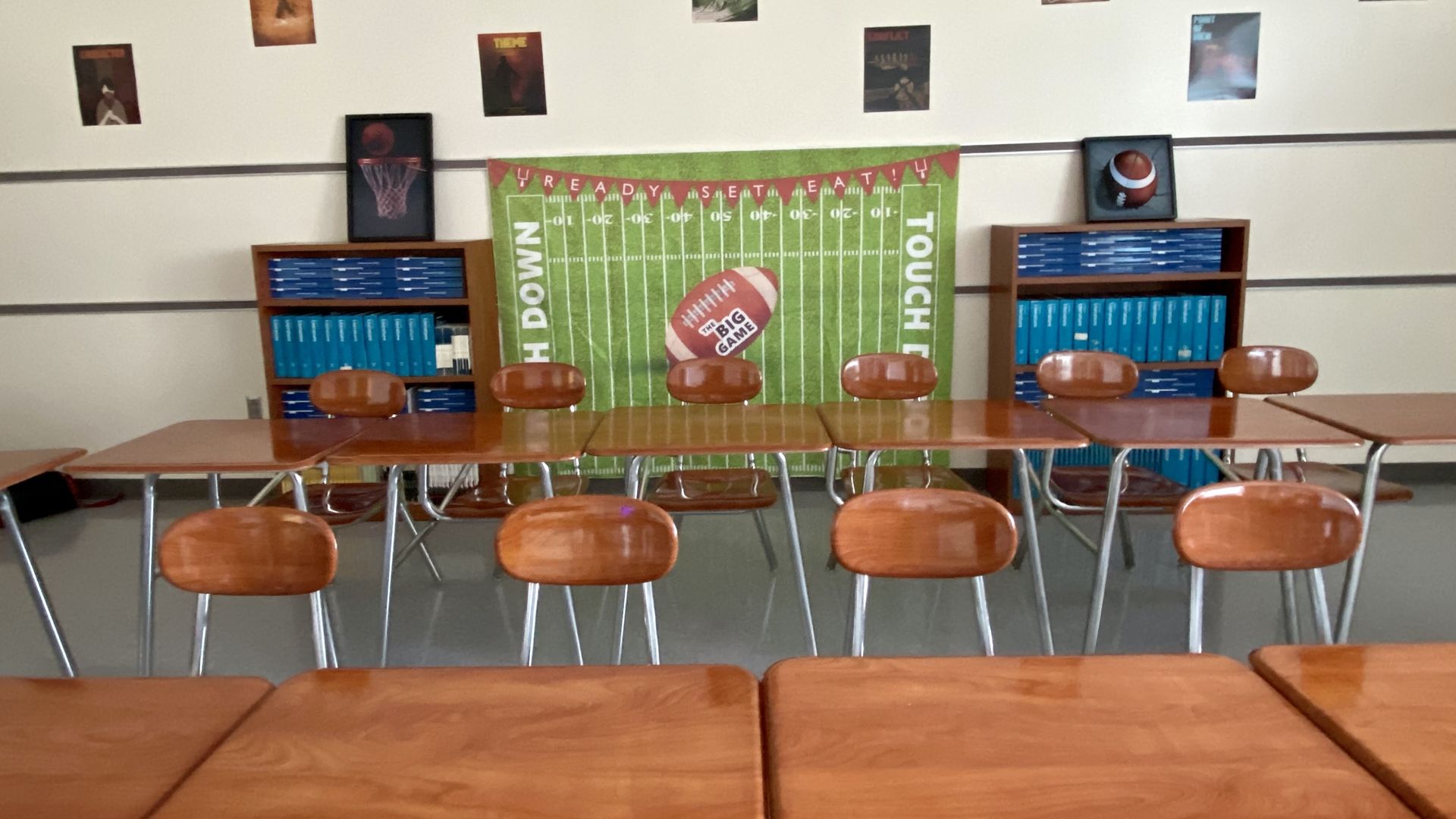
A West Charlotte High School classroom. Photo: Ashley Mahoney/Axios
Seventy years ago today, the U.S. Supreme Court unanimously ruled in Brown v. Board of Education that it was unconstitutional to separate children in public schools based on race.
Why it matters: Charlotte was a beacon for integration in public schools from the 1970s through the 1990s. Today, like public school districts across the nation, Charlotte-Mecklenburg Schools has once again become segregated.
Between the lines: The discussion around integration in the 20th century focused on Black and white students. Today it's a larger conversation around Black, Hispanic and white students, who make up the bulk of CMS' student body.
By the numbers: CMS has 184 schools and 141,097 students — 34.4% are Black, 31% are Hispanic and 23.7% are white as of April 18, 2024, according to CMS data.
Zoom in: West Charlotte High School was once a model of successful integration when students were bused in from other parts of the city following the Supreme Court's unanimous decision in Swann v. Charlotte-Mecklenburg Board of Education in 1971.
- West Charlotte alum and Charlotte city council member James "Smuggie" Mitchell experienced the early days of integration after Swann.
- "Everyone was there to prove a point that your skin color was not a determination for how successful you could be in the classroom," Mitchell told Axios in a 2022 interview.
- West Charlotte's reputation grew so prominent that in the early 1970s the school invited students from Boston to visit when that city was experiencing its own turmoil over busing, as WFAE reported,
But busing as a means of integration ended in the 1990s, when federal court judge Robert Potter ruled in favor of seven white parents who argued that race shouldn't be a factor in pupil assignments.
- CMS had ''eliminated, to the extent practicable, the vestiges of past discrimination in the traditional areas of school operations," Potter said in his ruling.
- The case created tension throughout the district and beyond. Some hailed Potter's ruling as the end of "the nightmare of forced busing," in a Los Angeles Times article, while others predicted dire consequences for the district.
Reality check: Today at West Charlotte, less than 2% of students are white and about 75% of students are Black, according to data from The Educational Opportunity Project at Stanford University.
Some West Charlotte students thought it was always like this, social studies teacher Alan Hall tells Axios. He's currently teaching Brown v. Board to his students, along with other cases like Swann.
- "If history doesn't repeat itself, it definitely rhymes," Hall says of segregation in public schools.
- CMS did not provide an interview or a statement when Axios asked about the district's integration or plans for improvement.
Yes, but: Some of CMS' largest high schools are fairly integrated when measured against the definition of "intensely segregated schools of color," which are schools with 90-100% of nonwhite students, as Axios' Russell Contreras reported.
- Ardrey Kell High School in south Charlotte is CMS' largest high school with 3,554 students. It's 43% white, 31% Asian, 11.6% Hispanic and 11.2% Black.
- Myers Park High School, the district's second-largest high school, is 56% white, 20.2% Black and 17.7% Hispanic.
- South Mecklenburg High School in south Charlotte, is the district's third-largest high school. Students here are predominantly Hispanic (44.3%), followed by 29.1% white and 21.6% Black.
Flashback: To facilitate integration, CMS chose to significantly alter four schools in 2017 — Dilworth Elementary was paired with Sedgefield Elementary, and Cotswold with Billingsville.
- Today, Dilworth Elementary has two campuses: Latta and Sedgefield. Both campuses are just shy of 75% white.
- Cotswold, on the other hand, is 39.2% Black, 34.7% white and 17.8% Hispanic.
- Billingsville is 39.8% Black, 34% white and 19.1% Hispanic.
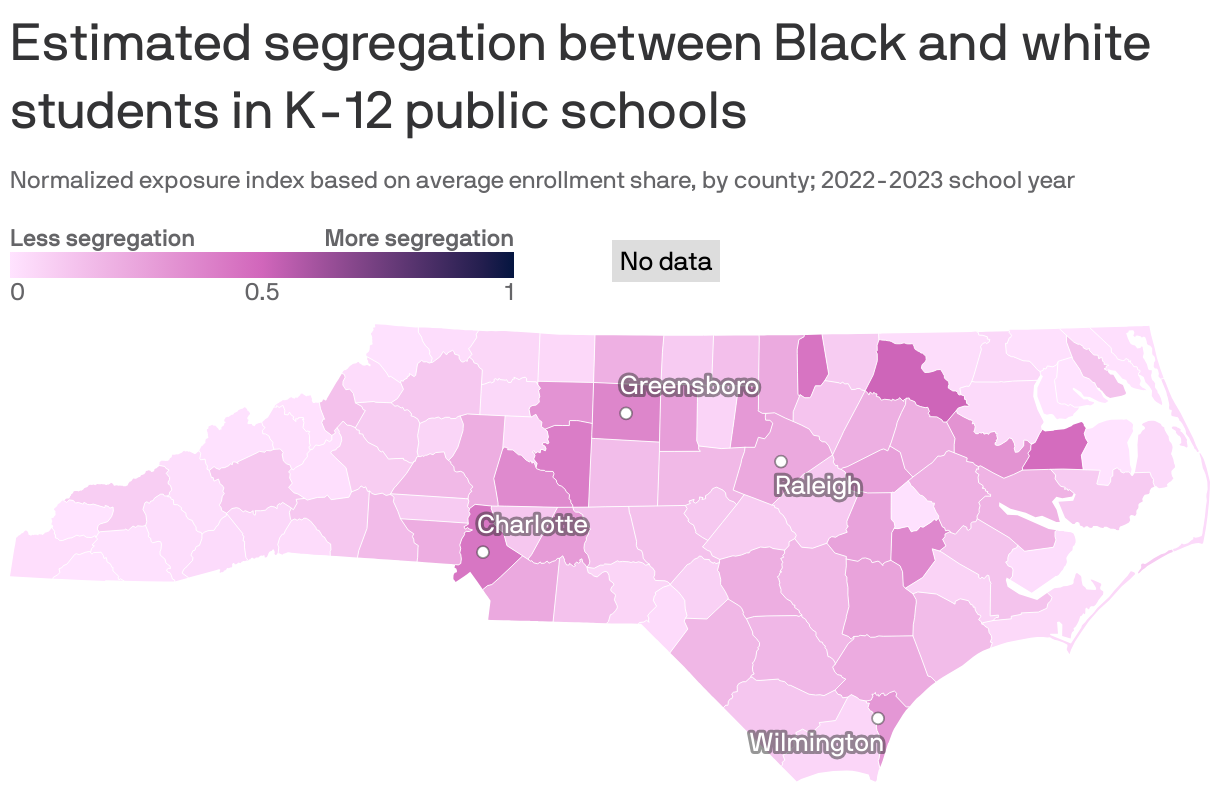
Zoom out: Statewide, one in four Black students and nearly one in five Hispanic students attend "an intensely segregated school of color," according to a recent report from The UCLA Civil Rights Project.
- In the late 1980s, less than 5% of Black students attended highly segregated schools, per the study.
The big picture: There are three major causes of re-segregation of public schools in North Carolina, says Jennifer Ayscue, an assistant professor of education at N.C. State University and one of the co-authors of the UCLA report.
- A shifting legal landscape, meaning many school districts, including Charlotte-Mecklenburg Schools, have been released from mandatory school desegregation plans.
- The expansion of school choice without civil rights protections, which in North Carolina means the expansion of charter schools and voucher programs.
- Residential segregation, meaning districts have student assignment policies and boundaries drawn in ways to facilitate more segregation.
The other side: Debbie Veney of the National Alliance for Public Charter Schools told Axios' Russell Contreras that neighborhood schools and charters are not causing racial segregation, but simply serving the students who appear at their doorsteps.
- "The researchers might instead focus on why white families move from neighborhoods and pull their children out of schools when too many Black, Brown or low-income kids start showing up. When we try to integrate, they leave."
Go deeper: How a family with Charlotte ties helped launch Brown v. Board