The city will subsidize rents for low-income residents at an east Charlotte apartment complex

Add Axios as your preferred source to
see more of our stories on Google.
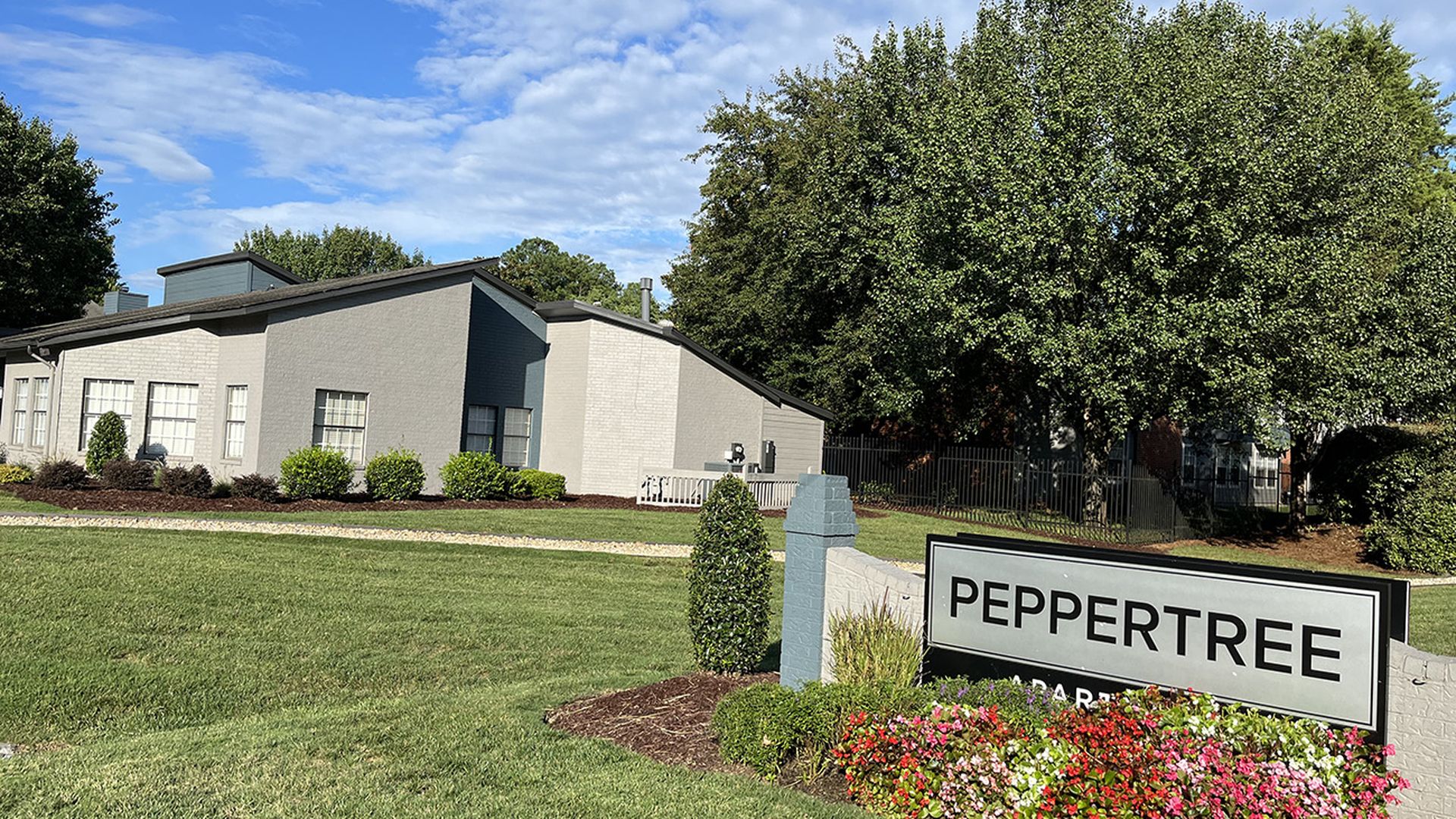
Photo: Danielle Chemtob/Axios
A developer plans to renovate the Peppertree Apartments on Central Avenue and turn them into affordable housing. And a local government-funded rental subsidy will help house some of our poorest residents there.
What’s happening: Charlotte City Council voted unanimously Monday to allocate $8 million in American Rescue Plan Act funding toward the purchase and rehab of the complex. The total budget for the development is $55.87 million, per the city.
- Of the 292 units, 88 will be priced for those earning 30% of the area median income or below, which is a little more than $28,000 for a family of four. Half of those units will be set aside for residents who do not have a Section 8 voucher through the local rent subsidy.
- Another 146 will be affordable for those earning between 31% and 60% of AMI, the latter of which is $56,520 for a family of four.
- And 58 units will be priced for people making 61% and 80% of AMI, which is $75,350 for a family of four.
Why it matters: Charlotte faces a shortage of about 23,000 affordable housing units for its poorest residents, defined as those earning 30% of the area median income or below.
- Plus, longtime residents are being priced out of fast-growing areas like east Charlotte. Peppertree is sandwiched by the Eastland Mall redevelopment in one direction along Central Avenue, and Plaza Midwood on the other.
Ascent Housing is partnering with the privately-financed Housing Impact Fund on the project. It’s the seventh NOAH, or “Naturally Occurring Affordable Housing,” deal for Ascent.
The big picture: The idea is, instead of building new affordable units, which are costly, the city subsidizes the acquisition of an existing building that is older. In such properties, apartments often cost less to rent. In return for receiving public money, the developer agrees to keep rents affordable.
- While the approach doesn’t create new affordable housing, part of the idea is to prevent displacement, as new owners often raise rents when they buy older buildings.
Between the lines: Through a program set up last year, the city will also contribute the equivalent of what Ascent pays each year in property taxes to subsidize rent for low-income households. The goal is to help house the thousands of poor residents who do not have federal Section 8 vouchers that are in limited supply.
- The city will give that money to the nonprofit Housing Collaborative, formerly Socialserve, which will cover the difference in cost between what the tenant can afford to pay and the rent for the apartments.
What they’re saying: Mark Ethridge, operating partner with Housing Impact Fund, declined to comment on the Peppertree project because the sale hasn’t closed yet.
But he said in general, the rental subsidy program is a way for developers to make the numbers work when it comes to providing affordable housing for the lowest-income residents. Ethridge previously told Axios it costs $600 to $700 just to break even on costs like property taxes and maintenance, which is more than what those earning 30% AMI can afford.
“We have this opportunity where both the county and the city have taken leadership to look at our property tax dollars and said, ‘how do we get it in the hands of the households that need it the most?'” he tells Axios.
What’s next: The county is slated to consider doing the same property tax deal with Ascent, plus another $4 million for the project, on September 20.