City incentives for affordable housing near transit only led to 8 units

Add Axios as your preferred source to
see more of our stories on Google.
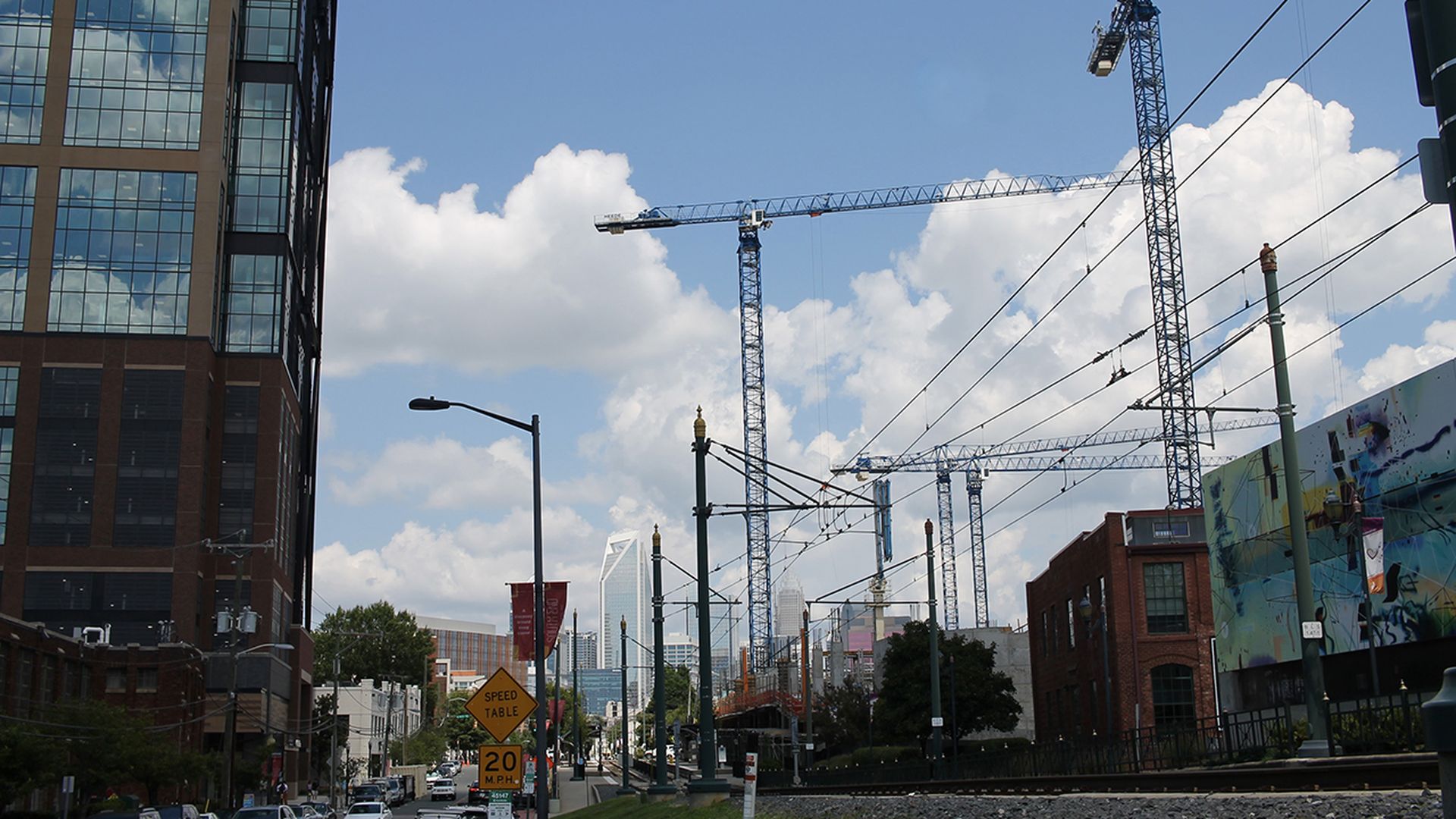
Construction cranes in South End. Photo: Alexandria Sands/Axios
More than three years ago, Charlotte City Council adopted a program to incentivize affordable housing along the light rail by allowing developers to build taller buildings in exchange for including affordable housing.
Despite the construction of thousands of apartments, just eight affordable units along the light rail are underway as a result of the program, a new city report shows.
What’s happening: Known as a “bonus menu,” the initiative also allows developers to pay a fee-in-lieu toward the city’s Housing Trust Fund or donate land in order to gain the additional height above what is allowed by-right. The city just expanded the bonus menu to other zoning districts through its Unified Development Ordinance, a rewrite of development rules.
- Another $1.7 million was paid into the Housing Trust Fund by developers using the bonus program.
- Of note: There are several other ways developers can earn additional height, such as building more open space or paying for transportation improvements beyond what is required.
Why it matters: Charlotte has a shortage of tens of thousands of affordable housing units, which is most severe for its poorest residents.
Yes, but: The city calls the program a “success” in the report and told Axios it is growing.
- In total, $6.6 million has been committed from developers, but the city hasn’t received all of it because the plans and permits are still being finalized. Alyson Craig, the interim planning director, said in email through a city spokesperson that “many other developers” have expressed interest in the program.
Details: The eight affordable housing units built were all part of one project, The Oliver, at 3020 Gloryland Avenue near the Tom Hunter LYNX Blue Line station in north Charlotte. The developer, J. Forest Development, was able to add an additional 10 feet of building height in exchange, per the city.
- The units will be affordable for those earning 80% of the area median income or less, which is about $75,350 for a family of four, per the city.
Three projects paid into the $1.7 million that went to the Housing Trust Fund, all in South End. They include:
- Greystar contributed the bulk of that money, at nearly $1.3 million for its project at 1714 South Boulevard. It is part of a 324-unit, 24-story tower it is building with developer White Point. The developers were able to build another 123 feet as a result.
- Akridge Invested contributed $189,002 for a development at 2300 Dunavant Street, and $302,941 for a project at 3441 South Boulevard.
- The 2300 Dunavant Street project, which earned another 13 feet in height, is part of an eight-story, 426-unit multifamily development (the property is technically at 2200 Dunavant, per the developer’s website). The 3441 South Boulevard development is a 310-unit, six-story building.
Flashback: The city had a similar bonus system on the books that allowed developers to build more dense projects in affluent areas if they included some affordable housing. But no one used that either, the Observer reported in 2015.
What they’re saying: Collin Brown, a land use attorney for Alexander Ricks PLLC, worked with both Akridge and Greystar.
- He says it’s easier for developers to pay the fee as essentially a cost of doing business than to construct affordable units.
- “Your land costs are through the roof, construction costs are higher than they’ve ever been, and the ask is that you essentially provide units that lose money,” he says.
The big picture: The city is limited by state law in being able to require that developers include below market-rate housing. That’s why it has often relied on ways to encourage affordable housing supply in the private market. But housing prices are also rising rapidly in Charlotte, especially in places like South End.
- “If you’re talking about a development that can make X amount of money without having to take advantage of any sort of bonus, and most of these developments are in popular, profitable places, I think it’s somewhat of an open question whether something like a bonus height or a bonus of more density allowed is attractive enough,” says Ely Portillo, director of research engagement at UNC Charlotte’s Urban Institute.
The money developers are paying is going toward the Housing Trust Fund, which uses bond money to subsidize affordable housing construction. So on the one hand, it’s another way to raise funds for that effort without raising more money from taxpayers.
Between the lines: But according to an Axios analysis earlier this year, two-thirds of the projects the trust fund has helped finance were built in neighborhoods where the median income is below that of the city overall. In other words, affordable housing isn’t going up in wealthy parts of town.
The city has long desired to build housing in what’s considered “high-opportunity” neighborhoods with access to essential infrastructure like transit, such as South End.
To do that, the city shouldn’t allow developers to pay the fee instead of building affordable housing, says David Furman, principal at Centro Cityworks, which worked with Ascent Real Estate Capital to build micro-apartments at The Winnifred (formerly called Centro Railyard) in South End and is working on a similar project in NoDa.
- “Apartment developers have a singular mission: how much money they can make, and affordable housing dilutes that mission. It’s as simple as that,” he says. “As long as they’re letting developers buy out of it, then that’s what they will do.”