What overturning Roe v. Wade means for North Carolina abortion laws

Add Axios as your preferred source to
see more of our stories on Google.
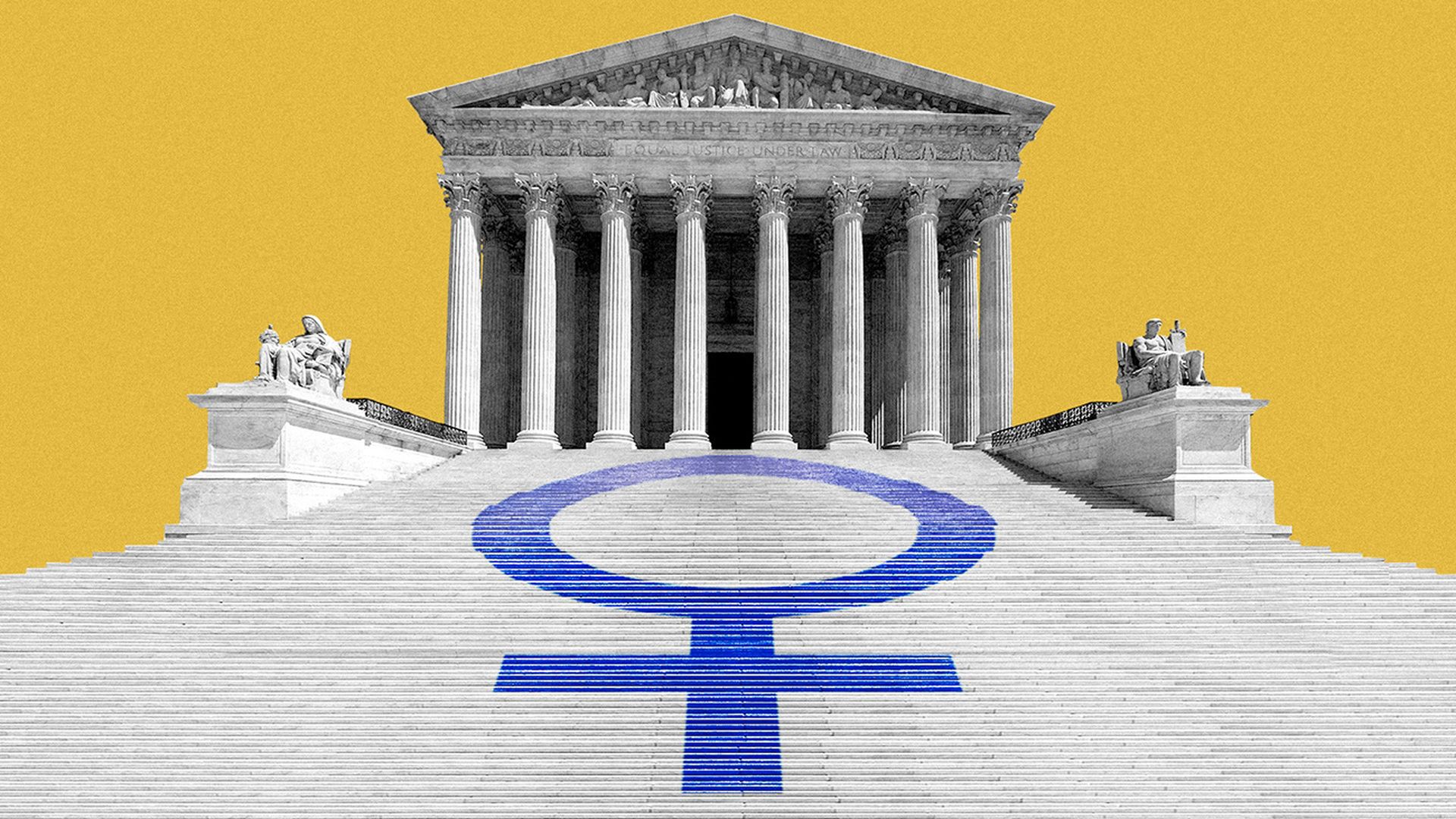
Illustration: Lindsey Bailey/Axios
Abortions will remain legal in North Carolina following the Supreme Court’s decision to overturn Roe v. Wade, but now the question becomes: for how long?
What’s happening: The Supreme Court on Friday upheld a restrictive Mississippi law in a 6-3 ruling, and also chose to overturn Roe v. Wade in a 5-4 ruling. (Chief Justice John Roberts said he would’ve stopped at the Mississippi ruling.)
- “The Constitution does not confer a right to abortion; Roe and Casey are overruled; and the authority to regulate abortion is returned to the people and their elected representatives,” Justice Samuel Alito wrote in the ruling.
- That leaves the legality up to state legislatures and governors.
- Thirteen states have trigger laws immediately banning abortion, and 16 states and Washington, D.C., have laws preserving abortion rights, Axios’ Oriana Gonzalez reports.
Of note: Justice Clarence Thomas said the Supreme Court should reconsider opinions protecting same-sex relationships, marriage equality and access to contraceptives, Gonzalez reports.
Why it matters here: North Carolina falls in the middle, with no immediate plans to protect or ban abortion.
- The Republican-led legislature would likely move to restrict abortion in the coming years, but Democratic Gov. Roy Cooper is just as likely to veto any such legislation as long as he’s in office. He’s in his second and final term, though, and the next gubernatorial election is set for 2024.
- “I will continue to trust women to make their own medical decisions as we fight to keep the politicians out of the doctor’s exam room,” Cooper said in a statement.
- North Carolina Attorney General Josh Stein, a Democrat rumored to make a run for governor in 2024, tweeted: “I have a message for the women of North Carolina: you still have a legal right to an abortion in our state. North Carolina state law protects women’s reproductive freedoms.”
Between the lines: Whatever the states decide to do with the laws, the burden will fall to local prosecutors to enforce them.
- Mecklenburg County District Attorney Spencer Merriweather, who is a supporter of abortion rights, told Axios in May he hopes people will call their General Assembly members now and often.
- “I’m not sure that people who are contemplating a restriction that changes the way that we view a public health procedure, and criminalizing it understand what that means,” Merriweather said the day before the ruling.
Flashback: A leaked Supreme Court draft document, first reported by Politico in early May, indicated the court would upend the precedent set by Roe v. Wade.
- Merriweather told Axios in May he didn’t sleep that night, thinking about the possibility of one day facing the prospect of prosecuting abortions in the county.
- “It would require extremely invasive questions of both medical professionals as well as patients about very private procedures,” Merriweather, who won the Democratic primary election in May and does not have a Republican opponent for the general election, told Axios in June. “In my own experience as a sex assault prosecutor, I certainly wouldn’t want to put neither doctors nor patients, or even my own prosecutors in the position of having asked those sorts of questions.”
- Zoom out: His home state of Alabama is the only state “where performing an abortion of a viable fetus is punishable by life imprisonment,” Gonzalez reports.
The big picture: Cooper and 16 other governors called on Congress to immediately protect women’s reproductive rights when the draft opinion was leaked in May.
- “We know that Democratic governors are the strongest and last line of defense to protect abortion rights,” Cooper told Axios’ Lucille Sherman in May. “We have always been in that position, but now it’s even more intense.”
Between the lines: Abortion now is almost certain to become the most important issue in the 2024 governor’s race.
- But it will also be central to the 2022 U.S. Senate race between Cheri Beasley and Ted Budd, as Democrats try to cling to a slim majority.
Closer to home, Calla Hales is executive director of A Preferred Women’s Health Center in Charlotte, which has been the target of countless anti-abortion protests over the years, seeing some of the largest and more frequent protests nationwide, National Abortion Federation chief program officer Melissa Fowler told Axios’ Danielle Chemtob in May.
- “Folks who have been doing abortion care work and work with abortion access have expected this type of ruling for a significant amount of time now,” Hales told Chemtob. “It didn’t make it any easier to hear though. My first and foremost major concern is making sure patients know abortion is still legal.”
Friday night, hundreds of people gathered in from of the Charlotte-Mecklenburg Government Center to protest the ruling.
- Dozens of people addressed the crowd, including U.S. Rep. Alma Adams. They continued to march through Uptown after dark.
- “You don’t change policy until you change policymakers,” Adams said.
What they’re saying:
U.S. Senator Thom Tillis, a Republican, said a a statement: “This ruling is historic and monumental and affirms my belief that all life is sacred. Each state government and its duly elected representatives will now make the determination about the types of laws they wish to have in place. I, for one, will continue to advocate for commonsense measures that the broad majority of Americans support like protecting life at crucial points of development and prohibiting horrendous procedures like partial-birth and pain-capable abortions. This is a very emotional and sensitive issue for many Americans, and I urge calm and respect for the Court’s decision and hope people who have strong feelings on both sides will voice them peacefully.”
Adams, who represents north Mecklenburg County and Cabarrus County in district 12, said in a statement: “I’m angry, that’s all that can be said. While abortion care is still legal in the State of North Carolina, today’s decision is fundamentally wrong. Despite this disastrous decision, we will continue to work in Congress for reproductive justice and equality, and enshrine the bodily autonomy of women and parents in the law. Finally, I will work with legislators and advocates to fight any proposal from the North Carolina General Assembly that uses this ruling as an opportunity to turn back the clock for women.”
Beasley, a Democrat, advocated for women’s reproductive rights at Marshall Park in Uptown last December.
- The former North Carolina judge and frontrunner for senate said in a statement: “As a former Chief Justice of the North Carolina Supreme Court, I want to be clear: Our Constitution grants Americans the right to make decisions about their health care free from government interference. Today, for the first time in our history, the Supreme Court took away an individual constitutional right. I join people across the country in anger and fear at this moment for what the Supreme Court’s decision will mean for women, American families, and health care providers. This wrong and dangerous decision that overturns nearly 50 years of precedent shows exactly what’s at stake in this election and I will not hesitate to stand up for Americans’ freedom to make our own decisions about our own families.”
/2024/01/06/1704506120169.jpg)
Budd, a Republican, said in a statement: “Today’s ruling by the Supreme Court is a historic victory for the millions of Americans who believe that every life is precious and deserves protection.”
State Sen. Jeff Jackson, who is running for U.S. House of Representatives in district 14, which includes south Mecklenburg County and Gaston County, tweeted: “This election is now about who will defend the freedom of women to make their own choices over their own bodies. I’ll vote to codify Roe and protect the rights they’ve had for 50 years. Taking this freedom away is wrong.”
What’s next: The legislature wouldn’t likely take up a measure until next year. Early voting for the 2022 midterms runs Oct. 20-Nov. 5.
- Election Day is Nov. 8.
Editor’s note: This story was first published on May 4, 2022. It was updated on June 24, 2022 to reflect the Supreme Court’s ruling.