An east Charlotte abortion clinic became the epicenter of America’s abortion debate

Add Axios as your preferred source to
see more of our stories on Google.
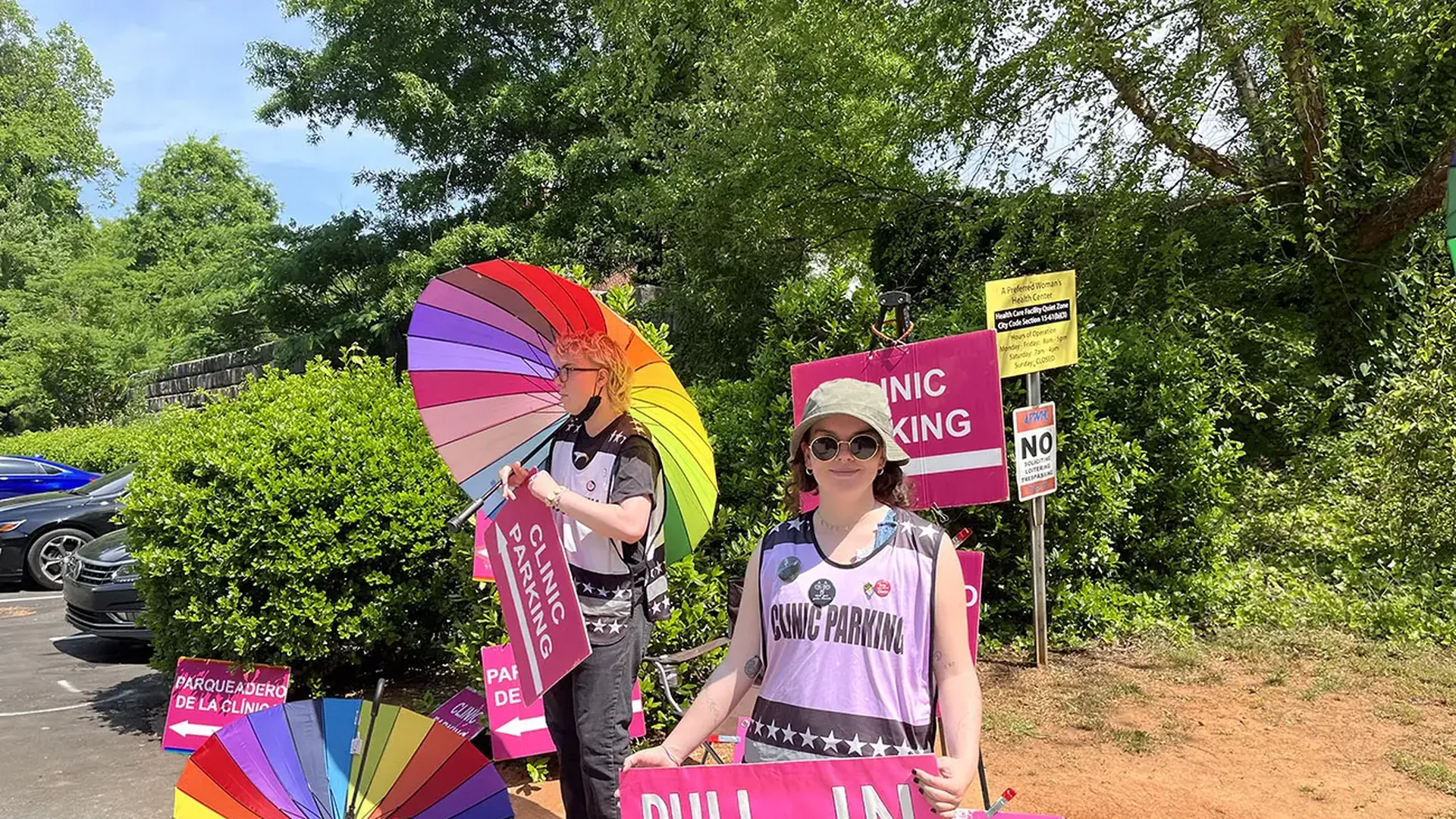
Volunteers with A Preferred Women’s Health Center in Charlotte. Photo: Danielle Chemtob/Axios.
Calla Hales ducks out the back door of the administrative offices for A Preferred Women’s Health Center, escorted by a security guard. A voice blares over a loudspeaker calling the medical clinic that provides abortions the “gates of hell.”
The noise is muffled inside Hales’ office, but it’s still a constant reminder of what Hales, executive director of the clinic, has experienced for the last eight years.
Why it matters: The national debate over abortion has played out on the sidewalks here since long before a leaked draft document indicated the U.S. Supreme Court may overturn Roe v. Wade.
- Along an otherwise quiet, wooded road lined with office buildings, anti-abortion rights protesters gather daily, sometimes a dozen, and on Saturdays, sometimes hundreds. Security guard Al McCree says he’s seen up to 3,500 protesters in a single day.
- The clinic sees some of the largest and more frequent protests nationwide, says chief program officer Melissa Fowler of the National Abortion Federation.
Maybe that’s why the news that rocked the country last Monday night didn’t surprise Hales or clinic volunteers — a gut punch, but not a shock.
They’ve been fighting a losing battle for years.
- “I feel like they’ve been winning since they created the term pro-life,” Hales says of the anti-abortion rights groups.
Hales and her teams are frustrated that many have only just woken up to a reality where abortion could become illegal.
“I spent the past five years surrounded by people who told me I was overreacting for being upset about these things, and for worrying about these things,” Hales says. “And here we are, and they’re just now seeing it now. When it’s almost, if not already, too late.”
Background: Tragedy led Hales’ parents to start the clinic in 1998: In the 1980s, her mother’s cousin died by suicide after she was raped and couldn’t find a place to get an abortion where she lived in South Carolina.
- There were protesters since the clinic’s beginning, but their numbers began to grow roughly seven years ago.
- One morning in December 2015, the roads were blocked, and staff and patients couldn’t make it to the clinic, according to Hales. That was the first Love Life parade.
The other side: Love Life, according to its website, works to mobilize the Christian church to bring an end to abortion and the “orphan crisis.” Activists affiliated with the group on site refused to be interviewed.
- In a statement provided through Facebook to Axios, the group said it was “thankful” to hear that Roe v. Wade may be overturned.
- “We are praying and hoping that the Supreme Court will make a righteous ruling on the sanctity of life,” the group said.
/2024/01/06/1704506626419.webp)
Hales stepped up security after the first Love Life parade. A volunteer group escorts patients from their cars into the clinic using rainbow vests and umbrellas to distinguish themselves.
- She later added people to direct clinic visitors into the parking lot and keep protesters at bay.
In 2018, a corporate entity affiliated with Concord attorney Jason Oesterreich purchased the site next to the clinic’s administrative offices, which is now listed on Google Maps as Love Life.
- Oesterreich, per police and local media reports, was one of three men affiliated with Love Life who were arrested in Greensboro in 2020 while protesting outside a medical clinic that performs abortions.
The scene: A dozen or so protesters stood near or at the driveway leading to the Charlotte clinic last week, two days after the Supreme Court’s draft document was leaked.
- One held a sign with what appeared to be an aborted fetus, and another handed out pamphlets entitled “Life in the Womb.”
- They approached vehicles as they turned into the clinic, and called out to patients leaving their cars.
- A bus from the Monroe-based HELP Pregnancy Center offered free ultrasounds. “Please come and see your precious baby,” a woman said over the loudspeaker.
/2024/01/06/1704506626635.webp)
Philip “Flip” Benham, a well-known conservative activist and minister, took to the microphone on Wednesday. He’s been arrested for protesting previously and was convicted on a stalking charge. The group he was with, Operation Save America, was known for distributing wanted posters of doctors who perform abortions, NPR reported.
- “Right now, you’re in the gates of hell, you’ve already made that choice,” Benham said to passersby. A volunteer whoops and responds sarcastically with, “I love it here.” Benham continued with: “But that child is still alive. There is still time.”
Tensions were high. At one point, volunteers yelled at a protester who was blocking the driveway, blaring a bike horn to drown her out. Another volunteer shouted an obscenity at the protester.
- Both sides pulled out their phones to record the situation as it started to escalate.
Shannon Bauerle, a professor of women’s and gender studies at UNC Charlotte and executive director of Charlotte for Choice, watched nervously as a truck she didn’t recognize pulled up near the clinic.
- She knew some of the protesters by name after three years of volunteering. She asked one of them, who she called Denise, if the truck was from someone with her group. The woman shrugged.
Tina Marshall sat outside in a lawn chair, donning a shirt that said “abortion defender” and a sign directing visitors to the clinic’s parking. She started the Black Abortion Defense League around eight months ago after what she observed as white men trying to shame Black women who visit the clinic and weaponized religion.
- She said she believes white people who support abortion rights turned their heads to the issue because it disproportionately impacted Black women.
- Black people make up 22% of North Carolina’s population, but Black women made up nearly half of those who received an abortion in the state in 2019, according to data from the Kaiser Family Foundation.
“Nothing is promised, at least not in this country,” Marshall said. “And it’s certainly something that Black people have always known. But I think that now, white folks are now waking up to.”
/2024/01/06/1704506626880.webp)
Between the lines: The most frustrating backlash Hales has faced is from within her own movement, she explained. About a year and a half ago, Hales was doxxed — meaning her private information was posted on the internet.
- It had happened to her before, usually with her address, email and phone number, and usually with anti-abortion rights activists. But this time, somebody who Hales says was pro-abortion rights found information about her daughter, and the surgery she received, along with her husband and family members.
- Hales decided to get off social media for good, and has stayed out of the spotlight until this week’s news.
The bottom line: Abortion rights advocates, Hales and Bauerle say, are fractured.
- Not everyone agrees with the clinic’s decision to have volunteers interact with protesters, for example, because they believe it creates more of a spectacle.
- “It definitely impedes the ability to create change, like lasting and substantial change,” Hales says of the division.
What’s next: Both sides are mobilizing ahead of the Supreme Court’s decision.
- Love Life is asking churches to become what it calls houses of refuge for people in difficult situations, per its statement. “Abortion will not just disappear. There will still be families that need the hope of the gospel and the help of the local church,” the group said.
- At the clinic, volunteers and staff are exhausted from fighting this battle, but they’re also determined to continue helping patients, Bauerle said.
At least three times a day, Hales asks herself why she’s still doing the work. After all, she rarely works fewer than 80 hours per week, answers texts and calls at 11pm and 7am, and jokes she doesn’t know what a social life looks like.
- “I don’t think I could live with myself, if I knew that I walked away and couldn’t help somebody — I didn’t try to help somebody,” she said.