How South Asians are growing political power in Central Texas

Add Axios as your preferred source to
see more of our stories on Google.
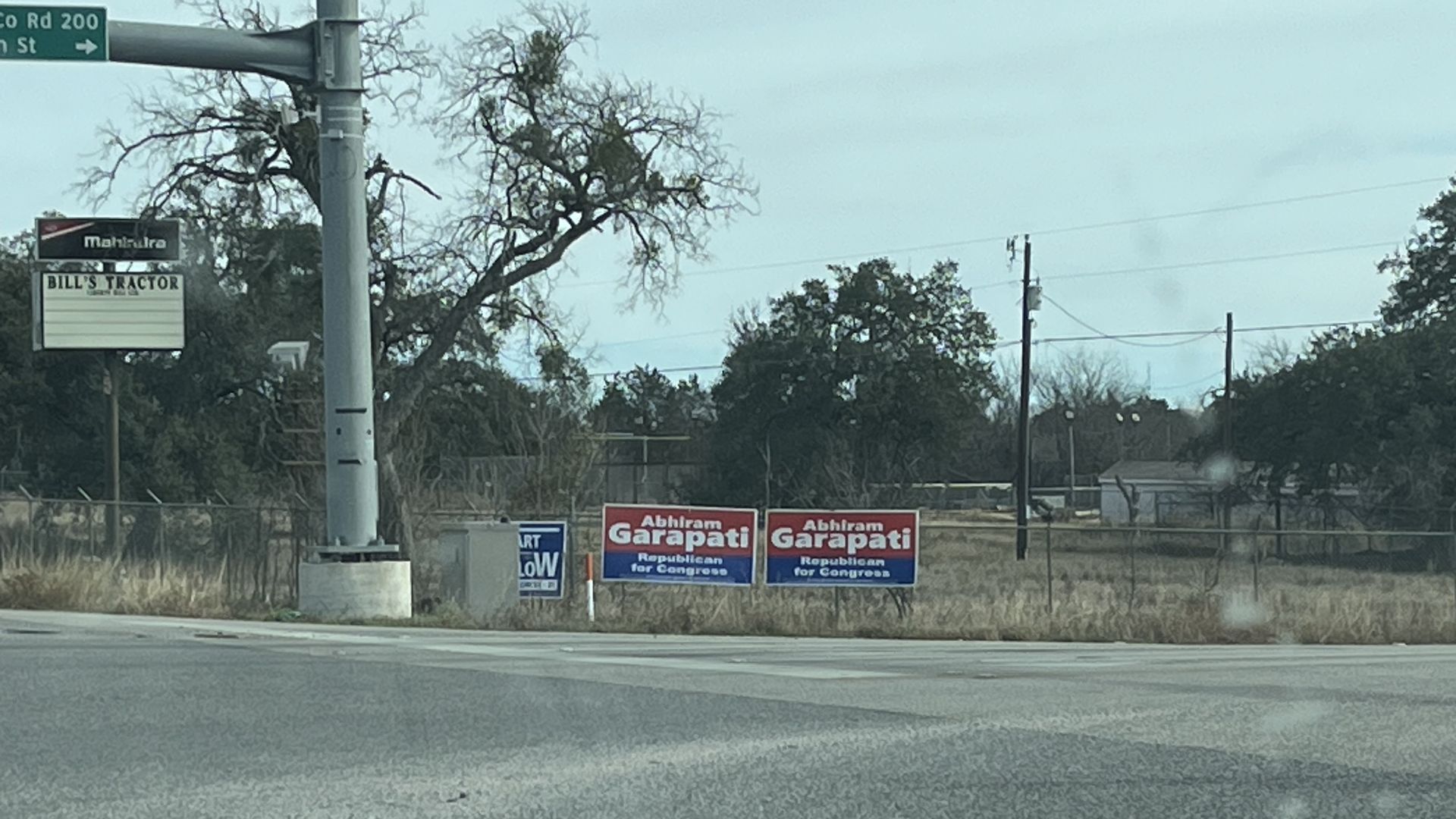
Signs for a South Asian candidate in Liberty Hill. Photo: Asher Price/Axios
Despite their historically broad support for Democrats, some Indian Americans are turning to the GOP — and running for office as Republicans.
Why it matters: The shift comes as the party's most prominent Indian American political candidate calls out bigotry within the party's ranks.
The big picture: Indian Americans, who make up the largest portion of South Asians in the U.S., moved toward President Trump in the last election.
- Trump enjoyed a 5 percentage point increase among Asian American voters between 2020 and 2024, per exit polls.
Driving the news: Abraham George, a native of South India, announced in February he is running for reelection as Texas GOP chair.
- In Central Texas, Abhiram Garapati, an investor and cattle rancher who studied electrical engineering in South India, is among nine candidates challenging U.S. Rep. John Carter in the Republican primary for the 31st Congressional District, a mostly rural district that includes parts of Williamson County.
- Also in Williamson County, attorney Rupal Chaudhari, who earned her undergrad degree in India, is running in the GOP primary for Precinct 2 of the Commissioners Court, which includes Liberty Hill, Cedar Park and Leander — areas that have seen some of Central Texas' fastest immigrant growth.
Yes, but: Last year at a conservative conference organized by Turning Point USA, former Republican presidential candidate Vivek Ramaswamy warned about bigotry within the party.
- "The idea that a 'heritage American' is more American than another American is un-American at its core," he said.
- At a City Council meeting in February in Frisco, just north of Dallas, one speaker criticized the H-1B visa program as leading to an "Indian takeover" of the city, according to the New York Times.
What they're saying: "While I have seen bigotry ... it is not indicative of the sentiments of the people at large," Garapati told Axios via email.
- Neither George nor Chaudhari responded to Axios interview requests.
- Garapati, who has run previously for Congress as a Republican, says on his website that he is "deeply committed to the conservative principles that make our state and nation strong," emphasizing his support for gun rights and border security.
Reality check: 68% of Indian American registered voters identify as Democrats or lean Democratic, per a 2023 Pew Research Center survey.
- "Indians have been one of the most progressive groups in Asian America," Janelle Wong, a professor of government at the University of Maryland, said on the "Science of Politics" podcast in December 2024.
- But concerns over the economy and immigration motivated conservative-minded South Asians to go to the polls in 2024, Wong said.
By the numbers: Indian Americans' population growth is playing out in Texas and nationally.
- As of 2021, the U.S. Census Bureau estimated more than 450,000 Indian Americans in Texas — almost double from 2010.
- Nationally, the population of Indian Americans has grown from 1.8 million in 2000 to more than 5.2 million today.
That's translated into political power. "Indian Americans are increasingly visible in national politics," Sara Sadhwani, an assistant professor of politics at Pomona College and a senior researcher at AAPI Data, observed last year. (The FBI director, Kash Patel, is of Indian descent.)
Zoom out: South Asians are also running for office as Democrats.
- Immigration attorney Pooja Sethi is running against Joseph Kopser for the Democratic nomination in Texas House District 47, which takes in Austin's western flank, as well as Bee Cave and parts of Lakeway.
- Austin Council Member Zohaib "Zo" Qadri, who represents Travis Heights, downtown Austin, West Campus, Hyde Park and Mueller, is running for reelection this year.
- A Pakistani American and a Muslim, Qadri tells Axios "it's not lost on me what my representation means" for other South Asians — especially as top state elected officials designate some Muslim groups as foreign terrorist organizations.
The bottom line: There are "absolutely" more South Asians running for office as the community aims for political representation, Chanda Parbhoo, executive director of SAAVETX, a nonprofit whose mission is to increase the political power of Texas' South Asian-American community, tells Axios.
- South Asians are a "very educated base of voters and we are up for grabs," she said.