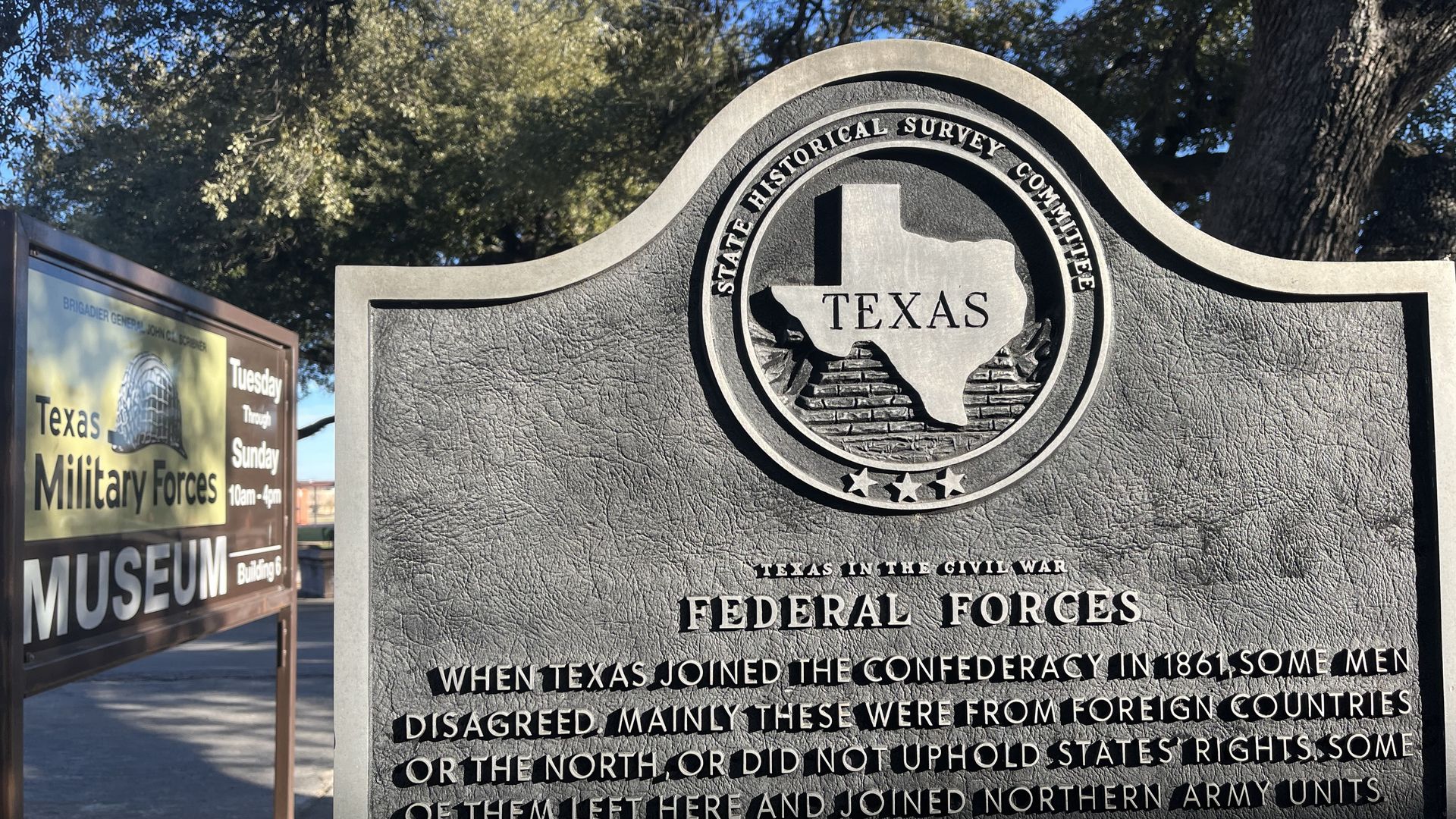
A Texas history plaque at Camp Mabry, outside the Texas Military Forces Museum. Photo: Asher Price/Axios
As Black History Month kicks off, signs of Texas' history with slavery remain around us — literally.
Zoom in: "When Texas joined the Confederacy in 1861, some men disagreed," an awkwardly written state historical plaque at Camp Mabry reads. "Mainly these were from foreign countries or the North, or did not uphold states' rights. Some of them left here and joined Northern army units."
The implication appears to be that real Texans — whatever that means — supported the Confederate cause.
Between the lines: The plaque was erected in 1965, part of a statewide effort to memorialize the centennial of the Civil War, per documents provided to Axios by the Texas Historical Commission.
What they're saying: We asked H.W. Brands, a scholar of American history at the University of Texas, what he thinks of the Camp Mabry sign.
"Texas Unionists did include large numbers of recent immigrants and former Northerners," he tells us. "These groups tended not to own slaves. But some Texas Unionists were as Texan as could be, starting with Sam Houston."
Flashback: In 2019, a state board that oversees the Texas Capitol grounds voted to remove a plaque that falsely asserted that the Civil War was "not a rebellion, nor was its underlying cause to sustain slavery."
The bottom line: The Camp Mabry plaque "is less misleading than many in its genre," Brands says. "A lot of accounts of Texas in the Civil War don't even acknowledge that any Texans opposed secession, let alone fought for the Union."