How Beto O'Rourke can shape the Democratic primary

Add Axios as your preferred source to
see more of our stories on Google.
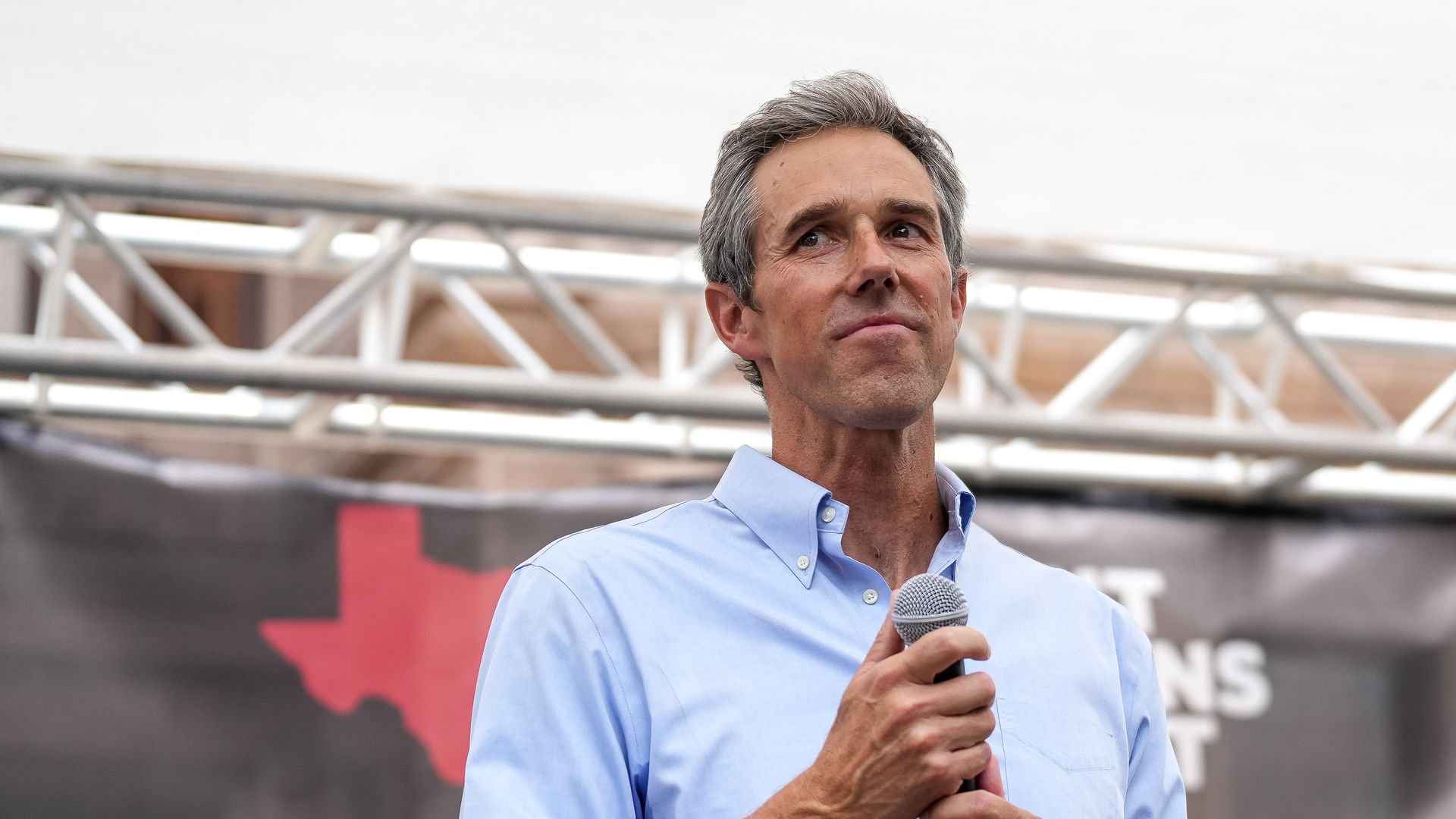
Beto O'Rourke during an anti-Trump rally in Austin in August. Photo: Aaron E. Martinez/Austin American-Statesman via Getty Images
As Texas Democrats gear up for a March primary, their best-known member is not in the running — and political observers tell Axios that might be a good thing.
Why it matters: The last time Beto O'Rourke ran in a Trump midterm, he galvanized the party.
- In 2018, he lost narrowly to Republican U.S. Sen. Ted Cruz, but his charisma on the trail helped draw Democrats to the polls, contributing to a down-ballot blue wave.
The big picture: While O'Rourke hosted campaign-style rallies last year, in the end, he didn't throw his name in the hat by the December campaign filing deadline.
- O'Rourke instead is focused on spearheading his political action committee, Powered by People, to register voters and get Democrats elected in Texas.
By the numbers: Among Democrats surveyed in an August University of Texas/Texas Politics Project poll, O'Rourke scored a higher favorability rating (73%) than U.S. Rep. Jasmine Crockett of Dallas (61%) and state Rep. James Talarico of Austin (31%) — who are now duking it out in the Democratic primary for U.S. Senate.
- Of note: 60% of Democratic respondents answered "don't know" or "neither favorable nor unfavorable" about Talarico, compared to 32% for Crockett and 17% for O'Rourke.
Yes, but: Beto's 2018 loss was the first in a streak of defeats — including a presidential run in 2020 and a gubernatorial campaign in 2022.
- In a press release in August, Texas Attorney General Ken Paxton — a potential opponent if O'Rourke had opted to run for U.S. Senate — described O'Rourke as a "repeat loser."
What they're saying: O'Rourke declined an Axios interview request.
- He's been building Democratic infrastructure in Republican strongholds, holding rallies in Amarillo, Wichita Falls and Tyler as he helped make sure Democrats were fielding a candidate in every state and federal race on the 2026 ballot in Texas.
Between the lines: "It's better for him to be a surrogate for other Democrats," Austin-based Democratic pollster Nancy Zdunkewicz tells Axios. Her private polling — which she declined to share directly with Axios because it was on behalf of a client — shows him underperforming a generic Democrat in a statewide general election.
- "I'd rather be a candidate with lower name ID and a chance to make a good impression than be a known commodity who has to count on changing someone's mind about me to win," Zdunkewicz says.
- "But he is still an effective fundraiser and communicator for Democrats. I'm sure he'll be very helpful in rallying the base to support our eventual nominees and I'm glad he's giving others a chance even though he would've won any primary race had he entered."
Joshua Blank, research director of the Texas Politics Project, tells Axios that O'Rourke as a candidate "has notable pros for the Democratic ticket" but that "Republicans and independents have well-informed views of O'Rourke that a lesser-known candidate might have the opportunity to influence."
The intrigue: Political watchers say Crockett, a firebrand who is the early favorite to win the primary, could have a hard time winning in the general election.
What's next: O'Rourke has said he will not be endorsing Democrats in contested primaries. He will be rolling out voter registration events on college campuses this spring — and is marshaling a ground game ahead of a North Texas special Senate race runoff at the end of January.
- He "sees what a lot of us here see — a chance to support an entirely new generation of qualified candidates who are raising good money," Ed Espinoza, a former Democratic National Committee official and Austin-based political consultant who is managing state Sen. Sarah Eckhardt's campaign to be state comptroller, tells Axios.
- But, he said, "we haven't seen the last of Beto O'Rourke" on the campaign trail.