The fate of Texas renewables is in jeopardy

Add Axios as your preferred source to
see more of our stories on Google.
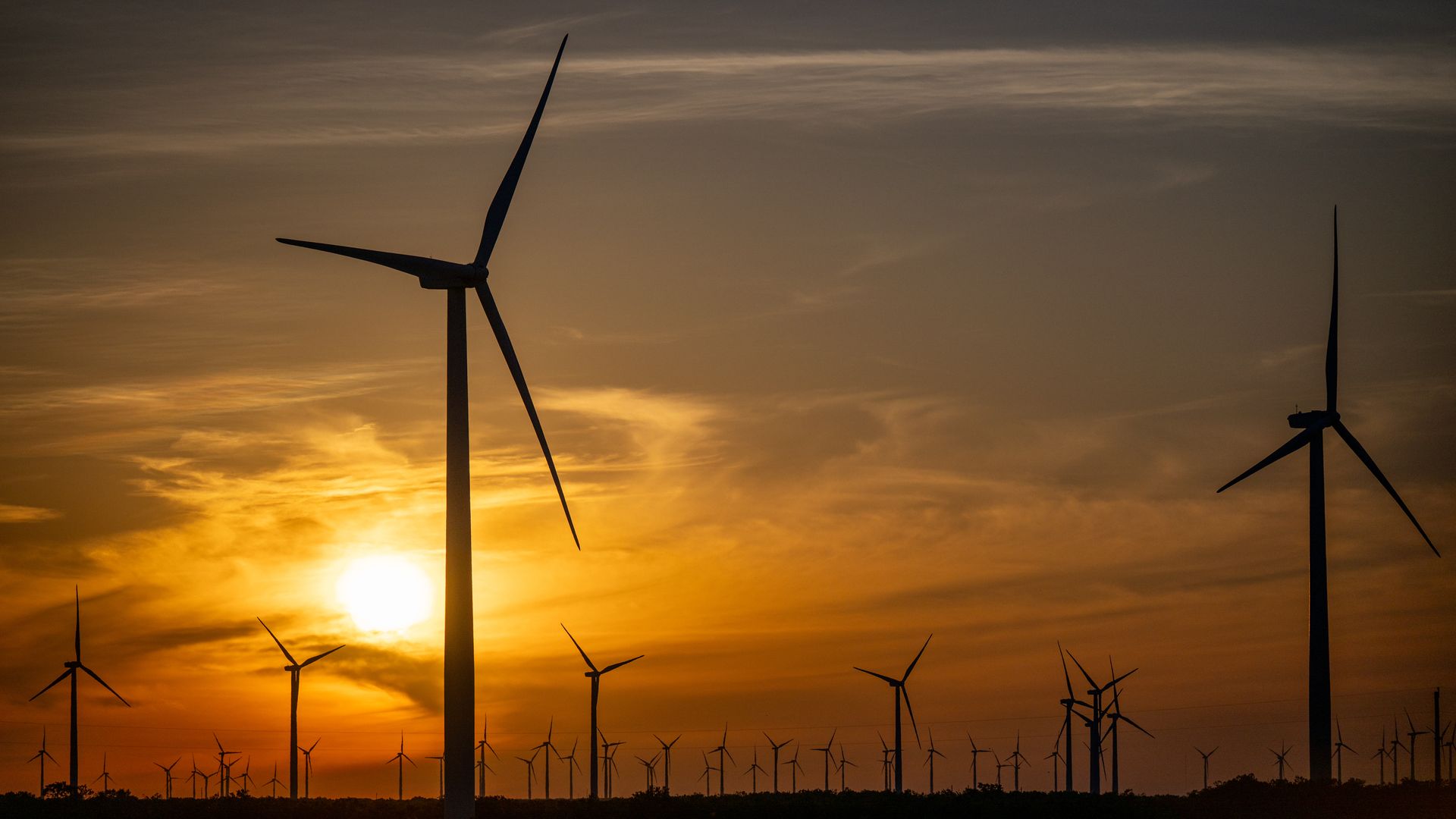
Wind turbines near Abilene. Photo: Brandon Bell/Getty Images
Texas' renewable energy industry is bracing for a hit in the new year as the Trump administration is ending key tax credits.
Why it matters: Wind and solar power are relatively speedy ways to add electricity to the grid as demand rises — and they helped stave off power shortages in Texas during the summer.
Driving the news: As part of the "big, beautiful bill," the Trump administration is phasing out a residential rooftop energy credit by January.
- Also on the cutting block, tax credits for energy-efficiency home improvements and big wind and solar projects that become operational after 2027.
- Separately, the administration has canceled a $7 billion solar power program meant to add rooftop solar in low-income communities across the country.
- About $400 million of that was earmarked for Texas.
What they're saying: In a July executive order ending subsidies for renewable energy, President Trump said wind and solar power displaces other forms of electricity, "compromises our electric grid, and denigrates the beauty of our nation's natural landscape."
- In another executive order, he argued that climate change policies are "burdensome and ideologically motivated."
Zoom out: The Tax Foundation, a think tank that generally favors lower taxes, predicts ending electric power and other business-related tax credits in the one-big-beautiful-bill will raise nearly $260 billion nationally for the U.S. Treasury over the next decade.
The other side: "This summer, renewables carried the grid," Matt Boms, executive director of the Texas Advanced Energy Business Alliance, told reporters this fall in a briefing organized by the Texas Reliable Grid Project, a group that promotes clean energy.
- In August alone, Boms said, wind and solar supplied about one-third of all power for the Electric Reliability Council of Texas (ERCOT), the Texas grid operator.
Zoom in: Economists predict Texans will pay higher power bills and the state will see slower economic growth due to the end of the renewable energy tax credits, the Texas Tribune reported.
- "From an economic perspective, it's not good for Texas," Robert Stavins, a professor of environmental economics at Harvard University, told the Tribune shortly after the one-big-beautiful-bill was passed into law.
By the numbers: Companies have invested more than $2 billion in solar and battery projects in Texas in the last year, according to the Clean Investment Monitor, a project from research organization Rhodium Group and MIT.
What's next: Because of the growth of renewables, "Texas is better prepared for winter than before," Doug Lewin, host of the Energy Capital Podcast and the founder of the consulting business Stoic Energy, said in the briefing.
- "With more flexible energy resources online, ERCOT is in a stronger position to manage extreme weather and keep power flowing," he said.
The bottom line: "A lot of people are trying to install solar right now, because once you roll into January you won't get the credit," Bret Biggart, the CEO of Freedom Solar Power, a residential solar installation company based in Austin, told the nonprofit news site Capital & Main.
- "I would say once that credit is gone, the solar market is going to go down by 30% to 40%."