Central Texas' reservoirs remain half-empty

Add Axios as your preferred source to
see more of our stories on Google.
/2025/03/27/1743103898472.gif?w=3840)
Illustration: Aïda Amer/Axios
Austin's welcome rains — forecast to continue Friday — won't be nearly enough to replenish the region's water supply.
Why it matters: Austin's continued growth puts demand on the region's long-term water supply.
Threat level: Lakes Travis and Buchanan, which provide water to more than a million Central Texans, remain a combined 49% full.
- That's more than half-empty in our book.
The big picture: The water that flows through those lakes and downstream to the Gulf is the drinking water for Austin and other Central Texas cities, cools the South Texas nuclear reactor, and sustains the ecosystem in Matagorda Bay.
Zoom in: As of Thursday morning, per the latest information available from the National Weather Service, 7.05 inches of rain had fallen since Jan. 1 in Austin — or about 2.5 inches less than normal for that period.
- Most of Travis County is rated as in "extreme drought," per the U.S. Drought Monitor.
Yes, but: Don't worry, your spigot is not about to go dry.
- Austin remains in the relatively mild Stage 2 of drought restrictions — in which homeowners are limited to one designated watering day per week for automatic irrigation systems, while hose-end sprinklers can be used only on weekends.
- In other words, restaurants are still serving water and our governor has not yet officially ordered prayer for rain.
State of play: While rain has fallen throughout the region, some gauges by Lake Buchanan notched less than a half-inch in the 72 hours through Thursday afternoon — and less than a quarter-inch in the Lake Travis basin.
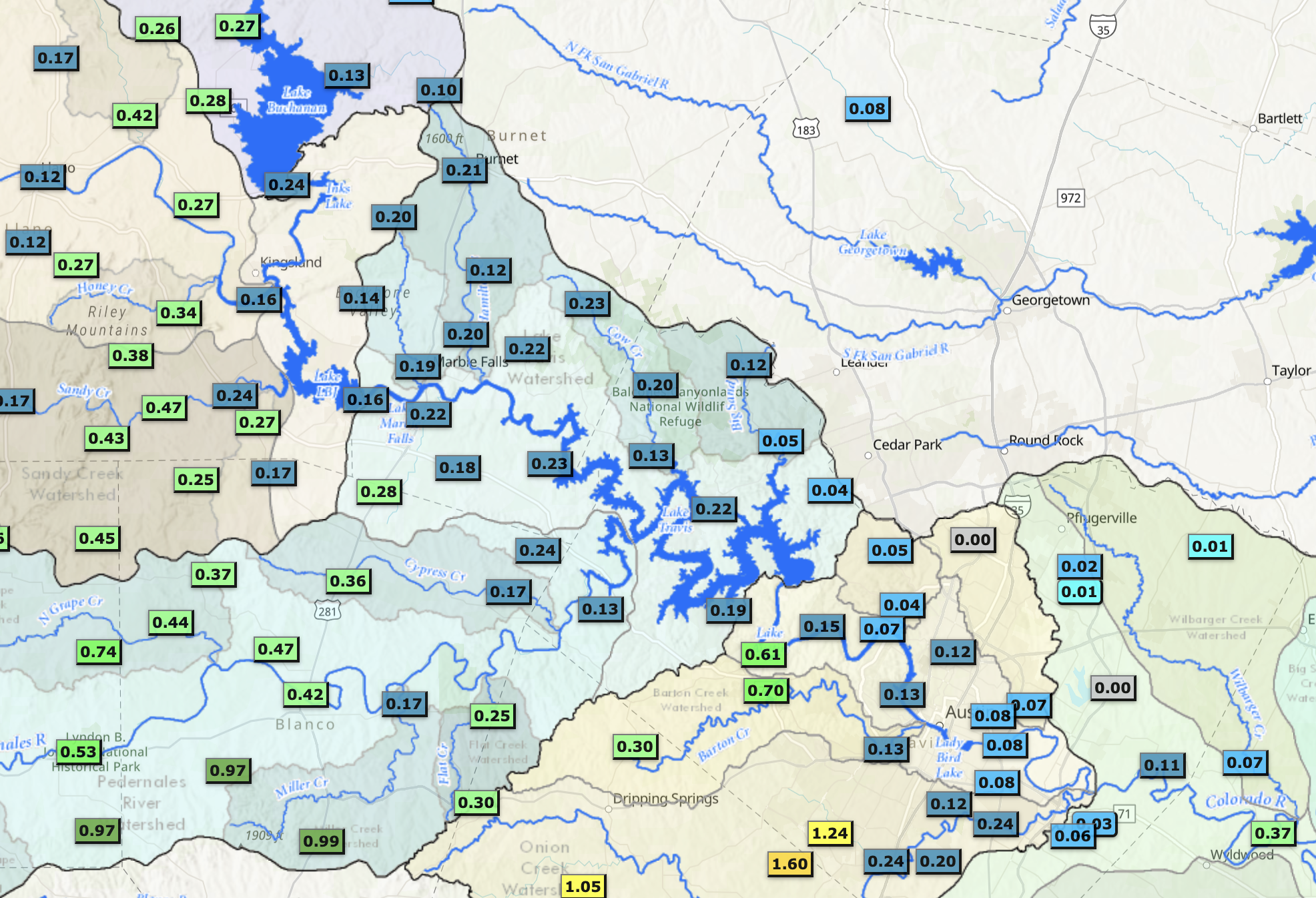
What they're saying: "While all areas" of Central and South Texas "will see beneficial rain, the highest totals over the next couple of days are predicted to occur across South Texas and the Coastal Bend area," Bob Rose, chief meteorologist with the Lower Colorado River Authority, which manages Austin's dams and the river that flows through the city, wrote on his weather blog Wednesday afternoon.
- The heaviest rains are predicted to fall east of Interstate 35 and south of I-10, Rose predicted.
What's next: Rain chances dissipate this weekend and the Climate Prediction Center forecasts that our part of Texas is likely to get below-average rain in the next month.