How politics influences where we live


Add Axios as your preferred source to
see more of our stories on Google.
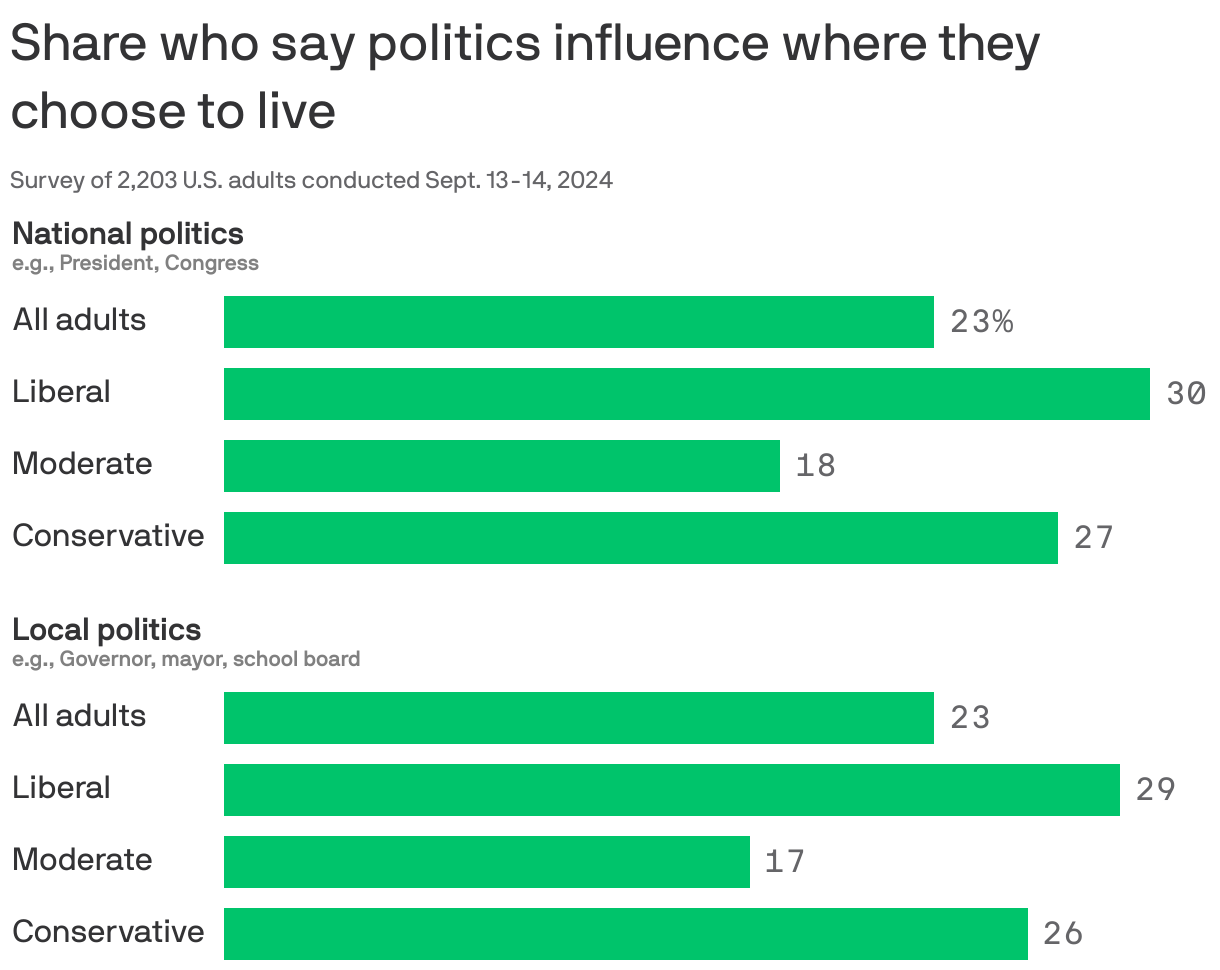
A little more than a fifth of people in the South say local or national politics very much influenced their decision on where to live, according to a recent survey from Realtor.com.
- Texas was designated as part of the South in the survey.
Why it matters: With the election behind us, and Austin's generally progressive voters feeling increasingly at odds with a state political leadership growing ever more conservative, where, how or whether to move has become part of a social media and dinner table conversation.
- More than 2 in 3 Travis County voters preferred Vice President Harris and more than 70% voted for Colin Allred for U.S. Senate, the highest portions in a state that tilted to the right.
The big picture: Nearly 1 in 3 frequent voters say living in a place where most people share their political views is very or extremely important, compared to 17% of occasional voters and 8% of inactive voters.
- Realtor.com surveyed 2,203 adults Sept. 13–14.
Zoom in: 22% of people in the South said local politics is extremely or very influential on their decision about where to live.
Zoom out: Political scientists have been studying the idea of "voting with your feet" since the 1960s, Penn State professor Bruce A. Desmarais says.
- What's become clear over time is places that tend to draw migration are extremes, Desmarais says.
- For example, college towns like Austin, which tend to be more liberal, are popular destinations for left-leaning folks. Those people may migrate from one college town to another.
The intrigue: Research shows people are not only leaving communities that don't align with their point of view, they also may be willing to pay more for a house if they know their new neighbors are likely to share similar views, Desmarais says.
Yes, but: We don't know if this is good for political discourse.
- Some say communities should have a mix of political views to temper extremes, but in some instances, reaching across the aisle causes people to dig their heels in further, amplifying extremes, Desmarais tells Axios.
📖 What we're reading: "The Big Sort," Bill Bishop's instant classic from 2008 about like-minded clustering in America, was written when he was a reporter at the Austin American-Statesman.
The bottom line: Politics hits close to home.