What moths can tell us about Austin parks

Add Axios as your preferred source to
see more of our stories on Google.
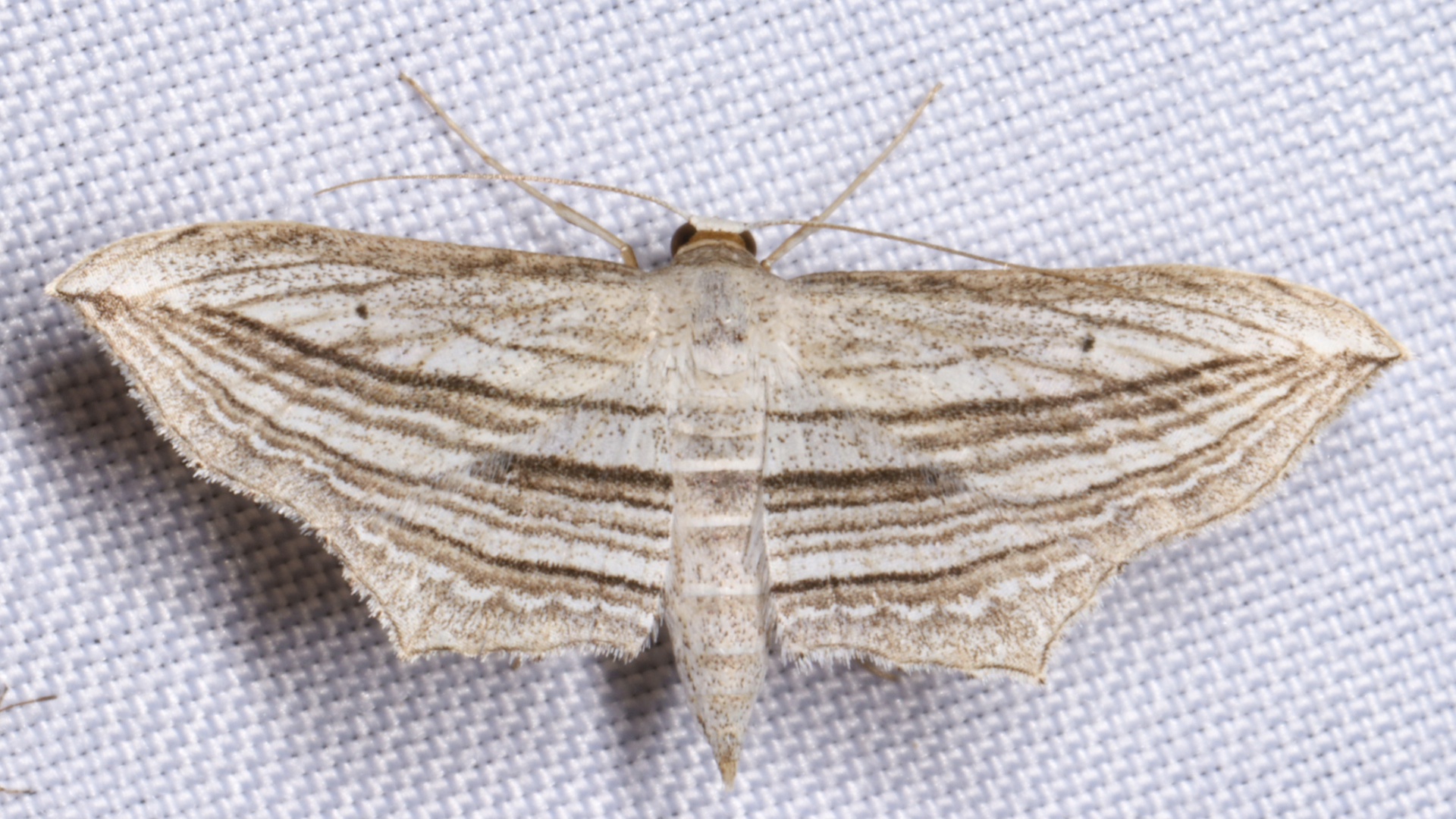
The arcobara multilineata moth spotted at Pease Park in 2022. Photo: Courtesy of Curtis Eckerman
With just a camera and a UV light, Curtis Eckerman has recorded more than 550 species of moths on the garage door of his South Austin home.
Why it matters: There are nearly 1,400 species of moths in Travis County alone, according to Eckerman, and the bugs can tell us a lot about the biodiversity of our environment.
Driving the news: Eckerman, the Biology Department chair at Austin Community College, will meet students Friday at Pease Park for a mothing expedition.
- Each semester, Eckerman's biology students take moth surveys — an effort to teach them about monitoring the biodiversity in city parks and to get a better sense of the environmental health of an urban area.
- Friday's event will be the first time Eckerman has made the mothing expedition open to the public.
What they're saying: "We're using (moths) as a barometer or a measuring stick … to look at how diverse an ecosystem is and how healthy that ecosystem is," he told Axios.
- "If I have a large diversity of moths, that tells me that I have a large diversity of plants in the area," Eckerman added. "And then, by extension, it tells me I have a wide diversity of potential predators who are going to eat moths and then eat those things that eat moths."
Flashback: Eckerman considers himself a herpetologist — focused on amphibians and reptiles — and didn't pay much attention to the fluttering insects until about seven years ago.
- "I decided, 'I'm going to learn something new this summer,'" he recalls.
- He began uploading photos of the moths to iNaturalist, a free app to share observations about bugs, plants and animals.
- The iNaturalist community helped Eckerman identify the moth species at his home and, "Before I knew it, I was doing it almost every night."
Between the lines: The moths also help us understand how important parks are — not just as a space for community gatherings — but as a place for nature to thrive despite booming urban development.
- "We can look at the number of species in a park to get a sense of not only what size of a park do (cities) need to maintain that diversity, but also to get a sense of how important those parks are."
How it works: Eckerman and his students will wrap a tree with a white sheet and illuminate it.
- They'll then take photos of the moths that visit the tree and use iNaturalist to record their observations,
If you go: You don't need a fancy camera to record your own observations. A cellphone works just fine, Eckerman said.
- The class will meet from 7-9pm at Pease Park's Kingsbury Commons, along the eastern trail. Register online for free.