Texas fertility rate rises


Add Axios as your preferred source to
see more of our stories on Google.
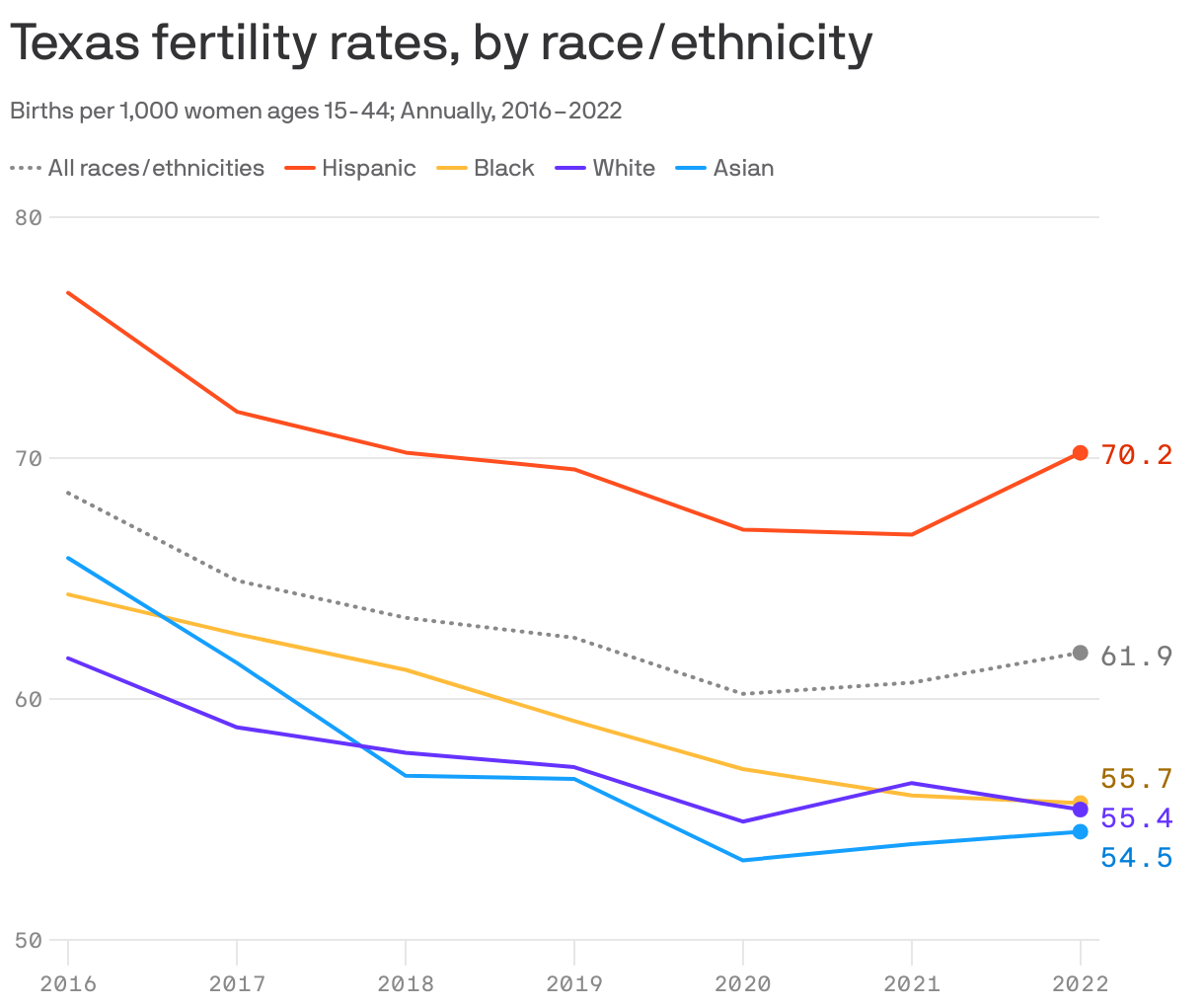
The fertility rate in Texas increased for the first time in eight years in 2022 — the year after the state passed its six-week abortion ban — but the growth is driven mostly by Hispanic women, a new analysis finds.
Why it matters: The report indicates Hispanic women are disproportionately affected by abortion restrictions in the state. It also offers a window into how bans or near-total bans across the country may play out over time, writes Axios' Astrid Galván.
Details: Using CDC birth data for 2022, the University of Houston's Institute for Research on Women, Gender and Sexuality sought to gauge what effect the abortion ban had on fertility rates.
- The researchers found that the overall fertility rate in Texas grew by 2%, but that figure is skewed by the much larger growth among Hispanic women, about 5%.
Zoom in: The analysis also found that, for the first time in 15 years, Texas registered an increase in teens' fertility rate in 2022.
Between the lines: The markedly larger fertility rate increase among Hispanic women over 25 years old is likely partly because many of those women already have children, complicating efforts to travel out of state for care, according to the analysis.
What they're saying: "Folks who have families are already probably stretched in terms of economics, they're probably having less time on their hands to be able to make these long trips to be able to get care," Lupe M. Rodríguez, executive director of the National Latina Institute for Reproductive Justice, tells Axios.
The other side: "We are thrilled to see that the protective laws the Texas Legislature put in place in 2021 are working," Joe Pojman, the executive director of Texas Alliance for Life, told the Catholic News Agency last year after a study showed a jump in live births following a restrictive state abortion law.