UT researchers develop COVID "lab-on-a-chip"

Add Axios as your preferred source to
see more of our stories on Google.
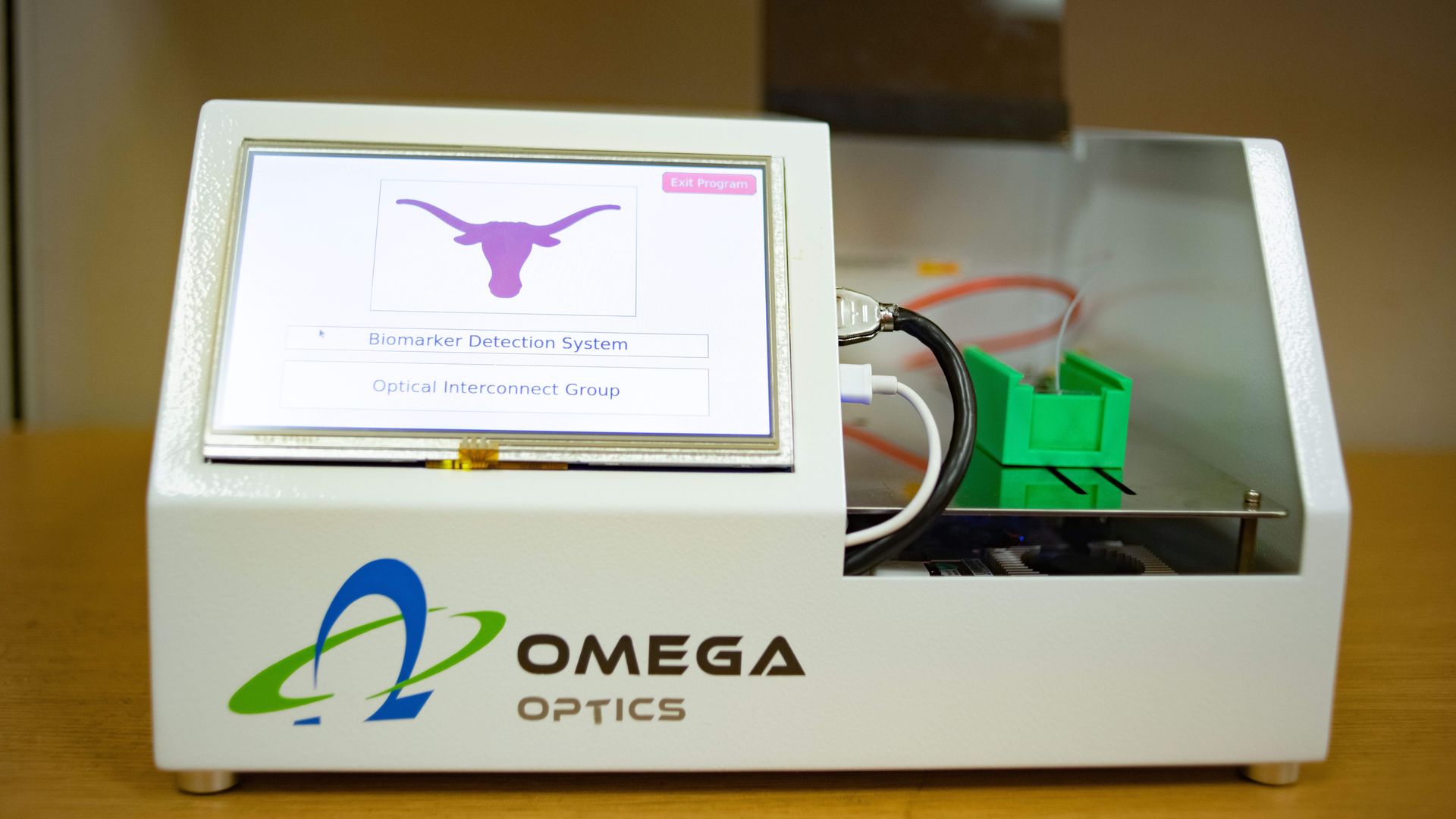
The "lab-on-a-chip" developed by UT researchers. Photo: Courtesy of the University of Texas
A team of University of Texas researchers is trying to reshape COVID testing for people who live far from medical centers.
The big picture: Researchers developed a small, lightweight device that can differentiate between COVID-19 and the flu using saliva as a sample material.
Why it matters: More than three years into the COVID-19 pandemic, accurate testing remains a challenge, particularly as the virus has mutated over time, becoming more contagious, with symptoms that are hard to tell apart from other illnesses.
What they're saying: The "emergence of new variants has made it increasingly challenging to differentiate it from other infectious diseases with similar symptoms, such as the common cold and seasonal flu," said Ray Chen, professor in UT's Chandra Family Department of Computer and Electrical Engineering and leader of the study published in Applied Physics Review.
- "Timely detection of COVID-19 is essential for patients to receive treatment and for curtailing the spread of the epidemic."
The goal: Shrinking lab-quality diagnostics down to a portable size to help people in isolated areas.
- The device weighs less than 10 pounds.
What's happening: PCR tests, the gold standard for detecting COVID, require large labs, expensive equipment and trained medical personnel to operate.
The cost: Pharmacies and clinics will pay no more than $50,000 per system, which will take under 30 minutes to deliver results, Chen tells Axios.
Of note: The project team includes researchers from UT and Omega Optics, an Austin-based startup that Chen founded to commercialize his discoveries.
- The project is funded through grants from the Air Force Office of Scientific Research, the National Institutes of Health, the U.S. Department of Energy and the U.S. Army.
What's next: Researchers aim to use this to test for dozens of different illnesses in a single sample, including COVID-19, influenza, other coronaviruses, biomarkers for depression and even some types of cancer, such as breast, lung and pancreatic.